skip to main content
News

Supporting the well-being of Black men and boys

Mental health organizations explore innovative solutions for reaching those historically excluded from mental health care

APA Style leaf logo Cite This Article in APA Style
American Psychological Association. (2024, November 1). Supporting the well-being of Black men and boys. Monitor on Psychology, 55(8). https://www.apa.org/monitor/2024/11/well-being-black-men-boys

two Black men shaking hands

Key points

  • Innovative solutions for Black men and boys focus on upstream prevention, peer support programs, and working through existing networks.
  • To lift the mental and physical health of Black men and boys, it’s necessary to rethink misconceptions and shift narratives from deficiencies to accomplishments.
  • Effective strategies include using terms like “mental strength,” meeting in comfortable spaces, and increasing mental health literacy.

Leaders from psychology, psychiatry, social work, counseling, media, government, and beyond came together at APA’s annual convention (APA 2024) in early August to explore innovative solutions for reaching a group historically excluded from mental health care: Black men and boys.

This conversation, spearheaded by APA’s CEO, Arthur C. Evans Jr., PhD, highlighted the importance of upstream prevention efforts, peer support programs, and meeting people where they are.

“I feel a sense of responsibility to lean in and to do something that’s going to bring about change,” said Shawn Boynes, CEO of the American Counseling Association. “We’ve been talking a lot, but what are the meaningful actions we can take?”

While the conversation was meant to be open-ended, Evans described several priorities of APA’s effort, including a focus on population health and mental health literacy. The group also used the platform to share ideas with the larger community of mental health and behavioral health professionals and to spearhead creative thinking about ways to improve mental health care for Black men and boys. The next steps will be to continue studying, building, and advocating for programs and policies that support mental health and well-being.

group of Black men on stage at APA 2024

Participants in the APA 2024 program “Lifting as We Climb: Supporting the Mental Well-being of Black Men and Boys”: Nicholas St. Fleur, science reporter, STAT News; Arthur C. Evans Jr., PhD, CEO, APA; Taft Parsons, MD, vice president and chief psychiatric officer, CVS Health; Anthony Estreet, PhD, MBA, LCSW-C, CEO, National Association of Social Workers; Shawn Boynes, CEO, American Counseling Association; and Malcolm Woodland, PhD, executive director, U.S. Congressional Caucus on the Commission of the Social Status of Black Men and Boys

Rethinking misconceptions

Redefining mental health care for Black men and boys first requires a recognition of the unique challenges they face. For example, constant reports of police brutality can lead to ongoing thoughts about personal safety, adding layers of excessive worry, tension, and panic attacks that may not fit within standard interventions (or support) to manage clinical levels of anxiety.

“When you’re feeling that kind of trauma, that kind of anxiety, that has a tremendous effect not only on our mental health but on our physical health as well. We’re not only seeing it but also living it,” said psychologist Malcolm Woodland, PhD, executive director of the U.S. Congressional Caucus on the Commission of the Social Status of Black Men and Boys.

Critically examining cultural misconceptions about Black men and boys is another key step in rethinking mental well-being. Narratives tend to focus on negatives rather than positives, Boynes said, such as the portrayal of Black men as absentee parenting partners without also highlighting the presence and attentiveness that many Black men bring to their families.

“We focus on the deficiencies versus the accomplishments of Black men and boys, and we just need to shift that narrative,” he said.

Promoting mental strength

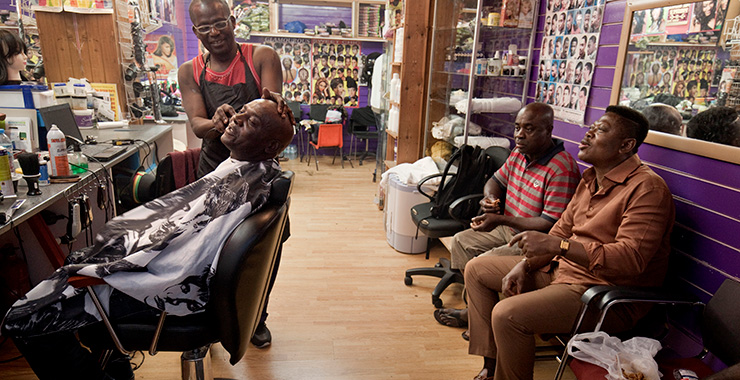
A further barrier to delivering care is one often repeated to Anthony Estreet, PhD, MBA, LCSW-C, CEO of the National Association of Social Workers: “Black people don’t do therapy.” But he found it doesn’t tell the whole story of a population that often feels more comfortable seeking support from people in their community, such as clergy members, trusted mentors, or barbers.

Estreet used those insights to start rethinking both how and where he talked with Black men and boys. Instead of using language that highlights deficiencies and reinforces stigma (“mental illness,” for example), he began using terms like “mental strength.” Leaders agree that shifting the narrative and terminology around mental health is a key part of reaching this underserved group.

Estreet also meets with people where they feel at ease—such as on the basketball court rather than in the therapist’s office. “How do we do therapy where are we actually meeting Black men and boys in the spaces where they feel most comfortable to talk about these issues?” he said.

An increased focus on mental health literacy is another key way to boost help-seeking. How can we model safe ways to ask for help when doing so has been discouraged for so long?

“We’re seeing more athletes talking about this more frequently. They’re raising their hand saying, ‘I need a timeout.’ That’s helping to break down stigma, but there’s still a ton of work we need to do,” Boynes said.

A broader view of health

Broadening the way mental health is funded and addressed will be critical. APA endorses a population health approach, which places a high value on prevention and early intervention efforts that can help address challenges before they become life-altering.

“With our nation’s current model for mental health, people require a diagnosis to receive help, which inadvertently ignores nearly 75% of the population. We are saying instead that everyone can improve their psychological health, no matter where they fall on the mental health continuum,” Evans said.

Research shows, for example, that help-seeking for mental health services is higher in communities that have more gun violence—and not just among people who witnessed a shooting or lost loved ones.

“That suggests that one’s psychological health is affected by a range of factors,” Evans said. “Therefore, we need a more sophisticated way of thinking about mental health and a broader set of strategies to inform our approach.”

Pressure on policymakers is an important vehicle for bringing that about, especially when it comes to getting funding for mental health programs into communities of color, Woodland said. APA has already begun advocating for such efforts, including more community training programs and mobile crisis outreach initiatives.

State and federal funding can also support workforce improvements, including educating mental health professionals on the cultural context necessary for treating Black men and boys (everything from warranted mistrust of the medical establishment to safe ways to convey distress) and recruiting, training, and employing more Black male therapists.

“Who you vote for matters,” said Taft Parsons, MD, vice president and chief psychiatric officer of CVS Health. “Right now, we’re seeing a backlash against all sorts of DEI initiatives.”

Having more Black male therapists is crucial, but it’s just one part of the solution, Evans said.

“Across all of our strategies—from building up the clinical workforce to advocating for policy change—we need to work with allies. It’s going to take all of us partnered together to truly make a difference in the mental health of Black men and boys,” he said.

Recommended Reading

Speaking of Psychology

Subscribe to APA’s audio podcast series highlighting some of the most important and relevant psychological research being conducted today.

Subscribe to Speaking of Psychology and download via:

Appleopens in new window
Apple podcast logo

Spotifyopens in new window
Spotify logo

You may also like