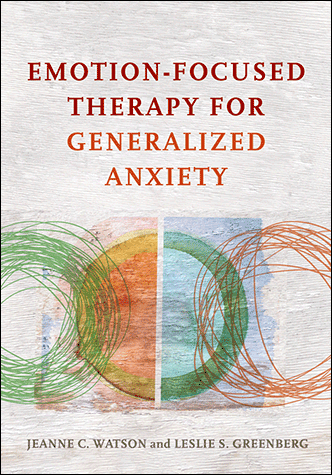
Emotion-Focused Therapy for Generalized Anxiety
ISBN: 978-1-4338-2678-8Generalized anxiety disorder (GAD) — characterized by near-constant worry that frequently coincides with intense feelings of shame and despair — is a highly treatment-resistant disorder, with clients often relapsing after making initial progress. Master therapists Jeanne C. Watson and Leslie S. Greenberg argue, however, that emotion-focused therapy (EFT) is uniquely capable of targeting the maladaptive emotional schemes that underlie GAD and helping clients maintain lasting, positive change.
In this practical guide, Watson and Greenberg teach mental health practitioners how to employ EFT methods in their work with GAD clients. The authors first review EFT's conceptualization of GAD, emphasizing the key role that emotion plays in pervasive anxiety. They then translate those foundational principles into detailed techniques and strategies as they walk readers through the EFT process, beginning with the establishment of a healing therapeutic relationship.
Chapters review different stages of EFT, describing specific therapeutic exercises, such as empty-chair and two-chair tasks, that allow clients to vocalize and directly address their deep-rooted emotional pain, anxieties, and relational injuries with significant others. Through this work, clients eventually learn to self-soothe and transform their maladaptive coping mechanisms into healthier ones.
Sample client–therapist dialogues demonstrate how these EFT techniques can be applied in actual practice.
Acknowledgments
Introduction
- Emotion-Focused Therapy Formulation of Generalized Anxiety Disorder
- The Role of Emotion in Generalized Anxiety Disorder
- Treatment Framework
- The Therapeutic Relationship
- Strengthening the Vulnerable Self
- Working With Worry: Anxiety Splits
- Changing Negative Treatment of the Self: Two-Chair Dialogues
- Transforming Pain: Working With Empty-Chair Dialogues in Generalized Anxiety Disorder
- Emotional Transformation and Compassionate Self-Soothing in Generalized Anxiety Disorder
References
Index
About the Authors
Jeanne C. Watson, PhD, is a professor in the Department of Applied Psychology and Human Development, Ontario Institute for Studies in Education, University of Toronto. As a major exponent of humanistic–experiential psychotherapy, she has contributed to the development of emotion-focused therapy, the process experiential approach.
In 2001, she received the Outstanding Early Career Achievement Award from the International Society for Psychotherapy Research and served as president of the International Society for Psychotherapy Research from 2014 through 2015.
Dr. Watson has coauthored or coedited seven books on psychotherapy and counseling, including Learning Emotion-Focused Therapy: The Process Experiential Approach to Change (2003); Expressing Emotion: Myths, Realities, and Therapeutic Strategies (1999); Client-Centered and Experiential Psychotherapy in the 21st Century: Advances in Theory, Research and Practice (2002); Handbook of Experiential Psychotherapy (1998); Process-Experiential Psychotherapy in the Treatment of Depression (2005); and Case Studies in Emotion Focused Treatment of Depression (2007), as well as more than 70 articles and chapters.
She conducts trainings in emotion-focused therapy in Europe and North America and maintains a part-time private practice in Toronto.
Leslie S. Greenberg, PhD, is a Distinguished Research Professor Emeritus of Psychology at York University in Toronto, Ontario, Canada.
He has authored the major texts on emotion-focused approaches to treatment of individuals and couples. These include the original texts Emotion in Psychotherapy (1986), Emotionally Focused Therapy for Couples (1988), Facilitating Emotional Change (1993), and Emotion Focused Therapy: Coaching Clients to Work Through Their Feelings (Second Edition, 2015); and more recently, Emotion-Focused Therapy of Depression (2006), Emotion-Focused Couples Therapy: The Dynamics of Emotion, Love, and Power (2008) with Jeanne Watson, and Case Formulation in Emotion-Focused Therapy (2015) with Rhonda Goldman, as well as Emotion-Focused Therapy: Theory and Practice (2010). He has published extensively on research on the process of change.
Dr. Greenberg has received the Distinguished Research Career Award of the International Society for Psychotherapy Research, as well as the Carl Rogers Award and the APA Award for Distinguished Professional Contributions to Applied Research. He also has received the Canadian Psychological Association Professional Award for Distinguished Contribution to Psychology as a Profession.
He conducts a private practice for individuals and couples and trains people internationally in emotion-focused approaches.
Very informative, practical, and helpful with numerous contributions to theory, research, and practice… provides an overall substantial contribution to psychology.
—PsycCRITIQUES
Watson and Greenberg have created another classic to go with their work on emotion-focused treatment of depression. Given the chronicity and relative degree of pain associated with GAD, this timely book highlights a formulation and treatment for GAD with clear clinical guidelines to help people have a new life. The rationale for and process of therapy are well explained.
—Michael J. Lambert, PhD
Professor of Psychology, Brigham Young University, Provo, UT
Watson and Greenberg, two sophisticated clinicians and researchers who are open to contributions of other orientations, have given us a thoughtful and novel way of working with GAD patients. Regardless of your orientation, practicing therapists will benefit from this important volume.
—Marvin R. Goldfried, PhD
Distinguished Professor, Psychology Department, Stony Brook University, Stony Brook, NY
Finally! This book is a very welcome and invaluable addition to the range of treatment options for GAD. Watson and Greenberg expertly detail the application of EFT to GAD in an easy-to-follow format with practical illustrations.
—Henny Westra, PhD, CPsych
Associate Professor, Department of Psychology, York University, Toronto, Ontario, Canada
A substantial number of clients treated for GAD fail to recover. With this conceptually elegant and clinically rich book, Watson and Greenberg offer a much-needed new avenue for clinicians to understand and address some of the most chronic and debilitating symptoms of GAD. This book not only enhances our repertoire of interventions to decrease worry and improve quality of life, it gives more life to the entire humanistic and experiential approach in psychotherapy.
—Louis Castonguay, PhD
Former President of the Society for Psychotherapy Research, Department of Psychology, Pennsylvania State University, University Park