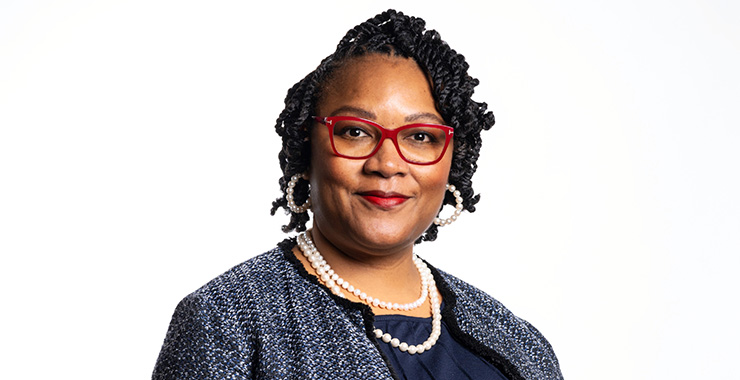
Restorative justice is a powerful tool for transforming mental health for justice-involved youth, says Kenya Key, PsyD, a clinical psychologist and Certified Correctional Health Professional–Mental Health (CCHP-MH) in Washington, D.C. As deputy director of health services for the city’s Department of Youth Rehabilitation Services, Key is responsible for the behavioral health service delivery system and a restorative justice program for more than 150 youth in custody. Key leads a team that brings critical services to justice-involved youth, many of whom receive acute psychiatric care. Their restorative justice approach promotes healing, accountability, and long-term resolution between victims, offenders, and community members.
Andoh, E. (2025, April 1). Kenya Key uses restorative justice to improve mental health outcomes for youth in custody. Monitor on Psychology, 56(3). https://www.apa.org/monitor/2025/04-05/kenya-key-restorative-justice
What are the most pressing issues you encounter in your current role?
In my experience, mental health spaces often don’t want to work with young people interfacing with the justice system. We may refer young people who experience suicidality to a hospital, and that facility will often deny admission attributing their suicidality to them just wanting to get out of jail. That pattern is frustrating. It leads to us having to treat all manner of acuity within our settings, which can be very difficult. This is why we need good clinicians—because we are often the beginning and the end for our young people.
How does restorative justice apply to justice-involved youth?
Restorative justice practices focus on healing and problem-solving rather than punishment. They are also inclusive and involve the community. We strive to have those involved in a specific incident to identify the harm caused versus just labeling something as a crime. It’s about trying to pull together victims, offenders, and whatever community members support both of those entities to focus on what the victim needs and how the offender may repair the harm that they’ve done. It is similar to trauma-informed care, where we ask individuals, “What happened to you?” With restorative justice, we ask, “Who has been harmed?” and “What obligations do we have to fix their needs?”
How have restorative justice principles influenced your team’s approach to improve outcomes for youth in the system?
When young people come to our facility, we invite their family, support system, or community together for a restorative circle. The circle is a safe space to talk about the harms in their families and relationships and how the young person will address some of those harms during their time with us. We do the same thing before we transition them back into the community. They talk about their growth, what needs have been met for folks who were harmed, what obligations they have fulfilled, and what they will need to do to continue that process. We also use restorative justice within the facility as an alternative to just sanctioning a young person when they do something wrong. Preparatory work involves speaking to the involved parties separately to assess their willingness, their readiness, and their process. It provides background on what happened, and what led them to that space, and then brings them together for conversations that create a sense of community. We want young people in our program to see the world through a lens of “We do harm, but we can also repair the harm.”
What is hopeful, if anything, for young people within the criminal justice system when it comes to accessing mental health care?
One of our young people was recently charged as an adult. When I met with him to discuss this significant sentence, he was truly as optimistic as one can be. He said “I’ve got my tool kit. I remember my restorative justice stuff, so if anything goes down, I will try to use these skills.” And this was the piece that both excited me and kind of broke my heart: He said, “If my mom had been able to get these groups that you all gave me, maybe me and my brother wouldn’t be locked up right now.” I think that we are an unfortunate gateway to healing. Many of the young people in corrections, particularly our Black and Brown men, spend so much time trying to be strong. When they work with us, they have an opportunity to see how they can heal those vulnerable parts of themselves and still survive. That is optimistic for me. We provide an opportunity for our young people to open themselves to healing as they go forward in their lives.
What key transformations would you make to the system to better support youth who need mental health care?
I would unify the system. If we’re not communicating and sharing information, it leaves a lot to fall through the cracks. Let’s say a young person has touched multiple agencies throughout their life. These may include mental health challenges noticed in school, contact with child welfare agencies or law enforcement, or even hospitalization for mental health issues. There are so many touch points, but all these things stay in separate buckets. While I fully appreciate and respect patient privacy, there’s got to be a way to communicate necessary information. What we do now is not working. What if we all communicated earlier in their timeline? There is the adage that “it takes a village to raise a child.” When the village has fences up around every house, it doesn’t feel like a village anymore.
You have been in this field for 20 years. What keeps you motivated and committed even on your toughest days?
I’ve learned to appreciate the small wins after young people leave us instead of thinking that success only means going to college and graduating. Did they go back to school consistently? Did they get a job and hold onto that job for 3 months? You know, those kinds of small wins keep me going. At a broader level, what keeps me going is pouring into the field. I used to tell people my biggest wish is for society to work me out of a job—for mental health needs to be met in the community and for mental health not to be criminalized. However, I don’t see that happening anytime soon, so it’s important to me that we continue to build the supportive pipeline. When people feel effective in this work, they stay in this space. I’ve trained students and supervised licensed clinicians, and some of my former students are now directors in correctional spaces. It’s wonderful to see other people thrive.