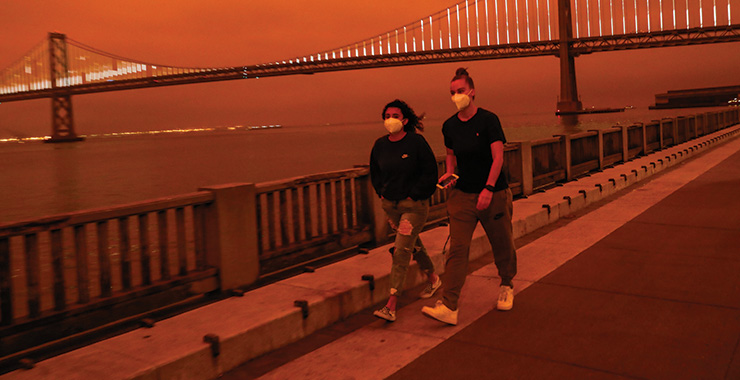
In 2020, 15-year-old Natalie Heller stepped outside her San Francisco home to an orange sky, a result of Northern California’s massive, climate-driven wildfires. “It was like we were on Mars,” recalled Heller, now a sophomore in environmental studies at the University of Southern California and a Gen Z adviser at the Climate Mental Health Network, an organization that offers tools to address the emotional impacts of the climate crisis.
Almost 99% of children in the world have been exposed to at least one climate or environmental hazard in their lifetime, whether that is heat waves, cyclones, floods, water scarcity, or vector-borne diseases (The Climate Crisis Is a Child Rights Crisis, UNICEF, 2021opens in new window). Children are also more physically vulnerable to extreme weather events than adults, facing bigger risks in terms of physiological consequences and even death.
“We have lots and lots of evidence that experiencing these kinds of extreme events, the storms, the wildfires, etc., is associated with threats to mental health, increases in anxiety, depression, post-traumatic stress disorder,” said Susan Clayton, PhD, a member of APA’s Climate Change Advisory Group and a professor of psychology at The College of Wooster in Ohio.
The ongoing reality of climate change and its consequences has significant psychological implications for young people, research is finding. In a survey of 15,793 U.S. youth ages 16 to 25, 85% said they were at least moderately worried, and 57.9% said they were very or extremely worried about climate change and its impacts on people and the planet. Meanwhile, 42.8% said that climate change impacted their mental health, and 38.3% said their feelings about climate change negatively affected their daily lives (Lewandowski, R. E., et al., The Lancet Planetary Health, Vol. 8, No. 11, 2024opens in new window). Similarly, a survey of 10,000 young people ages 16 to 24 in 10 countries found that 59% felt very or extremely concerned about climate change, expressing anger, sadness, powerlessness, fear, and other negative emotions, and they attributed a decrease in their ability to eat, sleep, concentrate, perform at school or work, engage in leisure activities, and maintain relationships to those feelings (How Youth Climate Anxiety Is Linked to Government Inaction, Avaaz, 2021opens in new windowlogin requiredlogin required).
Climate anxiety can even impact the cognitive development of children and youth, according to research highlighted in APA’s Mental Health and Our Changing Climate: Children and Youth Report 2023. Extreme weather events caused by climate change can disrupt normal fetal development, increasing the risk of anxiety, depression, attention-deficit/hyperactivity disorder, educational challenges, lower self-control, and psychiatric disorders later in life.
In fact, anxiety related to climate change could be considered a public health issue, said Lise Van Susteren, MD, a forensic psychiatrist and cofounder of the Climate Psychiatry Alliance, an organization that educates mental health professionals and the public about the effects of the climate crisis on mental health. This anxiety can resurface when young people encounter something later that reminds them of the event, such as thick cloud cover or smoke. In turn, such emotions can impact the cardiovascular, immune, digestive, and neurological systems, research finds (Child and Adolescent Mental Health, Vol. 26, No. 3, 2021opens in new window).
Knowing that a climate disaster could strike at any moment can morph into what is now known as climate anxiety, also called eco-anxiety or eco-distress, according to the Climate Mental Health Network (Climate Change & Youth Mental Health: Psychological Impacts, Resilience Resources, & Future Directions, Climate Mental Health Network, 2021opens in new window). The terms describe the distressopens in new window people feel about the effects of climate change on the environment and human life, and have led to the emergence of related concepts like eco-grief—sadness about ecosystem changes—and solastalgia, or nostalgia for what the environment used to be.
At its core, climate anxiety is fear about a lack of security and is a completely natural response to environmental challenges, said Leslie Davenport, MS, LMFT, a mental health professional who specializes in climate issues and leads the Climate Psychology Certificate program at the California Institute of Integral Studies in San Francisco, the first such program in the United States. “It means you care about what’s happening. You’re paying attention. You’re empathetic.”
In an overall sense, young people may feel anger and frustration that decision-makers and older generations have left them with a world in crisis—one they did not create but must fix, said Sarah Newman, MPH, a public health expert and founder of the Climate Mental Health Network, which helps communities address climate-related emotions through resources for mental well-being. While it is important to help young people cope with their feelings around climate change, “this is about governments and structures failing,” she said.
In fact, research finds that this perceived inaction by political leaders is also linked to feelings of climate anxiety, distress, and betrayal among young people (How Youth Climate Anxiety Is Linked to Government Inaction, Avaaz, 2021opens in new windowlogin requiredlogin required). Although ultimately governments are responsible for large-scale efforts to mitigate climate change, psychologists, educators, and organizations supporting youth can play a crucial role by implementing training programs to manage climate emotions and foster resilience. Additionally, they can create initiatives to ensure that young voices are heard in climate policy discussions to help mitigate feelings of powerlessness among young people (The Role of the Youth Sector in Addressing Young People’s Climate Emotions, European Union–Council of Europe Youth Partnership, 2024opens in new window).
“[Anger] can be a good motivator for people to get involved, and get engaged, and take action,” Clayton said, pointing out that research has shown that getting involved can be helpful for mental health “because then people don’t feel like passive victims.”
 Take a Hike! And Other Ways to De-Stress and Relax in Nature
 Ask Scarlett: Can Being Outside Help Me De-Stress? And More Questions About Nature and You
 Mindful Nature: Connecting With Our Great Green World