Traditionally, psychology research faculty have tended to nudge or outright push students toward careers in academia rather than applied fields, partly because they consider it a more prestigious path and partly because it’s the world they know the best.
But a dwindling academic job market and changes in the academic funding landscape mean faculty are recognizing the importance of preparing students at all levels for careers outside the ivory tower. In many ways, the shift mirrors efforts by students themselves to more proactively explore alternative career paths (see September Monitoropens in new window).
“We need to start being more deliberative about helping students think about careers outside of academia and helping them make career connections,” said industrial and organizational (I/O) psychologist Margaret E. Beier, PhD, who chairs the Department of Psychological Sciences at Rice University in Houston, Texas. While that need is most relevant for students at the undergraduate and master’s levels, it’s becoming increasingly important for some doctoral students as well, she said.
Besides fewer job options in academia, other factors play into the need to help students gain more real-world experience, said Karen Stamm, PhD, senior director of APA’s Center for Workforce Studies. For one thing, students with fewer economic resources and larger debt loads may need to find ways to enter the workforce sooner than others. A surveyopens in new window by the National Science Foundation, for example, found that the median debt for psychology PhDs in 2024 was $80,000 (that debt load is far higher for PsyD students).
There is also the long-standing issue of how to help undergraduate psychology majors gain psychology-related employment if they don’t pursue higher degrees in the field. (Only about 14% of psychology bachelor’s degree holders go on to earn a graduate degree in psychology, and only 4% pursue a doctorate or professional degree in psychology, according to APA statistics.)
Psychology departments are at different stages of working on these issues, with many just beginning. Fortunately, there are some strong role models to turn to: Areas with clear applied bents such as I/O psychology and human factors psychology have long been making connections with outside partners. And in the undergraduate arena, a few institutions with solid programs for connecting students with real-world career opportunities serve as guideposts for other psychology programs hoping to do the same.
That said, all psychology programs are facing the same needs. Here are some approaches they are taking.
■ Fostering networks with alumni and others
A simple way to help students connect to life outside academia is to bring in speakers from relevant applied areas. At Bowling Green State University in Ohio, for example, the I/O psychology program holds a weekly speaker series where faculty from other departments and practitioners in applied fields talk with students about various career options. In one recent session, an I/O psychologist who works at the Army Research Institute gave students an overview of how the Army works, while in other sessions alumni shared their experiences doing consulting work and executive coaching and how they found those positions, said Melissa G. Keith, PhD, an associate professor of I/O psychology at the university.
Similarly, Indiana University Bloomington’s Department of Psychological and Brain Sciences offers a colloquium series that invites outside speakers to talk with students about career options. Fifth-year graduate student J Wolny said that attending these sessions helped them to make valuable connections on the outside.
“I started to network with individuals who were in my department or had similar backgrounds and who now work in industry,” said Wolny, who studies equity issues and is considering pursuing such work in applied settings. “That was a really helpful starting-off point to building a career network.”
■ Creating job-minded programs on campus
Other universities and psychology programs are creating programs that are designed to help students gain tools for applied careers. The I/O psychology program at George Mason University (GMU) in Fairfax, Virginia, for instance, hosts an on-site nonprofit consulting firmopens in new window where students use their training to do pro bono consulting work helping local nonprofit agencies like animal shelters and environmental organizations improve their operations. The students survey volunteers about their experiences and then analyze the data and present it to the organization’s board for discussion.
The experience gives students a taste of the real world, said GMU professor and I/O psychologist Reeshad S. Dalal, PhD, who oversees some of these activities. While many clients give positive feedback, “some might be nonresponsive or even hostile, and students have to manage the conflict,” Dalal said. “So, all in all, it’s a good learning experience.”
Likewise, Bowling Green houses an internal consulting firm that connects I/O students with projects at companies including Proctor & Gamble, WEX, the City of Toledo fire and police departments, and more, said Keith. The university also features a campus-wide program called Life Design, which gives students tools to help them maximize their academic experience, manage work-life balance, and make connections with industry and other partners. “The program encourages students to think beyond, ‘I’m getting a psychology degree, now what?’” Keith said.
George Mason professor and I/O psychologist Dr. Reeshad S. Dalal (shown with PhD students Julia Baines, JeongJin Kim, and Jeeho Sohn) helps students gain work experience through an onsite consulting firm where they apply their training to pro bono consulting work with local nonprofits.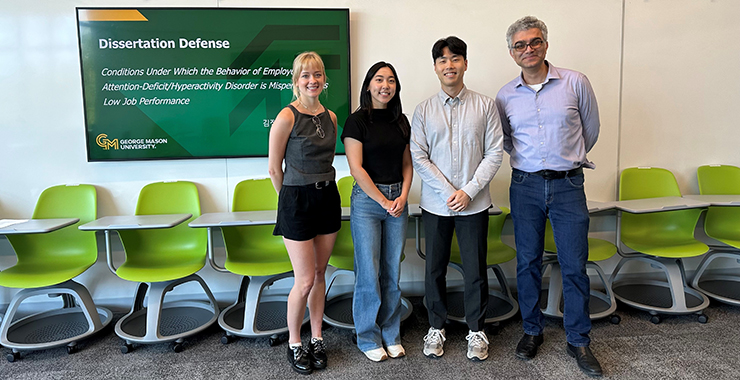
Faculty can also get students involved in competitions that mimic real-world problems. Dalal, for example, encourages his master’s and doctoral students to take part in “consulting challenges” sponsored by APA Div. 14 (Society for Industrial and Organizational Psychology) and by a local I/O organization in Washington, D.C., the Personnel Testing Council Metropolitan Washington. Students are asked to solve a real-world conundrum like why a particular firm has a high turnover rate, using tools such as literature searches and data analyses. “They also have to take that research and translate it for laypeople who don’t want to be confronted with a blizzard of statistics,” said Dalal. “Even if they don’t win,” he said, “it provides valuable real-world experience.”
■ Supporting internship and work experiences
Given the current job market, psychology students—particularly undergraduates and master’s students—are increasingly eager to find applied internships. That’s not always a plus because traditionally these experiences can prove a dead end if they are not well chosen, said Dalal. And because most programs aren’t equipped to help students find internships, it’s usually up to students to find these opportunities themselves.
Some programs, however, are building in mechanisms to support internship endeavors and to ensure they align with students’ psychology education, interests, and potential career goals. At American University in Washington, D.C., undergraduate psychology majors can do internships for course credit and/or as part of a required senior capstone experience. Although students find these placements themselves, they receive supervisory support from faculty member Noemí Enchautegui-de-Jesús, PhD, who has students outline up front what they want to learn from the internship and note who will be supervising them and how. During the internship, students take part in weekly group meetings and complete assignments on how the experience might fit with psychology, engage in structured reflection, troubleshoot problems that arise, and learn from others’ experiences.
“These reflections help them think about where they’re going with this experience and develop a higher level of thinking about the internship and how they’re approaching it,” Enchautegui-de-Jesús said.
Because internships aren’t easy to find, Enchautegui-de-Jesús lets students choose opportunities in varied settings as long as they make the case for how it applies to their degree. One student, for example, successfully lobbied to get an internship at a dental office by articulating how psychology might relate to the position and what she expected to learn. Once on site, the student observed patterns in the office related to dental phobias and gender dynamics and then found research related to these topics that she shared with her fellow undergraduates in the support group and planned to share with her site supervisor. In fact, she was so drawn to the topic that she wanted to study it further in graduate school, Enchautegui-de-Jesús said.
“She discovered there is a whole field of oral health sciences, and that it was an area she was really interested in.”
Similarly, in 2022, Rice graduate and I/O psychologist Tim Oxendahl, PhD, got the green light from his mentor Beier to pursue internships in industry when he realized he was more interested in an applied career than an academic one. That support helped him land internships at Gallup, the polling and analytics company, and SAP SuccessFactors, a cloud-based software company that helps organizations optimize workforce management. “I was able to wear a lot of different hats and feel out what potential careers would look like for me,” said Oxendahl, who is currently doing contract work for the Association of American Medical Colleges. “Doing those internships definitely broadened my perspective and helped me develop skills that I’m sure I’ll be using for the rest of my career.”
In a similar vein, Wolny of Indiana University said that mentoring support from Bill Hetrick, PhD, led to two part-time consulting jobs while Wolny was still in school: at APPA Health, a digital health company geared toward youth, and A-B, a company that studies and designs social-justice messaging campaigns.
“Oftentimes graduate students don’t realize they can pursue those kinds of opportunities,” Wolny said. “I’m fortunate to have a great relationship with [Hetrick] where he’s super supportive of me pursuing my goals and understands that I may not be on the tenure-track professor route.”
■ Making connections with industries and other outside programs
Other psychology programs are fostering relationships with outside entities that provide students with short-term psychology-related work opportunities. Dalal of GMU regularly shares information with students on relevant prospects including a recurring opportunity to conduct 3-day assessments at an employment assessment center in Alabama. The center pays students’ training and travel expenses, making it a relatively easy way to gain real-world experience.
“Several of our students have taken on that role, and they find it very intense but worthwhile,” Dalal said. His program also stays in regular touch with alumni who hire students for short-term projects such as scoring job-applicant essays and writing items for situational judgment tests, which evaluate potential employees on how they would respond to realistic, hypothetical work scenarios.
Meanwhile, a few programs geared mainly toward undergraduates have well-developed relationships with outside partners in industry and other settings that enable students to take degree-relevant jobs while still in school.
A key example is Drexel University in Philadelphia, which has a long-standing program in which any undergraduate, including those in the university’s Department of Psychological and Brain Sciences, can opt to take part in co-ops—paid work arrangements relevant to their areas of study (a co-op, in this use of the term, is a formal arrangement between the university and various companies, industries, and other outside employers). Some 94% of Drexel’s undergraduates—and 98% of psychology undergraduates—participate in co-op arrangements, which entail 6 months of work experience at a time, about 70% of which are paid, said Dorothy Charbonnier, PhD, the psychology department’s liaison to the co-op program. Altogether, the university’s co-op program has formal relationships with 1,500 companies nationally and internationally, and some 5,500 Drexel students take part in these arrangements each year. (In academic year 2024–25, about 90 psychology undergraduate students did co-ops with 61 employers for a total of 144 jobs, 111 of which were paid.)
Before taking part in co-op arrangements, psychology majors also take a class that educates them about the co-op program itself as well as a class on potential psychology careers, developed by Charbonnier. And, similar to the match system for clinical psychology graduate students, Drexel’s system has students make their top placement picks. Companies do the same with the students.
Because a psychology degree is more ubiquitous in potential application than more cut-and-dried degrees like business or engineering, the Department of Psychological and Brain Sciences has worked on ways to optimize the co-op experience for its students, Charbonnier added. One way is to encourage students to double major or declare a minor early, which allows them to apply for a greater range of co-op opportunities. For example, Drexel sophomore Sumeet Musfirah, who is double majoring in psychology and neuroscience, was able to secure a paid, 40-hour-a-week stint at Synesqo, a multinational chemical and biochemical manufacturing company. At the company’s Bristol Research and Innovation Center in Buck’s County, Pennsylvania, Musfirah applied the research skills she learned in her psychology classes to biochemistry projects in a “wet lab” setting, designing and synthesizing experiments, collecting and analyzing data, and interpreting results to inform ongoing research and development.
“They treated me like a full-time employee in the best ways possible,” she said. “They expected results, but they were also there to help me.”
Another Drexel undergraduate, Alli Dickerson, did a paid 40-hour-a-week co-op at the A.J. Drexel Autism Institute on the Drexel campus, where she supported a team that studies early detection and intervention of autism and other developmental diagnoses in children. She set up evaluation rooms, learned how to score standard behavioral measures for children, and even attended a national conference and published a paper with members of the institute. She also discovered that working in clinical and developmental psychology is an area she really enjoys: “It’s been great having this experience to really learn what I want to do and what I like,” she said. Getting this kind of hands-on experience can also help students figure out what they don’t want to do, Charbonnier added.