skip to main content
News

Do active shooter drills make students safer?

Lockdown drills may boost confidence, but hyperrealistic drills risk trauma and fear

APA Style leaf logo Cite This Article in APA Style
Key, A. P. (2026, January 1). Do active shooter drills make students safer? Monitor on Psychology, 57(1). https://www.apa.org/monitor/2026/01-02/active-shooter-drills-safety

""

Key points

  • About 95% of U.S. public schools conduct active shooter or lockdown drills, yet no national standards guide how they should be executed.
  • New research shows that, while some drills build confidence, others—especially realistic or deceptive ones—can cause fear, anxiety, and lasting emotional distress.
  • Best practices include calm drills that are clearly communicated in advance to school personnel, caregivers, and students.

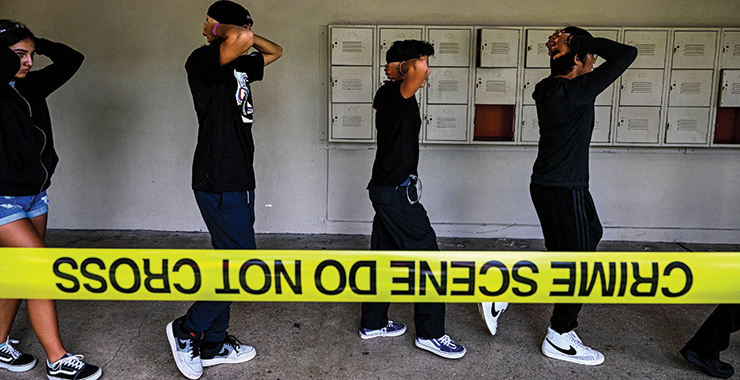
Every school year, millions of American students participate in a routine that has become as familiar as the fire drill was for past generations: doors locked, lights switched off, and children crouched silently under desks. In some schools, these drills go further, with simulated gunfire or actors playing an active shooter.

With the rise of gun violence in the past several decades, schools have implemented additional safety drills beyond the age-old fire drill. Most schools conduct lockdown drills, where students and school staff practice securing classrooms to guard against any immediate threat inside a school. Lockdowns are one practice within a broader spectrum of practices that schools might use to prepare for an active shooter.

Some schools have taken things a step further, conducting active shooter drills, training developed by professional security companies that teaches different options-based responses to a gunman inside a school, such as running, hiding, or even fighting back. The goal of these drills is to build “muscle memory,” and during a real crisis while under stress, automatically perform the actions learned.

Around 95% of public K–12 schools in the United States train students on procedures to survive threats inside a school, including someone with a gun, despite very few schools encountering active shooter events. Ambiguity surrounding the terminology (lockdown drills versus active shooter drills) makes it challenging to understand exactly what schools are doing to prepare for an active shooter situation. Even when focusing specifically on lockdown drills, there can be significant variation in their implementation—some schools may barricade doors, while others may simply lock them, turn off lights, and move out of sight. However, those who study these drills know that nearly all schools are taking some action to prepare for an active shooter event.

And, based on the experiences of school faculty and students, researchers are questioning whether active shooter drills also leave lasting emotional and psychological scars such as anxiety and depression.

A 2025 report by the National Academies of Sciences, Engineering, and Medicine took up this question. Produced by a committee of experts in education, child development, public safety, and mental health, School Active Shooter Drills: Mitigating Risks to Mental, Emotional, and Behavioral Healthopens in new window reviewed the limited research and the wide variation in how schools conduct drills.

The committee found that while nearly all schools carry out some version of these drills (many of which are required by state law), there are no national standards for how they should be conducted, and there are mixed findings on their impact. This gap leaves educators caught between the goal of preparing students and the risk of inflicting psychological harm.


Do drills really prepare children?

There is limited research to show whether active shooter drills keep students and school staff safer during an emergency.

A 2024 review found that calmly conducted lockdown drills with clear steps can help students and staff build confidence to act in a real-life crisis (Schildkraut, J., et al., Current Psychiatry Reports, Vol. 26, 2024opens in new window). But active shooter drills, which sometimes rely on frightening tactics, show mixed results.

That sense of readiness can come with a trade-off. Researchers and mental health experts warn that the same drills designed to protect children can also unsettle them, sometimes leaving lasting emotional marks.

When safety drills create fear

Dewey Cornell, PhD, a forensic clinical psychologist at the University of Virginia and director of the Virginia Youth Violence Project, cautions schools against taking active shooter drills too far in the name of preparation.

“It’s a big mistake to apply a military mindset to education,” he said. “When we have a fire drill, no one sets a fire in the hallway or puts ladders up to the windows to have kids come out. But school shooting drills can be dramatic and terrifying.” These kinds of drills, he and other experts say, risk doing more psychological harm than good for an emergency that, statistically speaking, is still incredibly rare. In 2024, 60 people died in U.S. school shootings, according to the advocacy organization Everytown, and the Centers for Disease Control and Prevention reports that 98% of youth homicides happen away from school. While research finds that lockdown drills may help students and staff feel more prepared to respond in an emergency, drills also risk creating fear, anxiety, and a sense that schools are less safe. As outlined in the National Academies report, some studies suggest that carefully conducted drills do not cause immediate harm. But other drills, especially those involving more realistic scenarios, show short-term and even lasting distress.

Some schools have enacted active shooter simulations without alerting parents, teachers, and students that it is a drill. “When we talk about high sensorial drills, like fake blood or simulating an actual active shooter event, one of the things we worry about is that they can be highly distressing, particularly when uses of deception are involved,” explained Nathaniel G. Harnett, PhD, director of the Neurobiology of Affective and Traumatic Experiences Laboratory at McLean Hospital and an assistant professor in psychiatry at Harvard Medical School.

“When students don’t know that it’s a drill, you can imagine that they’d have heightened fear and trauma responses to these sorts of events,” Harnett added.

Some students reported avoiding school or classes because of fear, while others showed more proactive self-protective behaviors after drills.

A separate study by Everytown and the Georgia Institute of Technology in Atlanta, which analyzed nearly 28 million social media posts around active shooter drills at 114 schools, found sharp increases in language tied to stress, anxiety, and depression (ElSherief, M., et al., Humanities and Social Sciences Communications, Vol. 8, No. 315, 2021opens in new window). These effects lasted for at least 3 months and extended beyond students and teachers to parents, suggesting the impact touches entire school communities.

With millions of children participating in lockdown drills each year, experts warn that the benefits of preparedness must be weighed against the potential for emotional harm, especially to vulnerable students.

The students who feel it most

While many students are exposed to active shooter drills, some of them carry a heavier emotional burden than others.

Justin Heinze, PhD, an associate professor in the Department of Health Behavior and Health Equity at the University of Michigan in Ann Arbor, explained that these drills can be especially difficult for children already living with heavy experiences. “If you’re coming from a highly disadvantaged community, you are more likely to have students who have been exposed to violence in the past,” he said. For many children from high-violence neighborhoods, school represents an oasis of safety. And when drills simulate chaos or danger, they risk undermining the sense of refuge that school can provide and retraumatizing those with lived experience of violence.

Experts also emphasize the need to adapt drills for students with developmental or specific communication needs, such as young children, English learners, and those with disabilities, including visual and hearing impairments.

“School-based mental health providers can provide valuable insight on how schools can adapt, support educators in helping kids understand what these drills are, and provide information to parents to guide how they have these conversations with them afterwards,” said Celeste Malone, PhD, MS, an associate professor and coordinator of the school psychology program at Howard University. Malone, along with Harnett and Heinze, served on the National Academies Committee on the Impact of Active Shooter Drills on Student Health and Wellbeing.

With thoughtful planning, drills can prepare vulnerable students instead of confusing or frightening them. For example, school staff, including teachers, health professionals, and law enforcement, should be trained in trauma-informed care, mental health first aid, and inclusive emergency preparedness. And experts suggest schools develop a communications plan that warns parents and other parties about drills in advance and gives them a chance to opt out.

Best practices

Experts agree that preparing schools for emergencies should not come at the cost of student well-being. Research and professional guidelines highlight ways to reduce harm and point to best practices that can make schools safer overall.

  • Physical safeguards. Improving the built environment with controlled entry points, cameras, locks, and security personnel, such as school resource officers, can enhance safety without involving students in stressful scenarios.
  • Social environment. Safety also depends on how students feel at school. Experts emphasize the role of bullying prevention, after-school programming, social-emotional learning, and an overall stronger school climate.
  • Attentive environment. Systems that encourage attentiveness, such as behavioral threat assessment teams and “see something, say something” policies, can identify risks early. These measures shift focus from reacting to violence toward preventing it.
  • Drill design matters. When drills are conducted, experts stress keeping them calm and nontheatrical. “Security drills should be as low-key as possible, comparable to fire drills,” Cornell said. Students should receive debriefing, mental health support, and clear communication with parents afterward. Hyperrealistic simulations with fake gunfire or blood can be distressing—especially if students are unaware that it is a drill—and are inappropriate in any school setting, agree many experts.
  • Professional guidance. The National Association of School Psychologists (NASP), the National Association of School Resource Officers (NASRO), and Safe and Sound Schools jointly recommend best practices, including notifying students and staff in advance, tailoring drills to be developmentally appropriate, involving mental health staff, and communicating with parents throughout (Best Practice Considerations for Armed Assailant Drills in Schools).opens in new window

Schools can adopt strategies informed by the best available evidence, incorporating the perspectives of the entire school community, including students, staff, and parents. At the national level, experts urge a coordinated effort between federal departments, including Education, Health and Human Services, and Homeland Security, to issue national guidelines for best practices around active shooter drills.

With limited research available, there is not yet a complete picture of the long-term impact of repeated exposure to active shooter drills. As the National Academies committee explained, “building the evidence base is a critical need and can help to inform interventions that equip students and staff to respond to emergencies while minimizing risks to their mental, emotional, and behavioral health.” The committee also calls on nonprofits, federal agencies, and research institutions to fund studies and build data systems that investigate the effects of drills and other security steps.

As Heinze noted, “There’s a little bit of work that’s been done in this space, but with nonexperimental designs, you’re asking students: Do they feel ready? Do they feel prepared?” Until that evidence base grows, schools and communities will continue navigating an uncertain balance between safety and harm.

Key concepts: School safety drills

In addition to fire drills, most schools practice one of these or a combination of the two. There are no national guidelines on how to conduct these drills. Psychologists and advocates are hoping to provide specific guidance to school systems so as to maximize safety and mitigate harm from these drills.

Lockdown drills—practicing how to secure classrooms when there is an immediate threat inside the school (not just a shooter).

Active shooter drills—practicing the same skills as lockdown drills, plus options-based trainings that teach different responses as a situation unfolds.

Practicing safety: What are lockdown drills and are they effective?

Lockdown drills and active shooter drills are often confused but mean different things. Lockdown drills consist of a set of five clear steps to handle any immediate threat inside the school: lock the door, turn off lights, hide from view, stay silent, and don’t open the door. Examples of threats include:

  • An intruder on campus
  • An animal on school grounds
  • A person of concern nearby
  • A chemical accident

Research on lockdown drills is still limited, but growing evidence shows they can help students and staff learn and keep safety skills over time. A large project in New York schools showed that after training, students and staff improved at following all steps and were able to maintain those skills for several years through repeated practice. The findings suggest that combining training with ongoing drills builds lasting “muscle memory” and helps schools stay prepared (Schildkraut, J., et al., Journal of School Violence, Vol. 22, No. 2, 2023opens in new window).

Recommended Reading

Speaking of Psychology

Subscribe to APA’s audio podcast series highlighting some of the most important and relevant psychological research being conducted today.

Subscribe to Speaking of Psychology and download via:

Appleopens in new window
Apple podcast logo

Spotifyopens in new window
Spotify logo

Related and recent