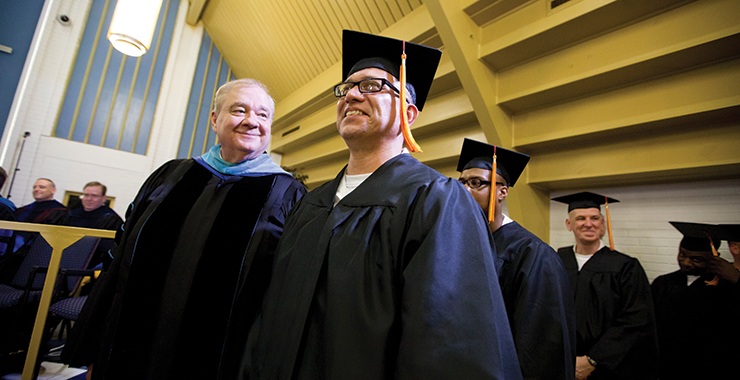
When the 1994 Crime Bill eliminated Pell Grant eligibility for incarcerated students, higher education programs in prisons across the country plummeted dramatically from nearly 1,000opens in new window in the 1990s to just 12 by 2005. That changed in July 2023 when Pell Grant eligibility was restoredopens in new window as part of the Free Application for Federal Student Aid (FAFSA) Simplification Act—opening doors to college for roughly 750,000 incarcerated people, according to the Vera Institute of Justiceopens in new window. As a consequence, there has been an upsurge in colleges and universities partnering with correctional facilities to offer credited courses and degree programs that duplicate what is available on campus.
Although funding increased with last spring’s passage of H.R. 1, or the One Big Beautiful Act, two new rules will limit access: Pell Grants can’t be added if other aid fully covers tuition, and a new short-term job training program, Workforce Pell, requires job placement—virtually impossible for incarcerated students still serving time.
The Alliance for Higher Education in Prisonopens in new window reports more than 400 higher education initiatives across nearly 600 correctional facilities as of November 2025. Psychology faculty have played a particularly active role in these initiatives, teaching courses that explore human behavior, mental health, and social systems in spaces often defined by isolation. For many faculty members, that work has helped reinvigorate their own sense of purpose as educators while also reshaping these students’ lives.
There is ongoing debate about whether courses in psychology offer tangible employment benefits compared with business or information technology for formerly incarcerated people upon their release. Mara Sanchez, PhD, programs director for the alliance, says that students in correctional settings deserve access to the same breadth of course options available to any college student. “While it is important to connect higher education with meaningful career pathways, I can see psychology as building skills that employers see as critical, such as communication, conflict resolution, teamwork, and problem-solving,” she said.
The United States incarcerates more people than nearly any other nation in the world, with close to 1.25 million peopleopens in new window confined in prisons across the country. Mass incarceration has far-reaching social and psychological consequences. Decades of research have shown that correctional education is one of the strongest tools for reducing recidivism and improving reentry outcomes.
A meta-analysis of 37 years of research found that people who participated in prison education programs were 32% less likely to return to prison than those who did not (Bozick, R., et al., Journal of Experimental Criminology, Vol. 14, 2018opens in new window). Another meta-analysis revealed that college or postsecondary education was more effective at decreasing recidivism—by 41.5%—compared with vocational education (15.6%), secondary education or GED (12.5%), and adult basic education (3.3%) (Stickle, B., & Sprick Schuster, S., American Journal of Criminal Justice, Vol. 48, 2023opens in new window).