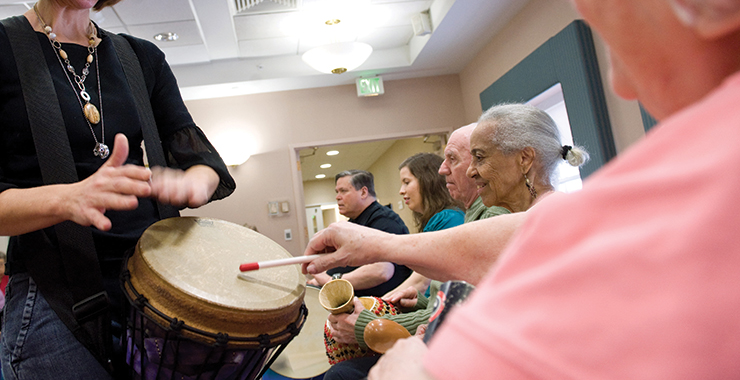
When former Congresswoman Gabby Giffords was shot in the head in 2011, her doctors used every available tool to help her regain the ability to move and speak. Alongside speech and physical therapy, Giffords began relearning the French horn, an instrument she had played as a teenager. Music therapy helped heal the shattered connections in Giffords’s brain—a tool that she has credited with helping her reclaim her ability to speak.
Music is an extraordinary feature of the human species. It unites us and conveys feeling when words fail. It speaks to our identity as individuals and as members of a group. It is universal—found in nearly every culture and society—yet wildly diverse. It is emotionally potent but cognitively complex. In all its intricacy, music is a mirror of the brain itself, and it has its own implications for cognition, emotion, and identity.
Although it is impossible to know for sure, music produced by humans seems to exist in a class of its own. Birdsong, while melodic, is thought to convey information to potential mates or rivals. But humans create songs just for the joy of it. “There’s no known human culture that lacks something that we would probably want to call music, and people have really powerful experiences to music,” said Elizabeth Margulis, PhD, who studies music perception and cognition and is acting chair of the department of music at Princeton University. “It is an intriguing window into what makes us tick.”
While music might seem like a niche area of psychological study, it’s actually a perfect platform for learning about cognition, emotion, and identity, said Robert Zatorre, PhD, a cognitive neuroscientist at McGill University in Montreal.
“If you really want to understand human cognition, you have to look at the whole gamut of processes, from the most basic to the most complex. And among the very top, I would place the arts, including music,” he said. Music touches on so many aspects of human cognition, from low-level functions like perceiving pitch and volume to more complex processes involving memory, attention, pattern recognition, sensorimotor interactions, learning, and emotion. “If you pick up a psychology textbook, music can inform you about each chapter,” he added.