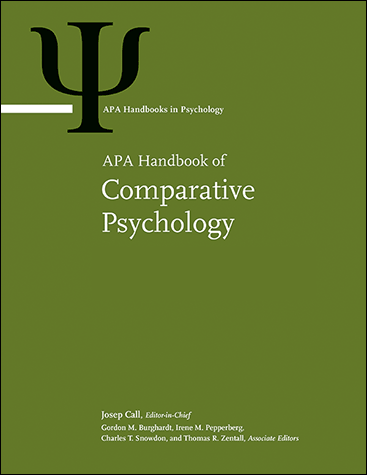
APA Handbook of Comparative Psychology
Available formats
Part of the landmark APA Handbooks in Psychology® Series from APA
Comparative psychology is the scientific study of animal cognition and behavior from an evolutionary perspective.
This two-volume handbook presents the different aspects of comparative psychology—behavior, cognition, learning, and neurophysiology—in a balanced and exhaustive manner.
There are 80 chapters across the set, divided into nine parts.
History/Basic Concepts and Methods constitute the first two parts of the handbook. Key events and basic questions (and controversies) that have shaped the field as well as the methods used to make those questions empirically tractable are presented here.
The next three parts—Adaptation/Evolution/Phylogeny, Genes/Hormones/Ontogeny, and Neural Substrate—present the conceptual foundations for understanding the genesis of behavior and cognition both from a phylogenetic and ontogenetic perspective.
Finally, the next four parts (Behavior, Perception/Attention/Memory, Learning/Motivation, and Cognition/Emotion) are devoted to the core of comparative psychology today.
Volume 1. Basic Concepts, Methods, Neural Substrate, and Behavior
Editorial Board
About the Editor-in-Chief
Contributors
Series Preface
Introduction
Part I. History and Basic Concepts
- Chapter 1. What Is Comparative Psychology?
Josep Call, Gordon M. Burghardt, Irene M. Pepperberg, Charles T. Snowdon, and Thomas R. Zentall - Chapter 2. Trends and Themes in the History of Comparative Psychology
Donald A. Dewsbury
Part II. Methods
- Chapter 3. Studying Animal Behavior: Integration of Field and Laboratory Approaches
Charles T. Snowdon and Gordon M. Burghardt - Chapter 4. Observational and Experimental Methods in Comparative Psychology
Ken Yasukawa and Kristin E. Bonnie - Chapter 5. Collecting Biologically Relevant Information: DNA to Population Density
Tobias Deschner, Mimi Arandjelovic, and Hjalmar S. Kühl - Chapter 6. Tools for Measuring Animal Cognition: T Mazes to Touchscreens
David A. Washburn, J. Antonio Salamanca, Rachel C. Callery, and William Whitham - Chapter 7. Neurons to Networks: Integrative Methods for Studying Social Behavior
Eileen A. Lacey and Nancy G. Solomon - Chapter 8. From Nonparametric Tests to Mixed Models: A Brief Overview of Statistical Tools Frequently Used in Comparative Psychology
Roger Mundry - Chapter 9. Methods and Applications of Animal Personality Research
Alexander Weiss and Drew M. Altschul - Chapter 10. Phylogenetic Approaches for Research in Comparative Cognition
Evan L. MacLean and Charles L. Nunn
Part III. Adaptation, Evolution, and Phylogeny
- Chapter 11. Behavioral Variation, Adaptation, and Evolution
Delia S. Shelton and Emília P. Martins - Chapter 12. Evolution of Learning and Cognition
Nathan J. Emery - Chapter 13. Evolution and Consequences of Sociality
Judith Maria Burkart - Chapter 14. The Evolution of Language
Michael C. Corballis - Chapter 15. Evolutionary Approaches to Human Psychology
Gillian R. Brown and Catharine P. Cross - Chapter 16. Behavioral, Emotional, and Cognitive Effects of Domestication
Ruth C. Newberry
Part IV. Genes, Hormones, and Ontogeny
- Chapter 17. From Instinct to Behavior Systems: An Integrated Approach to Ethological Psychology
Gordon M. Burghardt and Robert Ian Bowers - Chapter 18. The Rise of Behavioral Genetics and the Transition to Behavioral Genomics and Beyond
Oliver Krüger, Peter Korsten, and Joseph I. Hoffman - Chapter 19. Behavioral Endocrinology and Development
Elizabeth Adkins-Regan - Chapter 20. Cognitive Development in Comparative Perspective: Exploring the Role of Language Acquisition in Spatial, Quantitative, and Memory Development
Nora S. Newcombe - Chapter 21. Filial Attachment: Development, Mechanisms, and Consequences
Michael B. Hennessy and Harry N. Shair - Chapter 22. Epigenetic Mechanisms Shaping the Brain: Implications for Psychological Science
Anthony P. Auger and Catherine J. Auger
Part V. Neural Substrate
- Chapter 23. Instinctual Foundations of Animal Minds: Comparative Perspectives on the Evolved Affective Neural Substrate of Emotions and Learned Behaviors
Jaak Panksepp - Chapter 24. Comparative Vertebrate Nervous Systems
Andrew N. Iwaniuk and Douglas R. Wylie - Chapter 25. Parallel Processing of Spatial and Temporal Information in Rodents and Humans: Role of the Hippocampus
Raymond Kesner - Chapter 26. The Biopsychology of Birdsong: Birdsong as a Biological Model for Human Language
Kazuo Okanoya - Chapter 27. Laterality at the Neural, Cognitive, and Behavioral Levels
Giorgio Vallortigara and Elisabetta Versace - Chapter 28. Neural Networks, Learning, and Intelligence
Bruce J. MacLennan - Chapter 29. Biological Rhythms
Benjamin L. Smarr and Lance J. Kriegsfeld
Part VI. Behavior
- Chapter 30. Information, Communication, and Language
Michael D. Beecher - Chapter 31. Referential Communication in Nonhuman Animals
Klaus Zuberbühler and Christof Neumann - Chapter 32. Symbolic Communication in Nonhuman Animals
Irene M. Pepperberg - Chapter 33. Interspecific Communication
Irene M. Pepperberg - Chapter 34. Play and Exploration
Sergio M. Pellis and Gordon M. Burghardt - Chapter 35. Maternal Behavior
Phyllis C. Lee - Chapter 36. Paternal and Alloparental Care
Charles T. Snowdon - Chapter 37. Courtship and Mate Choice
Michael J. Ryan and Lyndon A. Jordan - Chapter 38. Ingestive Behavior
Kurt Schwenk - Chapter 39. Predator–Prey Interactions: Integrating Fear Effects
Liana Y. Zanette and Michael Clinchy - Chapter 40. Antipredator Behavior
Akira Mori and Ryo Ito - Chapter 41. Why Animals Fight: Uncovering the Function and Mechanisms of Territorial Aggression
Matthew J. Fuxjager, Xin Zhao, Nathan S. Rieger, and Catherine A. Marler - Chapter 42. Conflict Resolution
Teresa Romero and Filippo Aureli - Chapter 43. Friendships, Coalitions, and Alliances
Marina Cords and Nicole A. Thompson - Chapter 44. Comparative Studies of Cooperation: Collaboration and Prosocial Behavior in Animals
Katherine A. Cronin - Chapter 45. Thermoregulation, Energetics, and Behavior
Christopher Harshaw, Mark S. Blumberg, and Jeffrey R. Alberts
Index
Volume 2. Perception, Learning, and Cognition
Editorial Board
Contributors
Part I. Perception, Attention, and Memory
- Chapter 1. Animal Psychophysics: The Study of Sensation in Nonverbal Organisms
John Malone - Chapter 2. Hearing and Communication
Georg M. Klump - Chapter 3. Comparative Visual Perception: An Overview
Olga F. Lazareva - Chapter 4. Chemoreception
Alicia Mathis and Adam L. Crane - Chapter 5. Perceptual and Functional Categorization in Animals
Ulrike Aust - Chapter 6. Object and Picture Perception
Shigeru Watanabe and Ulrike Aust - Chapter 7. Face Perception and Processing in Nonhuman Primates
Ikuma Adachi and Masaki Tomonaga - Chapter 8. Comparative Visual Illusions: Evolutionary, Cross-Cultural, and Developmental Perspectives
Kazuo Fujita, Noriyuki Nakamura, Sota Watanabe, and Tomokazu Ushitani - Chapter 9. Selective and Divided Attention in Comparative Psychology
Walter T. Herbranson - Chapter 10. The Comparative Study of Working Memory
William A. Roberts and Angelo Santi - Chapter 11. Episodic-Like Memory and Mental Time Travel in Animals
Nicola S. Clayton
Part II. Learning and Motivation
- Chapter 12. Ethological and Evolutionary Perspectives on Pavlovian Conditioning
Mark A. Krause and Michael Domjan - Chapter 13. Comparative Learning and Evolution
Mauricio R. Papini and Carmen Torres - Chapter 14. On the Structure and Role of Optimality Models in the Study of Behavior
Marco Vasconcelos, Inês Fortes, and Alex Kacelnik - Chapter 15. Decision Making: Rational and Irrational Choice
Thomas Zentall - Chapter 16. Decision Making Under Uncertainty: Preferences, Biases, and Choice
Alexandra G. Rosati - Chapter 17. Relational Thinking in Animals and Humans: From Percepts to Concepts
Ed Wasserman, Leyre Castro, and Joël Fagot - Chapter 18. Serial Learning
Greg Jensen - Chapter 19. The Comparative Psychology of Social Learning
Bennett G. Galef and Andrew Whiten - Chapter 20. Animal Social Learning, Culture, and Tradition
Kevin Laland and Cara Evans
Part III. Cognition and Emotion
- Chapter 21. Spatial Cognition
Ken Cheng and Kate Jeffery - Chapter 22. Homing and Navigation
David J. Pritchard and Susan D. Healy - Chapter 23. Timing in Animals: From the Natural Environment to the Laboratory, From Data to Models
Marco Vasconcelos, Marilia Pinheiro de Carvalho, and Armando Machado - Chapter 24. Intertemporal Choice and Delayed Gratification
Jeffrey R. Stevens - Chapter 25. Quantitative Cognition
Michael J. Beran - Chapter 26. Comparative Metaphysics: Thinking About Objects in Space and Time
Trix Cacchione and Hannes Rakoczy - Chapter 27. Problem Solving
Amanda Seed and Carolina Mayer - Chapter 28. Animal Creativity and Innovation
Stan A. Kuczaj - Chapter 29. Causal and Inferential Reasoning in Animals
Christoph J. Völter and Josep Call - Chapter 30. Cognitive Insights From Tool Use in Nonhuman Animals
Elisabetta Visalberghi, Gloria Sabbatini, Alex H. Taylor, and Gavin R. Hunt - Chapter 31. The Comparative Psychology of Metacognition
Alexandria C. Zakrzewski, Jennifer M. Johnson, and J. David Smith - Chapter 32. Mind Reading in Animals?
Juliane Kaminski - Chapter 33. Reflecting on Mirror Self-Recognition: A Comparative View
Diana Reiss and Rachel Morrison - Chapter 34. Empathy Through the Ages: A Comparative Perspective on Rodent Models of Shared Emotion
Jules B. Panksepp and Jaak Panksepp - Chapter 35. Animal Welfare Science
Michael Mendl, Georgia J. Mason, and Elizabeth S. Paul
Index
Josep Call, PhD, is a professor of the evolutionary origins of mind in the School of Psychology and Neuroscience at the University of St. Andrews in St. Andrews, Scotland, and director and cofounder of the Wolfgang Köhler Primate Research Center in the Leipzig Zoo in Leipzig, Germany.
He received his BA in 1990 from the Universitat Autonoma de Barcelona in Barcelona, Spain, and his MA in 1995 and PhD in 1997 from Emory University in Atlanta, Georgia.
From 1997 to 1999, he was a lecturer at the School of Biological Sciences at the University of Liverpool in Liverpool, England. In 1999, he worked as a senior scientist at the Max Planck Institute for Evolutionary Anthropology in Leipzig, Germany.
A comparative psychologist specializing in primate cognition and cognitive evolution, Dr. Call's research focuses on elucidating the cognitive processes underlying technical and social problem solving in animals, with the ultimate goal of reconstructing the evolution of human and nonhuman cognition.
He has published four books and more than 300 articles and book chapters on the behavior and cognition of great apes and other animals.
He has been awarded the Irvine Memorial Medal and the Sheth Distinguished International Alumni Award, and has been elected a fellow of APA Division 6 (Society for Behavioral Neuroscience and Comparative Psychology), the Cognitive Science Society, and the Royal Society of Edinburgh.
He is the editor-in-chief of the Journal of Comparative Psychology and serves on the editorial board of several other academic journals.
The real potential from collaborative and cross-disciplinary thinking that comparative psychology can engender is only just beginning to be realized. This book will do much to push it forward to the benefit of both the human and nonhuman species. I thoroughly recommend this book to all, for university libraries, or your own. You will not regret it.
—PsycCRITIQUES
All articles are extensively researched, detailed, well written, and thoroughly documented…. These two volumes will serve as excellent additions to general and comparative psychology collections.
—Choice