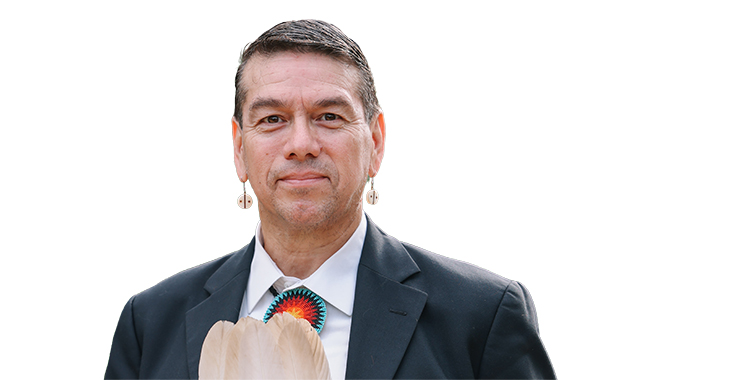
Mark Standing Eagle Baez, PhD, is an associate professor of counseling and clinical psychology and codirector of the Indigenous Students in Psychology Training program at Bemidji State University in Minnesota. He is the president of the Society of Indian Psychologists. A member of the Coahuiltecan Tribe, he is of Mohawk, Pawnee, and Mexican descent.
Baez developed the Sweetgrass Method, which integrates the best of Indigenous practice-based methods and Western evidence-based practices to build long-lasting, culturally intentional support for Indigenous communities in the area of mental health and substance use disorder. Additionally, Baez designed the Indigenous Suicide-Assessing Factors of Event (S.A.F.E.) Screening tool to assess suicide risk in a culturally responsive, respectful, and safe way for Indigenous clients.
The Monitor spoke with Baez about how he has applied a cultural strength-based approach in his work with Indigenous clients.
How has the Sweetgrass Method been effective?
In a nutshell, the Sweetgrass Method is a culturally responsive method for working with our people—American Indian, Alaska Native people. I chose the name “sweetgrass” because the plant is sacred. We use this plant in ceremony when we’re trying to focus and ground ourselves—for protection, for motivation. What better instrument or understanding to use when working with clients?
This model represents a healing process based on three pillars, or three strands, which are introspection, communication, and continuation. When you’re looking at that framework, instead of a rigid, one-size-fits-all approach, this model encourages the flexibility of the grass itself—community- centered methods that respect our Indigenous ways of knowing while also weaving in Western techniques with a continuous spectrum of active, culturally intentional services.
This framework is for the professional, whether that individual is Native or non-Native, who would come to the table with this cultural humility. Whether I am working with a Native student who has a disability or with a Native individual who has some behavioral issues, these cultural approaches are woven in when those services are applied.
For our people, the relationality [between clinician and client] begins at the very beginning. If we want change to happen, we need to have trust. To do that, we have this framework that is culturally centered, culturally grounded, and culturally responsive.
In terms of substance use disorders, what does your recent research show about the most effective ways to work with American Indian and Alaska Native clients?
We want to continue to have joy in our life. We want to continue to have healing be a part of our life. It’s difficult when a Western frame of thinking of “evidence- based practices” does not work for our people. It’s not because our people don’t want to be healed or they don’t want to have joy in their life. In plain terms, they do not like what you’re serving.
My understanding from clinicians—Indigenous and non-Indigenous—is changing the service delivery or the “menu.”
We are empowered by our own stories, our own ceremonies, our own traditional ways, and those are the ingredients that can be woven in. The Sweetgrass Method is leaving in the best evidence-based practices and weaving in the very best of Indigenous-practice-based evidence, with ongoing cultural intentionality of services for the clients.
Why did you need to develop the Indigenous Suicide-Assessing Factors of Event (S.A.F.E.) Screening tool?
Right off the bat, the challenges that we continue to see are not only that we have the highest rate of suicide among all ethnicities, [but] there are also cultural mismatches in the screening. I have been conducting suicide screening [assessments] for a good part of 15 years. The majority of suicide screening tools are not designed for our people and communities. [Those tools] lead to this insensitivity and even potential harm or triggering with some of the first questions. I don't even know the person across the desk, I haven't built a relationship with them, and the first question is, “Have you thought about killing yourself?”
These approaches can create mistrust and decrease engagement. It may be the last time I see that person. [The standard screening tools] fail to capture the unique risks of our people, but what are some of the protective factors that continue to be grounding for our people?
This hit home for me. Relatives were saying, “What are you going to do about it?” It was a loud, resounding call for me to be more proactive than reactive. A culturally tailored screening tool—like the S.A.F.E. tool—within a respectful, relationship-focused framework had to be created.
How does the Indigenous S.A.F.E. Screening tool differ from standard Western suicide screening tools?
[When developing it,] I met with elders and clinical practitioners working in the field in the United States, Canada, Australia, and New Zealand. With our people and elders, it is taboo to bring [suicide] up, but elders were saying, “It can be done if it is done in a way that honors our peoples’ experiences.” To do that, we first check in with them and who they are and what gives them strength.
This moves beyond a simple checklist by providing a structure for a more respectful way of identifying risk factors. It frames more of the story of our clients rather than a rigid, detached process.
The Indigenous S.A.F.E. Screening tool consists of nine questions. While most standard screening tools are quick—typically taking 3 to 5 minutes—the Indigenous S.A.F.E. tool requires about 7 to 10 minutes. Some might say, “That’s way too long.” My response is, “Seven to 10 minutes is not too long when we’re talking about saving a life.” Those additional minutes matter. This process builds trust, strengthens the relationship, and ensures the data we gather is accurate and culturally grounded.
This tool is rooted in cultural humility and relational accountability. It helps the client feel seen, respected, and understood. And while the Indigenous S.A.F.E. Screening tool can stand alone, it can also serve as an extension of other standard tools, complementing them with a deeper, more culturally grounded approach.