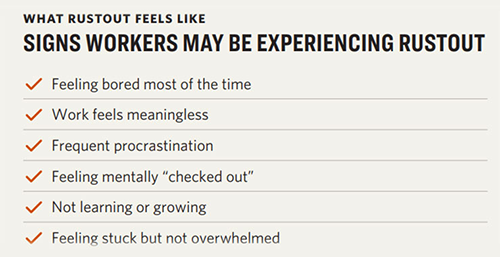
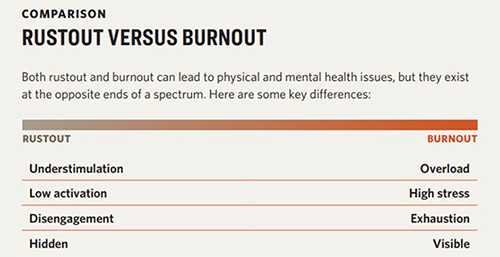
Rustout is often more than a reaction to boredom; it’s the result of how work is designed and structured. Decades of research in industrial and organizational (I/O) psychology finds that job design plays a central role in employee engagement, with job resources such as autonomy, meaning, and task variety consistently linked to higher motivation and well-being (Hakanen, J. J., & Kaltiainen, J., Annual Review of Organizational Psychology and Organizational Behavior, Vol. 13, 2026opens in new window).
One key factor is the nature of the work itself. Jobs that are overly routine or low in complexity can limit opportunities for employees to use their skills. “There’s just not enough to do, or the work is too simple or repetitive,” said Frederick Morgeson, PhD, an I/O psychologist and Eli Broad Professor of Management in the Broad College of Business at Michigan State University. He added that jobs lacking autonomy, variety, and intellectual challenge are especially likely to lead to disengagement.
A lack of control over how work is done can increase feelings of disengagement. “Constraint is one of the key drivers of boredom,” Danckert said. “Any situation where you find yourself having to do something but not really wanting to is a great recipe for being bored.” Without autonomy, employees have fewer opportunities to shape their tasks or make their work more engaging.
Rustout is also closely tied to a mismatch between employees’ needs and the demands of their roles. Research from consulting firm Fractional Insights suggests that growth is one of the most important psychological needs at work, yet it’s often unmetopens in new window. When opportunities to learn and develop are limited, even stable jobs can become disengaging.
Organizational practices and broader workplace trends can reinforce these conditions. Many modern jobs still follow old methods that focus on efficiency instead of engagement. “The way work is designed today is still heavily influenced by early ideas of breaking jobs into small, repetitive tasks,” said Sharon Parker, PhD, a professor of organizational behavior at Curtin University in Perth, Australia, and director of its Centre for Transformative Work Design. In these systems, responsibility and decision-making are often concentrated at the top, leaving employees with narrowly defined tasks and little room for initiative.
Larger shifts in the nature of work could also be making rustout more common. As expectations for meaningful, stimulating work have increased, not all roles have kept pace. “Working conditions have improved, but our expectations always rise even more beyond that,” said Tomas Chamorro-Premuzic, PhD, a professor of organizational psychology at University College London. “Because people have spent a lot of money and time getting educated, they have really high expectations about careers that should be fulfilling and stimulating. And then when those expectations meet reality, you have a bit of a reality check.”
Plus, advances in technology, including AI, are reshaping jobs in ways that can either reduce or intensify boredom. “AI won’t automatically make work more interesting—it depends on how it’s designed and implemented,” Parker said. In some cases, employees find themselves doing less complex, less engaging tasks even as technology becomes more sophisticated.
Taken together, these factors point to a common theme: Rustout is less about a lack of work and more about a lack of meaningful, challenging, and well-designed work.