The coalition of CEOs and masterminds of the inaugural Black Boys and Men Mental Health Summit at College Park, Maryland in July (from left to right): Daniel H. Gillison Jr., CEO, National Alliance on Mental Illness; Dr. Georges C. Benjamin, CEO, American Public Health Association; Dr. Arthur C. Evans Jr., CEO, APA; Dr. Arthur Taft Parsons III, vice president and chief psychiatric officer, CVS Health; Dr. Marketa Wills, CEO, American Psychiatric Association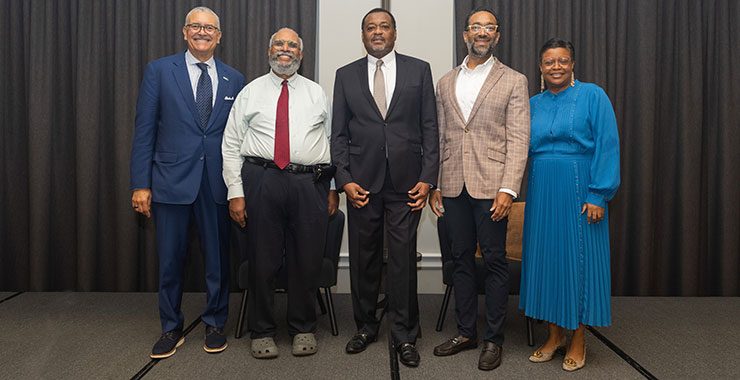
At a time when Black boys and men continue to face disproportionate mental health challenges, 150 clinicians, researchers, policymakers, elected officials, educators, faith leaders, cultural influencers, and youth advocates gathered for the inaugural Black Boys and Men Mental Health Summit in College Park, Maryland. Their goal for the July meeting was ambitious: to create a strengths-based, actionable framework to support the mental health and well-being of Black boys and men. Its cross-disciplinary design was intentional, focusing the conversation on the institutions, relationships, and systems that shape the daily lives of Black boys and men.
“There are things we need to do differently if we are going to reach Black men and boys, not just from a clinical standpoint but from a societal standpoint,” said Arthur C. Evans Jr., PhD, APA’s CEO. “The only way you can effectively deal with mental health is to have a real understanding of the context in which people are living and have interventions that address the drivers of their mental health challenges.”
[Related: Challenging assumptions]
“This gathering is more than a conference. It is a movement. We have gathered wisdom, built connections, and brought together distinguished figures, but most importantly, we have affirmed a powerful truth,” said Todd Jenkins, EdD, APA’s acting chief diversity officer, whose team organized the summit. “When we invest in the mental wellness of our boys and men, we invest in the future of our families, our communities, and our legacy. As our elders taught us, we are our brothers’ keepers.”
The summit was the brainchild of Evans and fellow CEOs Georges Benjamin, MD, of the American Public Health Association, Daniel Gillison Jr. of the National Alliance on Mental Illness, Anthony Estreet, PhD, of the National Association of Social Workers, and Shawn Boynes, formerly of the American Counseling Association. During a casual dinner in September 2023, they reflected on how their positions as Black men leading major national mental and public health organizations presented a watershed opportunity to elevate the mental health of Black men nationwide. In the months that followed, Marketa Wills, MD, CEO of the American Psychiatric Association, and Taft Parsons, III, MD, vice president and chief psychiatric officer, CVS Health, joined their coalition. Their respective organizations sponsored the July summit in partnership with the Prince George’s County chapter of 100 Black Men of America—a nationwide civic organization focused on mentoring and empowering Black youth.
The summit unfolded against a difficult policy and economic backdrop—including economic uncertainty, political hostility toward equity, diversity, and inclusion, and decreased funding for psychological science and health equity research. These add to the long-standing structural disadvantages that impact Black boys and men. Several speakers pointed to the cumulative effects of racial stress and trauma, which lead to poor outcomes for Black men’s emotional and physical well-being, as well as their prospects for equitable education and employment.
The research bears this out. Black boys as young as 10 are perceived as older and less innocent than their White peers (Goff, P. A., et al., Journal of Personality and Social Psychology, Vol. 106, No. 4, 2014). That pattern follows them into school, where teachers often mislabel Black children as angrier than their classmates (Cooke, A. N., & Halberstadt, A. G., Cognition and Emotion, Vol. 35, No. 7, 2021). They are disciplined, suspended, and expelled at disproportionate rates and fed into the school-to-prison pipeline (Brislin, S. J., et al., Journal of the American Academy of Child and Adolescent Psychiatry, Vol. 63, No. 12, 2025opens in new window; Simon, T., et al., Journal of African American Males in Education, Vol. 17, No. 1, 2026opens in new window). Suicide rates have also risen significantly in recent years, spiking by 60% for adolescent Black boys between 2001 and 2017 (Robinson, W. L., et al., Annual Review of Clinical Psychology, Vol. 18, 2022opens in new window) and 26% for adult Black men between 2018 and 2023 (Adams, L. B., et al., American Journal of Men’s Health, Vol. 20, No. 1, 2026opens in new window). More research is needed to better understand how overlapping forms of discrimination and oppression may be driving this surge. Despite these risks, the summit’s focus was not just on adversity but on possibility.
Wills said that he sees this moment as urgent, one that calls for collective impact and change. “Our Black men and boys are our future, yet they face unprecedented challenges. Those in leadership have a responsibility to invest in them so they can thrive. This is a pivotal moment for action. Investing in their mental health today will yield dividends for generations to come.”
Drawing on the call of Martin Luther King Jr., PhD, to choose “community” over “chaos,” Milton Jones Jr., board chair of both the United Negro College Fund and 100 Black Men of America, urged attendees to strengthen their organizations, leadership, and partnerships in ways that could produce lasting change.
One of the summit’s most powerful conversations paired Evans with author, minister, and Vanderbilt University professor Michael Eric Dyson, PhD. During their discussion, Dyson highlighted key mental health hurdles for boys and men: “You have a shortage of providers. There is an expectation of masculinity that operates in a particular fashion. We also know that stigma associated with pursuing positive reinforcement and affirmation for mental health exists not only in the Black church but more broadly in the culture.” Dyson encouraged practitioners to partner with faith communities to position mental health care not only as something to be accessed during moments of crisis but as part of everyday “maintenance and preservation” of mental wellness.
Summit work groups were charged with identifying actionable solutions that could be implemented at scale across domains and sectors, and would result in practices, programs, partnerships, and policies aimed at improving the overall well-being of Black boys and men.
Notable recommendations included integrating mental health conversations into spaces where Black boys and men naturally build community, such as barbershops and churches; engaging with providers and paraprofessionals to build competence in culturally responsive care; and creating networks of healing spaces known as “home places” that can serve as culturally affirming refuges from the discrimination and dehumanization Black boys and men face. The full list of recommendations will soon be published and used to inform policy and system priorities. For example, ideas that emerged from the workgroups will help shape intergenerational mentorship models that can be piloted with community-based organizations, such as 100 Black Men of America.
Howard C. Stevenson, PhD, a psychologist and University of Pennsylvania professor, described how he uses his Calculate, Locate, Communicate, Breathe, and Exhale (CLCBE) method to help youth manage and recover from racial trauma. The tool combines mindfulness, interoceptive awareness, and emotional regulation as skills to manage emotional distress throughout the life span. It can also be vital in high-stakes moments. “We can use this with boys who literally get stopped by the cops and don’t remember their first move,” Stevenson said. Stevenson uses role-play and CLCBE to help prepare youth to survive a variety of common high-stress encounters.
Benjamin reminded attendees that at the end of the day, the goal is not “to create a beautiful report that collects dust on a shelf.” To prevent that outcome, Benjamin emphasized the need for the CEO coalition and its partners to continue to press the issues raised and to track tangible progress. “I think what makes this unique is the serious group of leaders that we have together. Our success will be measured by our continuing to find things that we can work on collaboratively together.”
Gillison struck a hopeful note as the summit concluded. “Young boys and men can see that the 100 Black Men of America, APA, and other organizations are coming to the table,” he said. “That we care, are engaged, and want the best for them. If we can give them the tools to see the best of themselves and to take care of their full selves—not just the physical but also mental—this initiative is going to be an incredible success.”