At issue
Should the use of FRT be disclosed to the defense to examine its reliability?


What should the defense know about its reliability and role in criminal prosecutions?
Should the use of FRT be disclosed to the defense to examine its reliability?
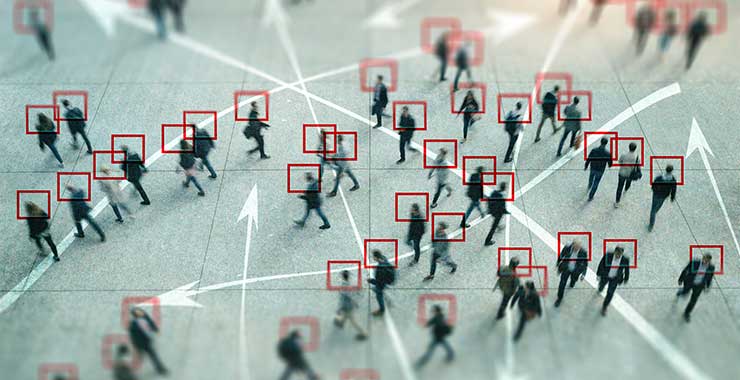
Law enforcement agencies regularly rely on facial recognition technology (FRT) to link images of faces from CCTV footage to possible suspects. It has increasingly become a standard part of investigations; a quarter of U.S. agencies had access to FRT by 2016 (Georgetown Law Center on Privacy & Technology, 2016opens in new window). By 2024, two million law enforcement searches per year used one vendor alone (The Record, June 27, 2024). But only a handful of judges have ruled on what procedures should be in place when FRT is used to identify offenders, despite the National Academies of Sciences, Engineering, and Medicine (NAS) highlighting concerns regarding its reliability in criminal prosecutions (NAS, 2024opens in new window).
Defense lawyers and courts often have no idea law enforcement used FRT to identify a suspect—one reason legal challenges to it remain rare. Few states or localities require disclosure. So, it was especially significant when a Maryland appellate court in State v. Johnson (2025) addressed whether the prosecution had an obligation to disclose to the defense that law enforcement initially identified the defendant by using FRT. Only two courts had previously ruled on this issue, with the New Jersey appellate court in State v. Arteaga (2023) ruling in favor of disclosing its use to the defense and a Florida appellate court in Lynch v. State (2018) ruling against.
In Johnson, an individual assaulted a retail employee and stole money from a cash register. To identify potential suspects, law enforcement used surveillance camera footage to place a still image of the perpetrator into an FRT program, which they said produced one suspect: Craig Johnson. Typically, FRT programs are designed to produce lists of candidates.
A search of Johnson’s home turned up no physical evidence linking him to the crime or the assailant’s distinctive jacket and jeans, though the detective thought a pair of sneakers resembled the assailant’s. A week before trial, the defense learned FRT was used to develop Johnson as a suspect and argued that the late disclosure was prejudicial and that a postponement, not a dismissal, was the appropriate remedy. Having already been incarcerated for a year, Johnson opted not to postpone. At trial, the victim identified Johnson with what she described as 100% certainty. Johnson was convicted but later appealed on the grounds that the prosecution had committed a prejudicial discovery violation by failing to timely disclose that law enforcement had used FRT and how. The Maryland appellate court agreed, explaining: “it would set a terrible precedent if we allowed the state to use FRT to identify Mr. Johnson, disappear all the discoverable bases for that identification, and introduce the identification and its fruits all the same.”
Notifying the defense about the use of FRT would then allow the defense to examine—and potentially challenge—its reliability, including how it was used in their case. Although FRT can be highly accurate under controlled conditions, research shows that it is far from foolproof. Its reliability can be widely variable in real-world situations depending upon the FRT program used, the database or algorithm it uses, and the quality of the input (NAS report; see also Center on Privacy & Technology at Georgetown Law, 2022opens in new window). Numerous false arrest suits have been filed by people wrongly identified by FRT. Further, an FRT search does not occur in a vacuum: Law enforcement must still examine the candidates and decide whether any is enough of a “match.” Because people are involved in these judgments, bias unavoidably enters the process. And unlike many eyewitness identification procedures, this FRT search process is not informed by clear scientific standards.
It seems inevitable that AI and other emerging tech will increasingly generate evidence used in criminal investigations. Yet it is difficult to imagine a future where such programs are 100% accurate and devoid of human error in all real-world settings. To prevent miscarriages of justice, law enforcement’s use of FRT needs more transparency. More research is needed on how reliable different FRT systems are in real-world conditions, how human judgment influences and is influenced by FRT, and on scientifically sound methods for conducting FRT searches, assessing results, and sharing FRT images with eyewitnesses and in court.
Subscribe to APA’s audio podcast series highlighting some of the most important and relevant psychological research being conducted today.
Subscribe to Speaking of Psychology and download via: