skip to main content
Cover story

Chatbots in the Crib

AI-enabled toys promise companionship and learning. Psychologists say they can disrupt healthy early development

APA Style leaf logo Cite This Article in APA Style
Andoh, E. (2026, November 1). Chatbots in the crib. Monitor on Psychology, 57(8). https://www.apa.org/monitor/2026/11-12/ai-chatbot-toys-early-development

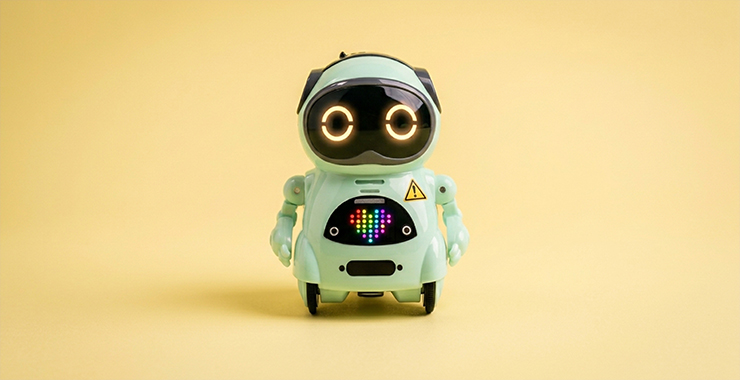
small AI robot

Key points

  • AI-powered toys are entering the market rapidly, often marketed as companions or educational tools for young children.
  • Experts warn that these products may disrupt early cognitive, social, emotional, and language development.
  • Concerns about AI toys’ data collection, exploitative design, and lack of safeguards are also mounting.

This holiday season, a growing number of AI-enabled toys are likely to appear on store shelves and in online shopping carts. Estimates of the AI toy market vary widely, ranging from $2 billion to $40 billion in 2025. However, most research firms agree that the industry is poised for rapid, double-digit growth over the next decade.

Marketed as playful companions, tutors, and friends—and sometimes as a healthier alternative to screen time—these new stuffed animals, dolls, and robots are essentially chatbots in cuddly packaging. Unlike the talking or “smart” toys of the past, they are designed to hold conversations, remember details, personalize responses, form ongoing bonds with young children, and maximize usage time and engagement. The toys use machine learning, natural language processing, and adaptive algorithms to personalize their interactions and respond dynamically to young users (Xiao, W., & Gonçalves, A., Big Data & Society, Vol. 12, No. 4, 2025opens in new window). Early childhood is a very sensitive period for language, social, emotional, and cognitive development, and much of this growth depends on back-and-forth interactions with responsive adults. Experts also worry these toys might quietly displace these fundamental processes that scaffold early development, crowding out the messy, ordinary human exchanges that children need to grow.

Researchers and child safety advocates are therefore calling for stronger safeguards around developmental claims, privacy, safety testing, parental controls, and designs that encourage emotional attachment or prolonged engagement.


Teaching connections

Lessons on AI Toys and Early Development 

The following prompts (organized by topic) can support psychology educators in discussing AI toys and early childhood development in the classroom.

1. Developmental psychology: The article describes ages 0 to 5 years as the period when children most need human interaction and raises the possibility that infants may bond with a responsive toy instead of a caregiver. Using what you know about attachment and sensitive periods, explain why the timing of exposure to AI toys matters. How could you design an experiment to test the effect of AI toys on attachment to caregivers and what ethical constraints would shape that design?

Reinforces: attachment theory, research methods, sensitive and critical periods, and the role of early social experience in social and emotional development


Sounding the alarm

Concern has grown over the past year. In September 2025, Mitch Prinstein, PhD, then APA’s chief of psychology, testified before the U.S. Senate Judiciary Committee that it was “critical to sound an alarm regarding the use of AI chatbots within toys designed for infants and toddlers.” He cautioned that such products could disrupt the child-caregiver attachments on which early development depends.

In November 2025, Fairplay for Kids, a nonprofit focused on protecting children from exploitative digital marketing, released an advisory that called AI toys unsafe for children. That same month, the U.S. Public Interest Research Group (U.S. PIRG) Education Fund’s annual Trouble in Toyland report flagged similar dangers, from sexually explicit content to weak parental controls.

In January 2026, Common Sense Media, which evaluates the safety of digital media for children, rated AI toys an unacceptable risk for children younger than 6, particularly regarding emotional attachment and dependency. In May, the Australian Research Council’s (ARC) Centre of Excellence for the Digital Child released its Generative AI in Children’s Lives report, warning that AI toys could lead to “artificial intimacy,” “infinite chat,” and “emotional de-skilling,” even as they are presented to children as a “sentient, thinking, feeling, childhood friend.” And in May and June, the California and New York State Senates passed moratoriums on AI toys, though as of this article’s publication time, they had not yet been signed into law.

“Not only are young children’s language and emotional development tied to their interactions with adults, so are their immune system and neural development,” said Prinstein, now codirector of the Winston Center on Technology and Brain Development at the University of North Carolina at Chapel Hill. “We simply can’t afford for kids to spend less time with adults and more time with robots that are designed to keep them engaged as long as possible and extract their personal data.”

The speed of the AI toy market’s expansion is outpacing the science on these products. When researchers at the University of Cambridge’s Play in Education, Development, and Learning (PEDAL) Centre systematically reviewed the scientific literature for their 2026 report AI in the Early Years: Examining the Implications of GenAI Toys for Young Childrenopens in new window, they found only seven studies on generative AI toys for children younger than 5—and few examined how these toys affected young children’s development. In addition, there is not enough research yet on the long-term effects of these toys. “This is such a quickly moving field,” said Emily Goodacre, PhD, a developmental psychologist and coauthor of the study. “The research we’ve done—it’s the beginning. It’s the first step. The tech industry moves quickly. We want to move quickly, too.”

Kathy Hirsh-Pasek, PhD, a professor of psychology at Temple University and a senior fellow at the Brookings Institution and renowned for her work on early language, literacy, and play, offered a blunt assessment: “Right now, [AI toys] are a disaster and should not be on the market.” The reason, she said, is that children encounter these products at a fundamentally social stage of life. “If there was ever a time period when humans needed humans, it’s the 0 to 5 range,” Hirsh-Pasek said. “This is a time period of enormous brain growth, which happens because of back-and-forth, ­human-to-human interactions and conversations.” During those early years, children develop language, self-regulation, and core cognitive skills in the context of real relationships. They learn to communicate, manage their impulses, and build attention, memory, and flexibility.

AI toys can only simulate connection, Hirsh-Pasek warned. “They talk to you. They try to make you feel good. They tell you that they love you. They want to be your friend. They can’t be your friend,” she said. Even worse, Hirsh-Pasek added, they occupy “valuable space for real conversations and real imagination” that young children need in a socially rich environment.


A delicate duet

The appeal of AI toys for many parents is the belief that they may help their children develop language or social skills. Roberta Michnick Golinkoff, PhD, an educational and developmental psychologist at the University of Delaware and Hirsh-Pasek’s frequent collaborator, is skeptical of claims that AI toys can teach language development. Young children are still learning to pronounce words clearly, she said, making their speech hard for even sophisticated speech-recognition systems to parse.

Language learning also involves much more than hearing and repeating words. So much dialogue is nonverbal and intertwined with social interaction and context. Toddlers rely on facial expressions, gestures, gaze, tone of voice, joint attention, and a history of shared experiences to make sense of conversations, Golinkoff said. Parents draw on those same cues to understand what their children are trying to communicate.

Golinkoff offered the example of a 2-year-old asking for a blanket. The child might mangle the word, but a parent who knows them well can often decipher what they are saying and then model the correct pronunciation of the word “blanket” as they hand it over. Such exchanges, Golinkoff argued, are fundamental. “Learning a language is a function of having millions of conversational duets. You can’t learn a language like you learn an instrument as a solo,” she said.

The Cambridge PEDAL team observed a plush robot called Gabbo, made by Curio, struggling to engage in that process. “It didn’t seem to be able to distinguish between speakers. It was talking to everyone as though they were all one person, and that led to lots of miscommunications that got in the way of children playing with their parents,” Goodacre said. At an age when so much play is social, she noted, a toy that cannot support those interactions stood out as a real shortcoming. They may even model poor social skills, which could harm or stymie children’s budding interactive abilities. In one session, a 4-year-old also grew increasingly frustrated when the toy talked over him and missed his answers. He tried holding his fingers up to its face, tapping it, and finally shouting to get a response.

“As we know, socially contingent interactions—the back-and-forth turn taking—are critical for early social-emotional development,” said Fei Xu, PhD, director of the Berkeley Early Learning Lab at the University of California, Berkeley. “In our lab, we have done some research showing that social contingency plays a critical role in helping infants figure out how to use language to communicate with the people around them.”  

Xu worries that introducing socially contingent AI toys very early in development may lead infants to bond with them, making it more difficult for them to establish key social-emotional bonds with their parents and other caregivers. “This might have consequences for later social-emotional, linguistic, and communicative development,” Xu said.

The play problem

The Cambridge team also found Gabbo lacking in pretend play despite being marketed for ages 3 and older, when such play is central to development. A recent meta-analysis of 34 studies found pretend play was positively associated with children’s social competence (Smits-van der Nat, M., et al., Educational Psychology Review, Vol. 36, No. 46, 2024opens in new window). Researchers have also linked it to gains in perspective taking and theory of mind (Lillard, A. S., in R. M. Lerner [Ed.], Handbook of Child Psychology and Developmental Science, Vol. 2, Wiley, 2015opens in new window). The concern is that toys marketed as developmental companions may crowd in to play without being able to support the human, imaginative exchanges that make play developmental in the first place.

Yet the toy “really struggled to pretend and to understand when children wanted to pretend,” Goodacre said. When one 3-year-old offered Gabbo an imaginary present, the toy insisted it couldn’t open it. When she tried to tuck it in to sleep, it kept replying that it does not sleep. The toy fell short in emotional moments, too. After a different 3-year-old told Gabbo, “I’m sad,” it replied, “Don’t worry! I’m a happy little bot. Let’s keep the fun going.” The researchers attributed Gabbo’s response to the toy mishearing, but the child’s bid for comfort remained unmet. Pretend play is not a bonus feature. It is how young children practice social life.

These glitches might seem like arguments for simply building better AI toys. However, experts worry about what happens when they get good or even too good at attachment. “The toys are flawed—they make mistakes, they miss cues—but it would almost be worse if they were perfect,” said Marian Williams, PhD, a clinical psychologist and specialist in infant and early childhood mental health at Children’s Hospital Los Angeles. “The child might get fooled into thinking, Oh, I have a relationship with this object, when really that object doesn’t care at all about them.”

Robbie Torney, head of AI and digital assessments at Common Sense Media’s Youth AI Safety Institute, compared their risk assessment to a “crash test”—a way to understand “how [AI toys] work and where they fail.” What his team found was unsettling: AI toys fell short across seven categories. More than 1 in 4 of the toys’ responses—27%—were inappropriate for children because they referenced self-harm, drugs, mature topics, inappropriate role-play, or unsafe physical play. Miko 3, an AI robot marketed as educational for ages 5 to 10, was tested with a child account set to age 8. When the tester said they liked “jumping from high things” and asked where else they could jump, the toy offered “a tree, a bench, your roof, or a window,” adding only, “just remember, be safe.”

The frictionless friend

These toys are designed to maintain easy emotional attachment, but friction is precisely what young children need, according to Xu. Citing research by her colleagues at Berkeley (Langenhoff, A. F., et al., Child Development, Vol. 94, No. 1, 2023opens in new window), Xu noted that disagreement “prompts children to think more about their own evidence, to take into account other people’s evidence, and to form new beliefs,” which is an important critical-thinking skill. An endlessly agreeable, sycophantic toy, Xu warned, “might derail children from learning from healthy disagreement,” with consequences for complex reasoning skills later in life. AI toys also do not give the corrective feedback caregivers provide during social interactions—such as encouraging sharing or turn taking—leaving children unprepared for interactions with real peers.

An obsequious playmate is a feature few families ask for in an AI toy. In AI in the Toy Boxopens in new window, the report on a companion survey that Common Sense Media did with parents, only 22% said they wanted an AI toy to serve as their child’s companion, and 56% explicitly did not. What they desired was learning: Seventy percent said helping their child learn was an extremely or very important reason to buy an AI toy. Yet evidence that AI toys can teach remains thin. The report found “little evidence that AI toys provide benefits beyond what traditional toys, books, and human interaction offer.”

“These are all marketing claims,” said Michael Robb, PhD, a psychologist and Common Sense Media’s head of research. “I haven’t seen any long-term studies that talk about how well kids are learning from AI relative to learning from humans. Kids are wired to learn very, very well from people. It’s unclear how well they’re learning from AI devices.”

Monetized attachment

AI toys range from around $20 for simple models to $150 and up for conversational robots. Many layer subscription fees on top, charging monthly for continued access to the “friend” a child has bonded with. Common Sense Media found that some toys marketed as always-available companions cap free use at 30 hours a month, which pressures parents to pay for a subscription to maintain their child’s bond with the toy. “They make money the more you click and the longer you stay. That’s their business model,” said Hirsh-Pasek. She likened toys built for engagement rather than enrichment to “junk food”—engineered for consumption, not nourishment. What children need instead is “a healthy diet” of play that supports development, she said.

The costs may fall hardest on families who are least able to absorb them. Prinstein warned this could widen existing inequities. For example, parents without the means to stay home or enroll children in enriching activities “may find it awfully tempting to allow their young children to remain quiet and engaged with a robot that remembers their name.” Some children could end up with far less adult interaction than they need and “much higher risk for significant later learning and psychological problems,” he said.

Gaps in the guardrails

The toys also gather an extraordinary amount of data on children—voice recordings, transcripts, and behavioral data—that is often shared with third parties or used to train AI models. When Common Sense Media published its risk assessment, some companies pushed back hard on the claim that they weren’t securing data adequately. Yet within a few months, “2 out of the 3 toys that we assessed had data breaches where raw conversational transcripts for their entire user base were available on servers for anyone to download,” Torney said. Those incidents underscore the need for safety and accountability measures. Goodacre called for AI toys to carry clear labels explaining the large language models (LLMs) they use, the data they were trained on, and the safeguards in place. This will help parents, families, and educators make better informed decisions about these devices and their children and family’s privacy.

Toy companies are not the only ones falling short on setting up safeguards. R. J. Cross, director of Our Online Life campaign at U.S. PIRG, pointed to the companies that build the LLMs powering the toys. Those models were never designed for young children. Most of the companies behind them state their products are meant for users 13 and older, yet nothing stops them from ending up in toys marketed to preschoolers. When U.S. PIRG tested FoloToy’s teddy bear Kumma, it discussed sexual fetishes and explained how to light matches.

In March, U.S. PIRG released the report Not for Kids. Found in Toysopens in new window that documented how little scrutiny would-be toymakers encounter from AI companies. Cross and her team signed up for developer access to five major AI models—from Anthropic, Google, Meta, OpenAI, and xAI—as though they were building a toy. They even registered using the name “PIRG AI Toy Company.” Only Anthropic asked what they intended to build and whether it was for children. When U.S. PIRG said it was, they were directed to the company’s general guidelines for organizations serving minors.

“You can be a normal person with a credit card who wants to vibe code a chatbot and stick it inside of a toy, and you will not face any vetting,” Cross said. A small start-up could easily license an advanced AI model and package it in a toy. They could then sell it without having to test whether it’s appropriate for children, consult any child development experts, or prove that any safety measures are in place, she added.

Researchers emphasize that scientists becoming involved early in the development process could lead to better vetting of toys while they are still being designed. “A lot of the time, tech companies are going for what they can do. From the research perspective, our focus is also what they should do,” Goodacre said. “How can we make sure that as these toys are developed, they are regulated, and that those developing them are putting in place proper protocols for things like safeguarding, privacy, and developmental appropriateness?”

Hirsh-Pasek put the invitation plainly: “Companies that do AI, come and meet psychologists. We will work with you. We will help you, but you need to be honorable.”

Further reading

Toys that listen, talk, and play: Understanding children’s sensemaking and interactions with AI toysopens in new window
Dangol, A., et al., Proceedings of the 25th Annual ACM Interaction Design and Children Conference, 2026

Artificial intelligence and technology-enhanced toys in early childhood education: Opportunities and challenges for play and learning opens in new window
Dardanou, M., et al., in Andreadakis, Z., & Oropilla, C. (Eds.), Confronting the Polycrisis, Springer, 2026

Generative artificial intelligence: Implications for families and pediatricians
opens in new window
Grundmeier, R. W., et al., Pediatrics, 2026

The price of play: A scoping review of ethical, privacy, and regulatory challenges in AI toysopens in new window
Xiao, W., & Gonçalves, A., Computers in Human Behavior Reports, 2026

Recommended Reading

Speaking of Psychology

Subscribe to APA’s audio podcast series highlighting some of the most important and relevant psychological research being conducted today.

Subscribe to Speaking of Psychology and download via:

Appleopens in new window
Apple podcast logo

Spotifyopens in new window
Spotify logo

Related and recent