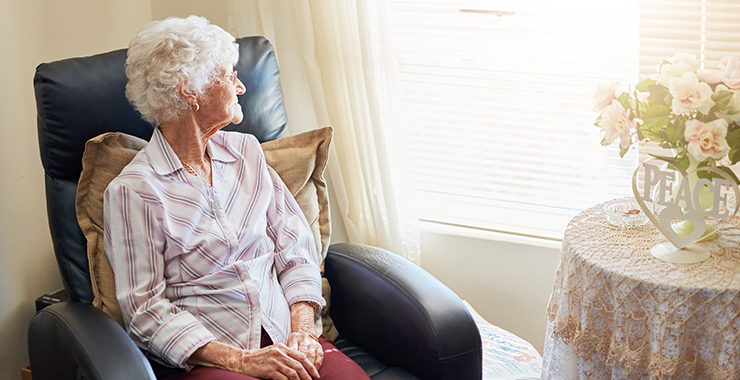
Because the risk of death from COVID-19 increases with age, family members and friends are limiting their visits to older people, whether they’re in nursing homes, assisted living facilities or just their own homes. But that new practice of social distancing — or reducing close physical proximity with others — may contribute to another deadly epidemic among older adults: social isolation and loneliness.
Even before the pandemic began, an alarming number of older Americans were so socially isolated and lonely that their health — and even their lives — are at risk, according to a new report released by the National Academies of Sciences, Engineering and Medicine in February. The AARP Foundation sponsored the study.
Social isolation and loneliness aren’t the same thing, the report emphasizes. Isolation is an objective lack of social contact, while loneliness is the subjective feeling of being lonely; you can be alone without feeling lonely. But both isolation and loneliness are associated with increases in heart disease, dementia and other health problems, the report finds. In fact, social isolation increases mortality risk on a par with such risk factors as smoking, obesity and lack of physical activity, according to a review by Julianne Holt-Lunstad, PhD, a psychology professor at Brigham Young University, and colleagues (American Psychologist, Vol. 72, No. 6, 2017).
And yet the connection between social relationships and health is often overlooked, says Holt-Lunstad, one of the three psychologists on the 15-person committee that wrote the “Social Isolation and Loneliness in Older Adults: Opportunities for the Health Care System” report.
“We have good evidence that the effect sizes of these social factors — lack of connection, social isolation and loneliness — are comparable to many of these other risk factors we take quite seriously,” she says. “But that surprises people.”
COVID-19 could make matters worse, says psychologist James S. House, PhD, a co-author of the report and a professor emeritus of survey research, public policy and sociology at the University of Michigan. “On one hand, you have to protect older people from the virus,” he says. “On the other, we’re cutting them off from one of the things that’s very important to their well-being.”
Psychologists can help mitigate the impact of social distancing, closures and other pandemic-related factors putting older people at even greater risk, say House and other experts:
- Stay in touch with patients. Reach out to patients during this crisis, says Brian Carpenter, PhD, a psychology professor at Washington University in St. Louis and president of the Society of Clinical Geropsychology, a section of APA’s Div. 12 (Society of Clinical Psychology). Let them know what your plans are for upcoming visits and how you plan to keep in touch. If your office is still open, you’ll need to make sure patients understand the risks of coming in.
- Consider telemental health options. “I wouldn’t assume that older adults are less savvy or connected, but ask about it,” says Carpenter. “If that turns out to be the case, relying on the telephone is another viable option.” Keep in mind that they’ll need to sign the appropriate consent form and that the reimbursement landscape is changing rapidly.
- Encourage older patients to keep in touch with family and friends. “I don’t like the term ‘social distancing,’” says Karen Fingerman, PhD, who co-directs the Aging and Longevity Center at the University of Texas in Austin. Psychologists should encourage older patients to ramp up other ways to stay in touch, whether through video chat apps, the telephone or even old-fashioned letters or postcards.
- Promote intergenerational connection. Encourage younger patients to check in with grandparents and other older people in their lives, whether that means running errands or just checking in, say Carpenter and Fingerman.
- Help families keep older relatives safe. Psychologists can help families come up with more effective ways to keep older adults at home. “Messages that focus on ‘We’re afraid for you’ get resistance,” says Fingerman. “Give them something important to stay home for.” That might mean encouraging older people to stay in to protect younger people with serious illnesses or to spend time writing the story of their lives for their grandchildren.