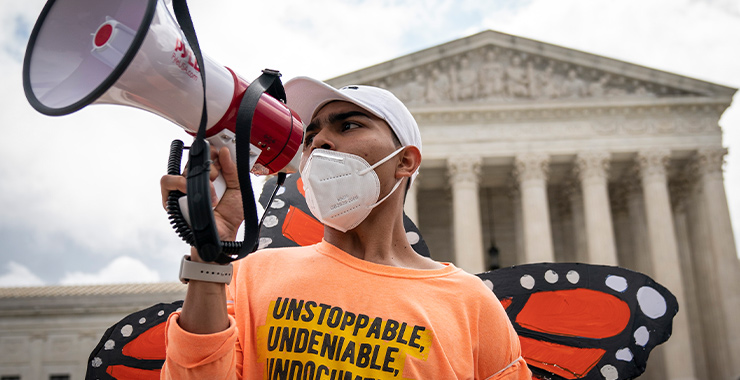
The U.S. Supreme Court decision that the Trump administration cannot immediately end the Deferred Action for Childhood Arrivals (DACA) program has spurred a wave of relief and victory in the DACA community—as well as a complex mix of emotions ranging from sadness, to anxiety, to resolve.
The June 18 decision on the DACA program was a major win for DACA recipients and their loved ones, who have been living under a cloud of uncertainty since the administration tried to end the program in 2017. DACA enables undocumented immigrants to remain within the United States, as long as they arrived before 2007 and were under age 16 when they came into the country, provided that they meet educational, work, and conduct requirements.
The program directly benefits approximately 700,000 people, including an estimated 27,000 essential workers within the health-care field. But DACA does not provide a path to citizenship, nor are its protections permanent, since recipients must apply to renew their eligibility every two years. In part because of this instability, psychologists recognize a huge unmet mental health need among DACA recipients, and in the undocumented immigrant community more broadly.
To meet this need, the National Latinx Psychological Association (NLPA), APA and immigration policy advocacy organizations such as United We Dream and FWD.us are working together to train mental health professionals on this community’s needs, to create a directory of therapists who are willing and able to work with undocumented immigrants on a sliding scale or pro bono basis, to conduct research on this population’s complex needs, and to raise awareness of the legal challenges still ahead. As part of this collaborative effort, APA is offering a free, three-part Continuing Education series that began June 21. The first installment features presentations on the context and impact of immigration policy and COVID-19 for undocumented communities. Registration for the webinar reached the 1,000-attendee limit within hours. Recordings of the series will be available for those who are unable to attend live.
“This is a time for us to build up, to prepare, because the community’s needs might have even become more complex after this decision,” says Luz Garcini, PhD, MPH, a clinical psychologist at the University of Texas Health Science Center San Antonio, and a faculty scholar at Rice University. “DACA recipients, their families, and their communities have been under constant and chronic stress for a very long time.”