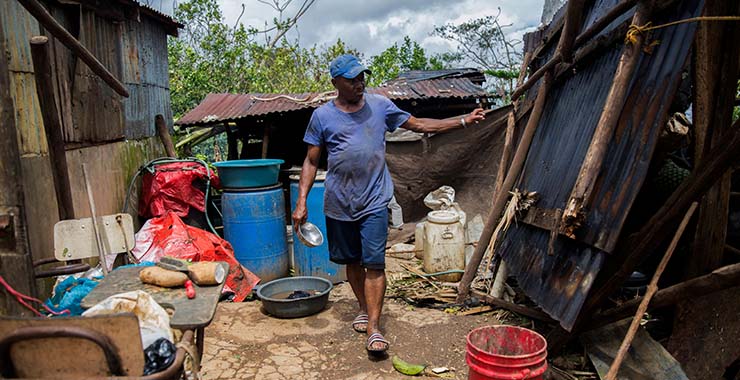
In the wake of yet another deadly hurricane hitting Puerto Rico, psychologists are in triage mode, working to reach those with the greatest needs first. Psychologists are a key part of the effort to deliver food, water, supplies, and emotional support to residents in the hardest-hit areas since Fiona hit Puerto Rico on September 18. Teachers, counselors, graduate students studying psychology, and volunteers trained in psychological first aid are fanning out across the island to help.
On September 23, psychologist Eduardo Lugo-Hernández, PhD, visited a family who “lost practically everything” when a river flooded their home, and helped them find food, water, and shelter nearby. Meanwhile, Frances Boulon, PhD, a psychology professor at the University of Puerto Rico at Rio Piedras and past president of Puerto Rico Psychological Associationopens in new window (APPR), met with a group that ensures people with disabilities and special needs are cared for during emergencies.
They are also assessing the damage and planning next steps to ensure that responders maximize their impact and avoid duplicating one another’s efforts. Mariveliz Cabán, PhD, assistant faculty in psychology at Ana G. Méndez University, Cupey Campus and coordinator of emergency response efforts for APPR, spent much of the first several days after Hurricane Fiona hit calling nongovernmental organizations (NGOs) to determine what sort of supplies and psychological first aid their constituents most need right now.
“Unlike five years ago, we have people on the ground, ready, who know how to help,” said Rosaura Orengo-Aguayo, PhD, an associate professor at the Medical University of South Carolina (MUSC) and director of the Puerto Rican Center for Intervention and Training in Traumaopens in new window, who has co-led post-Maria efforts to train first responders on the island. “It’s a very community-based, participatory approach.”
Immediately after Hurricane Fiona hit, Orengo-Aguayo and her team based at Albizu University, Mayaguez created “booster” tools in Spanish—including an eight-minute videoopens in new window and a tip sheet highlighting four key steps—to refresh trainees on disaster response protocols and express solidarity with first responders. Among their tips: First, check in with yourself and the people you live with. Are basic needs (food, water, safety) being met? If not, start there. Next, join a coordinated response through a community organization—the safest and most efficient way to help.
Third, focus on immediate needs. This isn’t the time to deliver therapy, but rather to connect people to basic support and resources. And it’s important to remember that the norm is distress. “If you see people crying, desperate, and anxious, that is a normal response to a traumatic event,” said Orengo-Aguayo, who also co-directs the Telehealth Outreach Programopens in new window for Traumatic Stress in Puerto Rico with Regan Stewart, PhD, of MUSC.
Finally, they provided several concrete tips about what to do if someone is in crisis in front of you—how to remain calm, use grounding techniques, and ask pointed questions that assess safety. Connect the individual with a professional trained to manage a mental health emergency (if needed, dial 988opens in new window to access the federal suicide crisis line).
Responders are also seeking help from the Red Cross’s Integrated Care Condolence Teams, who are trained in bereavement, to provide emotional support if a death has occurred. But for the most part, volunteers are there to help residents identify sources of strength and support within themselves, their families and peer groups, and their communities.
“People always tell me that they start receiving food, water, and basic supplies, but the emotional support is hardest to get,” Cabán said. “It’s critical that they get at least some basic emotional support in order to prevent further trauma.”