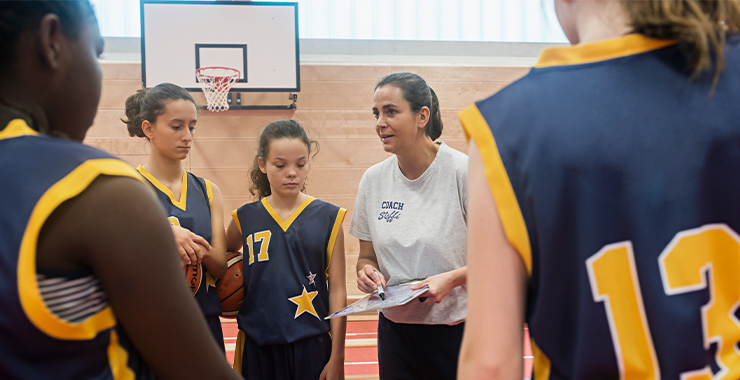
Fifty years after Title IX was passed, its effects are undeniable—if not ubiquitous. It has transformed women’s college sports, where funding must equal that allocated to men’s teams. It has laid the groundwork for professional women’s sports to flourish, such as the U.S. Women’s Soccer Team winning its equal pay lawsuitopens in new window in February. But schools across the country still apply the law selectively, even padding or inflating numbers to give the illusion of equity where none exists.
One of a series of amendments to the Higher Education Act of 1965, Title IX protects students from sex-based discrimination at any school that receives federal funding. It is commonly misconstrued as only affecting sports on college campuses but in fact is much larger than that—the law has also led schools to establish formal reporting structures to handle sexual assault and harassment within their communities, which remain crucial as sexual violence persists in higher education settings, and may even be on the rise.
While acknowledging the progress it spurred, experts agree that Title IX—or at least the way it’s implemented—needs a makeover for the modern age.
“Title IX has been great in terms of the initial push for equity after it was passed,” which has been crucial in bolstering mental health on campus, said Josie Nicholson, PhD, a counseling and sport psychologist at the University of Mississippi. “But it has since moved away from what it was intended to do.”
Reporting violations
Students who face discrimination based on sex—assault, harassment, or unequal treatment—are directed toward their school’s Title IX office (sometimes called an office of “equity” or “compliance”). A formal report can connect students to academic accommodations, mental health referrals, and other resources to preserve or restore their access to education, which is what the law is intended to protect.
But very few students who experience sexual assault—estimates range from 1% to about 13%—actually file formal reports (Halstead, V., et al., Journal of Clinical Nursingopens in new window, Vol. 26, No. 15–16, 2017; Report on the AAU campus climate survey on sexual assault and misconductopens in new window, AAU, 2020).
Reasons for that gap include a lack of awareness or understanding of Title IX protections, fears about what might happen if an incident is reported, lack of trust in the school’s willingness or ability to address the problem, and minimization of sexual harassment and assault, according to research by Kathryn Holland, PhD, an assistant professor of psychology and women’s and gender studies at the University of Nebraska-Lincoln (American Journal of Community Psychologyopens in new window, Vol. 59, No 1–2, 2017).
“There’s this idea that only extreme, stereotypical forms of harassment and assault actually matter or ‘count,’ and much of that is fostered by the inaction of institutions when people do come forward,” Holland said.
For example, one student in Holland’s study was cornered by a postdoc in her lab, who demanded sexual favors and blocked her from leaving. She escaped when a colleague entered the room, then reported the incident because she feared returning to the lab alone. Her school declined to take action because the behavior wasn’t deemed “severe and pervasive.” In another case, a perpetrator of sexual assault was found responsible, but only suspended for a semester because the school determined that he “could have used more force” during the assault.
Those cases illustrate that students often lack clarity about how procedures are applied. Schools should provide more education to students, faculty, and staff about how formal reporting mechanisms work, who is protected, and what “counts” as sexual harassment or assault, Holland said.
Students would also benefit from more transparency around the number of cases reported, how many of those are investigated, and how many result in sanctions. Some states, including New York and Maryland, already require schools to submit annual statistics on Title IX complaints, and similar regulations could be enacted at the federal level.
“At this stage, choices about whether to move forward [with a case] tend to be aligned with problematic notions about what is ‘severe’ and what isn’t,” Holland said. “We need more direct conversation and guidance about how schools should decide when to act, as well as the consequences of not taking action.”
Supporting sexual and gender minorities
Though no gendered language appears in the law, Title IX was largely understood to protect heterosexual, cisgender women when it passed. Now, LGBTQ students form a growing part of the population seeking support from their campus Title IX offices.
“I often encourage schools to center this population in their sexual assault response and prevention efforts, because research has shown again and again that they have a higher risk of experiencing sexual assault in college,” said Sarah Nightingale, PhD, an assistant professor of social work at Eastern Connecticut State University, who has worked as a victim advocate in two Title IX offices and conducted a national survey of sexual violence against LGBTQ students.
Nightingale found that LGBTQ students’ hesitance to report sexual assault largely stemmed from the sense that Title IX offices were unequipped to serve them. Students wanted to talk to staff who were trained to work with sexual and gender minorities, or who openly identified as members of a sexual or gender minority (Journal of Diversity in Higher Educationopens in new window, advance online publication, 2021).
The students Nightingale surveyed also expressed frustration with mandatory reporting policies, which have traditionally required faculty and staff—such as instructors, resident advisors, and athletic coaches—who hear about a Title IX violation to file a formal report, regardless of a student’s wishes.
“Many schools look at Title IX through a compliance or liability lens,” said Nightingale. “This started off well-intentioned, but it’s created very few places where students can go and have confidential assistance.”
Changes to Title IX regulations dispensed by the U.S. Department of Education in 2020 removed the mandatory reporting requirement. These Trump-era changes also narrowed the definition of sexual harassment, excluded off-campus assaults from the law’s protections, and made a series of other changes that left some Title IX offices scrambling to update their institution’s procedures—yet another barrier to efficient application of the law, said Eric A. Kidwell, the Title IX coordinator at Huntingdon College in Montgomery, Alabama.
A new round of updates to the law, anticipated this year, are expected to clarifyopens in new window that “sex-based discrimination” includes discrimination based on sexual orientation or gender identity, further solidifying protections for LGBTQ students.
Gains for athletes
While there’s plenty of room for improvement in the application of Title IX, it’s important to acknowledge the monumental changes it has wrought across society, Kidwell said. Before the law was passed in 1972, women could be legally barred from studying certain topics, such as business administration, and they had few opportunities to participate in sport.
“It’s really given an incredible opportunity for women to not only participate in sport at a high level, but to be fully supported in that participation,” said Chelsi Day, PsyD, a sport psychologist at The Ohio State University.
Equity in college sports has directly fueled the gains in women’s professional sports, both by developing a pool of talent and as a proof of concept, said Day.
“The success of college athletes has demonstrated that there’s a valuable market for women’s sports, which allows them to make more demands in the pro-sports space,” she said.
Female athletes still face plenty of barriers, though, including a higher likelihood of sexualized portrayals and inequities in sponsorships, salaries, and more (Frisby, C., International Journal of Humanities and Social Scienceopens in new window, Vol. 7, No. 6, 2017). They may require specialized support for these and other challenges, Nicholson said, which Title IX does not account for.
Meanwhile, some institutions still look for ways to skirt the law, shortchanging female athletes. In 2021, footage of the disparitiesopens in new window between men’s and women’s NCAA basketball facilities sparked outrage on social media; this year, USA Today reported that Florida State University inflated its number of female track athletesopens in new window by double counting those who competed outdoors.
Across the board, more transparency and consistency in how Title IX is applied would enhance its power to protect students, Holland said. It could also help eliminate some of the inherent conflicts as schools balance the competing interests of accusers, accused, and their own reputations (Franklin, T. J., et al., Brigham Young University Education and Law Journalopens in new window, Vol. 2017, No. 1, 2017).
“Looking forward, it’s important for us to remember that Title IX hasn't just benefited girls and women,” said Kidwell. “It protects human rights, and it protects all of us, and that’s why we should all be committed to it.”