Abrams, Z., & Straight, S. (2024, January 12). How psychology is shaping the future of technology. https://www.apa.org/news/apa/2024/psychology-shape-future-technology
Las Vegas — Technology leaders have turned their attention to psychological research for the science behind how humans can safely engage with innovations changing our world. From artificial intelligence to social media to gaming, psychologists are increasingly being asked to play a central role in developing the research needed to form a sustainable relationship with the technology shaping our lives.
The American Psychological Association, in coordination with the Consumer Technology Association, presented a series of science conversations at the 2024 Consumer Electronics Show, the world’s leading technology conference, on January 9. The sessions helped tech experts understand how input from psychologists will support innovation in artificial intelligence while protecting the public, helped to define the future of privacy and related equity issues, showed how behavioral science can help build games for good, and much more.
Shaping the ethics of artificial intelligence
Artificial intelligence (AI) holds great promise for the future, but it can also cause great harm if ethics aren’t woven into its design.
“We’re building these powerful AI systems that are shaping the world, but they’re being created by a tiny minority of the world’s population,” said Nathanel Fast, PhD, who directs the Neely Center for Ethical Leadership and Decision Making at the University of Southern California’s Marshall School of Business. “The more voices we can get into the design of these AI systems, the better.”
When AI tools don’t represent the populations they serve, they can amplify bias and discrimination in society. Early facial recognition systems used by police were not trained on darker skin tones and made errors that led to wrongful arrests.
“One of my deepest concerns is gaining the public’s trust in AI, and the field of psychology has a pretty big role in that,” said David Luxton, PhD, a clinical psychologist and an affiliate professor at the University of Washington’s School of Medicine.
Luxton highlighted two types of trust. The first is trust in the machine itself: Is the system safe? The second is trust in the humans behind it: How is AI being used and what’s happening to the data?
[Related: What psychologists need to know about the evolution of generative AI]
The information used to train AI is critical, especially since technology that exists to gather data is so ubiquitous. For example, smartphones can collect data on people nearly everywhere in the world.
“Smartphones can be used anywhere, by anyone…that’s how we get data to be representative,” said psychologist Rhoda Au, PhD, a professor at the Boston University Chobanian & Avedisian School of Medicine.
Ethical product development is a balance between iteration and reflection. Luxton, who sees AI as a “super-disruptive technology” said it is advancing so quickly that society can scarcely keep up. Input from psychologists can help support innovation while protecting the public.
“We’re about to hit a whole new rush of innovation in this area,” Luxton said. “We need more than just a technological solution—this is about values and ethics.”
[Related: Addressing equity and ethics in artificial intelligence]
Designing privacy controls that work
Digital privacy has become a wildly complex environment with many challenges. Even the definition of privacy means different things to different people. There are benefits to giving up privacy—like being able to buy tickets online or watch classrooms for safety. However, experts agree that the current patchwork of privacy permissions for apps, for example, is too complex.
Heng Xu, PhD, Professor, Warrington College of Business, University of Florida
“We really have to better design privacy in a way that we don’t expect our consumers to manage each individual application,” said Heng Xu, PhD, of Warrington College of Business at the University of Florida. “Think twice before sharing anything because it’s so hard to be forgotten in cyberspace.”
Even with legislation protecting consumers and their “right to be forgotten,” so far there isn’t a way to remove consumer data from machine learning algorithms.
“We haven’t figured out the implementation of removing data from the influence and output of algorithms,” said Xu. “Machine ‘unlearning’ is a huge challenge.”
What is the future of privacy? Psychologists are quick to recognize the equity issues.
“Privacy is a commodity that is available to people with more resources. That is something we need to be very careful to work against,” said Tara Behrend, PhD, a professor at Michigan State University and president of the Society for Industrial and Organizational Psychology.
Researching social media safety
Psychological science can provide a roadmap for tech leaders to enhance the positive effects of social media and reduce harm. While social media isn’t the sole driver or cause of the current crisis in youth mental health, research shows social media can exacerbate the suffering.
Mitch Prinstein, PhD, chief science officer, APA
“The adolescent brain is not fully cooked and we are looking at a window of unique vulnerability when adolescent brains might interact with social media in a manner that’s quite different from what we see among adults. [Social media] products were made to interact with adults predominantly and now you have teens interacting with them as well,” said Mitch Prinstein, PhD, chief science officer at APA.
[Related: Health advisory on social media use in adolescence]
For peak social media users—those ages 10–25—research shows the brain has a hypercharged desire to connect with peers. How to optimize social connections while minimizing harm depends in large part on how young people are encountering and using social media. Instead of precise recommendations of screen time limits or content based on ages, “what we should be talking about are the risks and competencies that could help or harm their development,” said Prinstein.
Ravi Iyer, PhD, managing director at the University of Southern California Marshall School Neely Center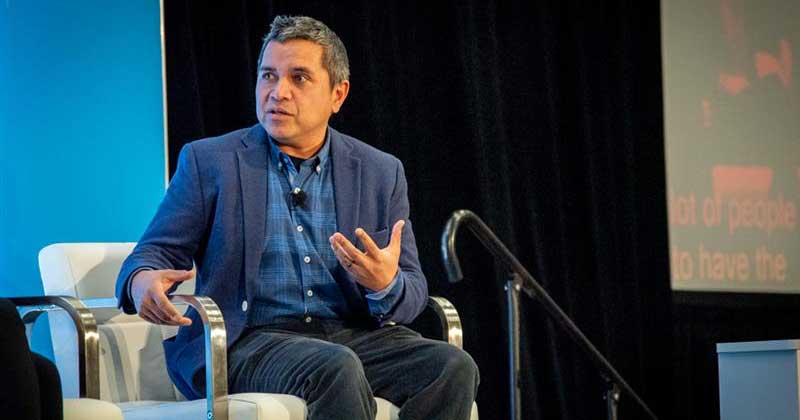
Other ways to limit harm include holding platforms accountable for the design choices they make, making it harder for small groups of users to manipulate online spaces and harass other users, and paying more attention to what people aspire to engage with rather than buying into the myth that what they engage with is actually what they want, according to Ravi Iyer, PhD, managing director at the University of Southern California Marshall School Neely Center. “I don’t think social media is responsible, necessarily, for the entire mental health crisis, but I do think there are ways to design for better mental health,” said Iyer.
In addition, kids need a healthy life off-screen, and could benefit from a longer delay before accessing social media platforms for the first time. “There’s no psychological science that kids’ social relationships or intellectual capacity will be harmed by waiting to be on social media,” said Prinstein.
Improving well-being through science
America is in a mental health crisis—one that can’t be solved simply by training more clinicians. And in many countries around the world, access to mental health care is virtually nonexistent. That’s where digital therapeutics come in.
“There really is no other option,” said Jenna Carl, PhD, a clinical psychologist and chief medical officer at Big Health, a company that develops digital therapeutics. “It’s not feasible to reach the full scale of support that we need just through training more clinicians.”
Digital health interventions run the gamut from wellness apps designed to help with sleep to full-scale clinical treatments for depression and other conditions. Some are delivered in tandem with traditional therapy, while others put patients fully in control.
“What’s really wonderful about these new opportunities is that people can get different levels of support,” because patients often have very different preferences about treatment for mental health concerns, said Sabine Wilhelm, PhD, a professor at Harvard Medical School and director of the Center for Digital Mental Health at Massachusetts General Hospital.
While some patients prefer traditional one-on-one therapy sessions, busy schedules, geographic location, and stigma around mental health care can prevent them from accessing such services.
But not all digital health apps are effective. It can be hard for patients and providers to tell which ones will work, because most are not yet integrated into traditional health care systems. Rigorous research that involves patients from the start is part of the solution, as are research insights and algorithms that can help personalize treatment plans to fit individual needs.
“We want a system that can assess someone at the beginning and match them with the intervention they want that has the highest likelihood of success,” Wilhelm said.
The future of digital gaming
“Teens today really care about issues in the world today, but they feel powerless to do anything about it,” said Alicia Clifton, COO and cofounder of Wicked Saints Studios, which works to apply behavioral science to build games for good.
But teens have power in games, where they can escape from reality and explore a place of their own, Clifton said as part of a panel on gaming for good. “Could the confidence, problem-solving, and happiness they get in a game come with them into the real world?”
She is part of the team behind World Reborn, a mixed-reality fantasy game where gamers’ choices in the digital world merge with real-life missions and coping skills.
Games can be entertainment, art, education—or something in between. But when people can see themselves reflected in games, they can also be a tool for identity development. That’s inspiring some creators to build new storylines that feature groups who are often left out of the gaming world.
Mitu Khandaker, CEO, Glow Up Games; Assistant Professor, New York University, Tisch School of the Arts
“Games have traditionally been developed around a very specific, very limited series of cultural lenses,” said Mitu Khandaker, PhD, CEO of Glow Up Games, a company that builds games that “celebrate Black and brown joy” and elevate diverse voices. “What we’re doing now is basically building a whole new genre of games.”
One universal message from behavior experts: Include young people in game design from the start, said psychologist Susan Rivers, PhD, the executive director and chief scientist of iThrive Games, which designs games that advance learning while promoting mental health.
“If you create a game for young people and don’t ask them what they want, even while continuing to show them what you’re creating, you’re going to fail,” she said.