skip to main content

APA think tank: Advancing educational equity and workforce development in a changing landscape

Psychology leaders convene to develop strategies for expanding access and strengthening the profession’s impact across sectors

APA Style leaf logo Cite This Article in APA Style
American Psychological Association. (2025, August 5). APA think tank: Advancing educational equity and workforce development in a changing landscape. https://www.apa.org/news/apa/2025/educational-equity-think-tank

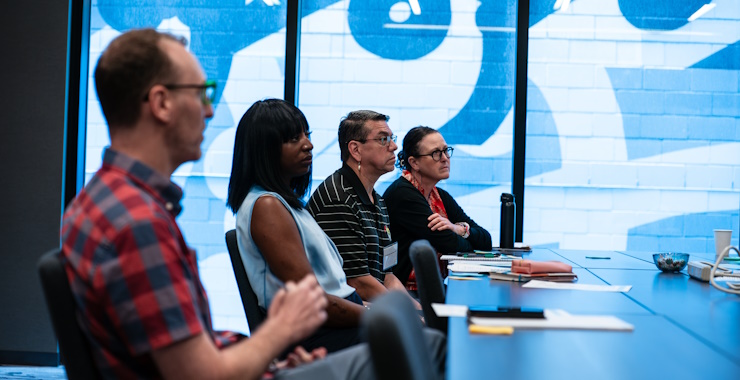
Attendants at the 2025 APA think tank meeting

In July 2025, the American Psychological Association brought together over 50 thought leaders from psychology, education, technology, and philanthropy for its third think tank focused on educational equity and workforce development. The two-day Washington, D.C. convening tackled urgent questions about training, preparing, and positioning psychological professionals to lead across diverse sectors while closing opportunity gaps that have historically limited access to the field.

Building on previous think tanks that addressed health equity and knowledge production, this year’s gathering came at a critical moment as participants grappled with sustaining equity initiatives in an increasingly challenging political and social environment.

Courage in the face of uncertainty

Keynote speaker Akua K. Boateng, PhD, opened the convening with a powerful message about equity-driven leadership in times of adversity. Drawing on the story of a Coast Guard rescue swimmer who saved 165 lives during severe flooding, she challenged participants to embody similar courage in their equity work.

“Courage is most visible in moments of great challenge when the easy choice is to walk away,” Boateng said. “Equity-driven leadership means choosing to stay, to stand alone if necessary, and to move toward those in need even when the waters are rising.”

APA’s leadership team reinforced this message. President Dr. Debra M. Kawahara framed the convening as “more than a meeting” but rather “a moment for us to pause, to reflect and to reimagine.” She emphasized that “the world is changing, and our field must evolve with those changes.”

“The challenges we’re confronting today will undoubtedly reemerge in new forms over time,” said CEO Arthur C. Evans Jr., PhD. “Our task is to think strategically—how do we future-proof our work? How do we embed core principles and values so deeply into our efforts that this work moves forward and continues to evolve, even amid shifting political and social pressures.”

Maysa Akbar, PhD, APA’s chief diversity officer, encouraged participants to embrace the creative tension of the moment: “We can hold both truths at once, discomfort and progress. This moment demands it of us. We’re still here, still doing the work, and we believe in the change we’re building, step by step, together.”


Learning from cross-sector leaders

Day two’s interdisciplinary panel, moderated by Evans, brought essential perspectives from outside traditional psychology. The panelists—political strategist Jalisa Washington-Price, marketing executive Alexis Kerr, and environmental health executive Aja Ladson—illuminated how psychological principles already inform work across sectors.

The power of emotional connection

Kerr emphasized that successful communication isn’t about facts but feelings. “It’s about how we connect. Ultimately, that’s all sales and marketing really is —connections. How am I making you feel comfortable? It’s building your trust.”

Real-time engagement

Washington-Price urged psychologists to engage with policymakers in real-time rather than waiting for post-hoc analyses. “You all are front and center in what we’re going through and how it is affecting people every day,” she noted.

Holistic well-being

Ladson highlighted the growing recognition of psychosocial factors in workplace safety. “The total well-being of an employee is becoming more of a hot topic,” she explained, describing how organizations increasingly need psychological expertise.

Strategic adaptation and resilience

Perhaps the most pressing discussions centered on navigating the current political climate’s impact on equity initiatives. Rather than retreating, participants focused on strategic adaptation.

“Just because the words are gone or the names are gone... that doesn’t stop us from doing the great work that we have already been doing for decades,” Kerr reminded participants.

Washington-Price added historical perspective: “I was reminded by my grandmother that we’ve been here before. We have found our way out.”

The panelists offered practical guidance:

  • Stay focused on your North Star and core mission
  • Build coalitions for collective impact
  • Partner with unexpected allies
  • Remain action-oriented rather than getting stuck in what’s been lost

Key themes and emerging ideas

Through intensive working sessions, participants explored strategies ranging from immediate actions to long-term visions:

Reclaiming the narrative

Groups emphasized the need to articulate psychology’s public value clearly and counter misinformation. Participants discussed ideas like a “Psych Did That” campaign showcasing psychologists in non-traditional roles and partnering with marketing firms to better communicate psychology’s relevance.

Transforming education

Discussions centered on reimagining introductory psychology courses to connect with student passions, creating stronger partnerships between academia and industry, and engaging students earlier. Ideas included embedding psychological science in STEM programs and creating dual-degree opportunities.

Workforce development

Participants stressed the importance of continuing data collection on workforce trends despite current challenges. Groups explored expanding internship opportunities beyond clinical settings and fostering better alignment between training programs and industry needs.

Supporting students and early career professionals

Considerable discussion focused on challenges including funding cuts, lengthy training programs, and navigating politically hostile environments. Participants explored creating support systems and resources, while acknowledging the complexity of implementing systemic changes.

Building forward

The 2025 think tank represents the continuation of APA’s transformative journey that began with its 2021 apology to people of color for perpetuating racism. This systematic approach, grounded in the Racial Equity Action Plan adopted in 2022, demonstrates commitment to sustained action beyond statements.

“Psychology, when it is at its best, is not only a science or a profession, but it is a force for social change,” Akbar reflected. “Can you imagine a world where decisions are made because psychology and behavioral health is at the table guiding and supporting what those decisions should be?”

With over half of APA’s Board of Directors attending, the Think Tank signaled deep organizational commitment. Participants left with renewed purpose and practical strategies for advancing equity in challenging times.

The gathering reinforced that meaningful change requires sustained effort across multiple stakeholders—not just APA, but educational institutions, state associations, individual psychologists, and partner organizations. Despite current challenges, the field of psychology remains committed to its role as a force for positive change, ready to adapt strategies while holding firm to values of equity, inclusion, and human dignity.

Recommended Reading

Speaking of Psychology

Subscribe to APA’s audio podcast series highlighting some of the most important and relevant psychological research being conducted today.

Subscribe to Speaking of Psychology and download via:

Appleopens in new window
Apple podcast logo

Spotifyopens in new window
Spotify logo