

skip to main content
Public Interest

Native American Women’s Firsts

Native American Women’s Firsts in Psychology

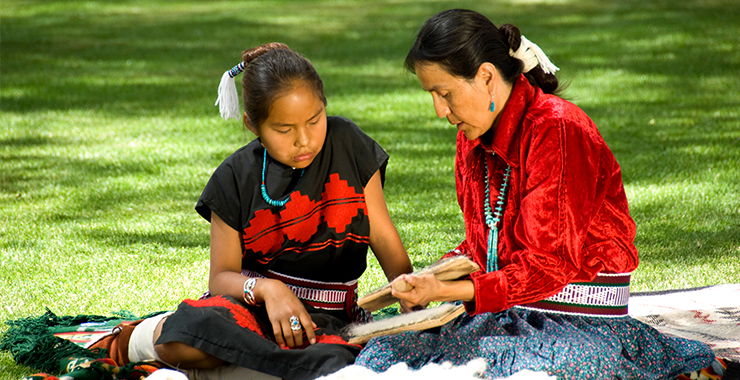
This November, in honor of National Native American Heritage Month, the Ethnicity and Health in America Series will highlight the contributions and accomplishments of Native women in psychology. This month will focus specifically on Native women who were the first to take on leadership roles in their field, and a new profile will be posted every week on the APA Office of Ethnic Minority Affairs’ website in partnership with the I am Psyched! Women Firsts series. There will also be a panel titled I am Psyched! for National Native American Heritage Month hosted by the APA Women’s Program Office, APA Health Disparities Office, and APA Office on Ethnic Minority Affairs. This event will be the fourth in the series, and will be held at the American Psychological Association headquarters on November 28th.

While November was officially declared to be National Native American Indian Heritage month in 1990, the cultures, traditions, and histories of Native peoples have resiliently and boldly existed for thousands of years. This heritage month serves as a time to celebrate the richness and diversity of the Native community; to educate the general public about Native peoples’ existence; and to raise awareness regarding the challenges that Native people face presently and historically.

Native Americans and Alaska Natives are members of the original Indigenous peoples of North America. Today, 573 of these original tribal nations (referred to interchangeably by terms such as tribes, nations, bands, communities and pueblos) are federally recognized as sovereign bodies. Tribal sovereignty constitutes the ability of tribes to self-govern and protect the health, safety and welfare of tribal citizens within tribal territory.1 Currently, there are a number of mental health disparities affecting tribal nations which deserve extra recognition during this month.

Mental Health Disparities Affecting Tribal Nations

Despite Native Americans comprising only about 2 percent of the United States population (approximately 6.1 million people) these communities face rates of psychological distress, depression, suicide and substance abuse disorders at a disproportionately high rate.2

The suicide rate for American Indians/Alaskan Natives of all ages is 16.93 deaths per 100,000 people, which is significantly higher than the overall U.S. rate of 12.08 deaths per 100,000 people.3  Furthermore, suicide is the second leading cause of death among Native American youth between the ages of 10 and 24.4 American Indians/Alaskan Natives also experience PTSD twice as often as the general population, and substance abuse disorders appear more frequently and at younger ages than in any other ethnic group in the U.S.5  Native women face immensely compounded struggles — they suffer from domestic violence and assault at rates far exceeding those of any other ethnicity. Native American women are 2.5 times more likely to be sexually assaulted than women in the general U.S. population, and more than one in three Native women will face sexual violence during her lifetime.6-7

These statistics stress the need for strengthening protective factors in Native American communities. Such factors include effective mental health care; connectedness to individuals, family, community and social institutions; problem-solving skills; contact with caregivers; and cultural continuity, identification and spirituality.8-9 The Indigenous community in the United States continues to work diligently to end the epidemics of youth suicide and missing and murdered indigenous women and girls, among others. National Native American Heritage Month is a great time to expand knowledge about these epidemics and ways to act in solidarity as allies to the Indigenous community. It is essential for the mental health field to be aware of the challenges which so many Native Americans face so that they can best support and aid in their ability to overcome them.

Sources

1 Tribal Nations and the United States: An Introduction. (2015). Washington, DC: National Congress of American Indians, Embassy of Tribal Nations.

2 U.S. Census Bureau, Population Division “Annual Estimates of the Resident Population by Sex, Age, Race Alone or in Combination, and Hispanic Origin for the United States and States: April 1, 2010 to July 1, 2017” Retrieved from https://factfinder.census.gov/faces/tableservices/jsf/pages/productview.xhtml?src=bkmkopens in new window.

3-4 Beals J, Manson SM, Whitesell NR, Spicer P, Novins  DK, Mitchell CM. (2005) Prevalence of DSM‐IV disorders and  attendant help-seeking in 2 American Indian reservation  populations. Arch Gen Psychiatry, 62(1), 99‐108.

5 SAMHSA, HHS. (2007) Results from the 2006 National Survey  on Drug Use and Health. Retrieved from https://files.eric.ed.gov/fulltext/ED498206.pdf.opens in new window

6 Steven W Perry, American Indians and Crime:A BJS Statistical Profile 1992-2002, Bureau of Justice Statistics, US Department of Justice, Office of Justice Programs, December 2004. Retrieved from https://www.bjs.gov/content/pub/pdf/aic02.pdfopens in new window.

7 Tjaden, P. & Thonennes. (2000). The Prevalence, Incidence, and Consequences of Violence Against Women: findings from the National Violence Survey Against Women. National Institute of Justice & the Centers for Disease.

8 U.S. Department of Health and Human Services (HHS) Office of the Surgeon General and National Action Alliance for Suicide Prevention. (2012, September). 2012 National strategy for suicide prevention: Goals and objectives for action. Washington, DC: Author. Retrieved from https://www.surgeongeneral.gov/library/reports/national-strategy-suicide-prevention/full-report.pdfopens in new window.

9 LaFromboise, T. D., Medoff, L., Harris, A., & Lee, C. (2007).  Psychosocial and cultural correlates of suicidal ideation among American Indian early adolescents on a Northern Plains reservation. Research in Human Behavior, 41, 119-143. doi: 10.1080/1542760070181020.

Date created: 2018

Ethnicity and Health in America Series Links