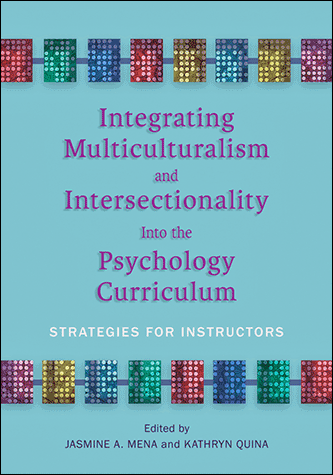
Integrating Multiculturalism and Intersectionality Into the Psychology Curriculum
Available formats
Also available from
Multicultural and intersectional aspects of identity are crucial components of human psychology. Yet, properly teaching and accounting for these factors in psychology courses can be challenging.
In this comprehensive volume, Jasmine A. Mena and Kathryn Quina provide instructors with practical guidance for incorporating multicultural perspectives into their courses and creating more inclusive classrooms.
The contributors are experienced graduate and undergraduate instructors who present effective teaching strategies and activities that encourage students to communicate their viewpoints, learn from each other, challenge their own biases, and expand their worldviews.
Authors examine specific sociocultural groups based on gender, ethnicity, religious beliefs, sexual orientation, and socioeconomic status. They discuss these topics using an intersectional approach, recognizing that individuals are members of multiple groups whose overlapping identities influence their development, social relationships, and worldviews.
Chapters offer recommendations for integrating multiculturalism into core psychology courses, including introduction to psychology classes, which are most undergraduate students' only exposure to psychology.
Contributors
Foreword
Stanley Sue
Foreword
Florence L. Denmark
Acknowledgments
Introduction
Jasmine A. Mena and Kathryn Quina
I. Multiculturalism and Intersectionality in the Psychology Classroom
- Teaching From an Intersectional Perspective: An Overview
Brittney Poindexter and Kathryn Quina - Developing a Culturally Competent and Inclusive Curriculum: A Comprehensive Framework for Teaching Multicultural Psychology
Annemarie Vaccaro - Racial Microaggressions and Difficult Dialogues in the Classroom
Tammy Vargas Warner
II. Gender, Ethnic, and Sociocultural Perspectives: Specialized Courses and Content Areas
- Who Is the Woman in the Psychology of Women? Addressing Diversity and Intersectionality
Beverly J. Goodwin, Camille J. Interligi, Ashley E. Kasardo, Maureen C. McHugh, and Andrea D. Poet - Intersectionality in Teaching the Psychology of Men
Christopher Kilmartin - Integrating Lesbian, Gay, Bisexual, Transgender, and Queer Issues in the Psychology Curriculum
Jacqueline S. Weinstock - Psychology of Asian Americans
Connie S. Chan and Kattalina Berriochoa - Teaching Africana Psychology
Lisa Whitten, Halford H. Fairchild, and Harriette W. Richard - Teaching Latinx Psychology
Jasmine A. Mena and Melba J. T. Vásquez - Weaving American Indian and Alaska Native Topics Into the Psychology Curriculum
Joseph E. Trimble and Gayle Skawen:nio Morse - Intersections Among Religion, Culture, Gender, and Mental Health
Kate Miriam Loewenthal - Disability as an Intersectional Diversity Variable in the Psychology Curriculum
Julie L. Williams - Teaching About Poverty and Social Class: Fostering Class Consciousness
Heather E. Bullock and Bernice Lott - Teaching Cultural and Transnational Psychology: Taking Intersectionality Across the Globe
Lynn H. Collins - Nontraditional Students: Multigenerational, Multilocational, and Multicultural
Mary Zahm and Kathryn Quina
III. Integrating Diversity Into General Psychology Courses
- The Introductory Psychology Course From a More Diverse Human Perspective
Su L. Boatright-Horowitz, Savannah McSheffrey, Marisa E. Marraccini, and Yvette Harps-Logan - Teaching Personality and Abnormal Psychology With Inclusivity
Alice W. Cheng, Kathy McCloskey, and Mala L. Matacin - Teaching Developmental Psychology: Celebrating the Dialectics of Development
Kathleen S. Gorman and Celeste M. Caviness - Overcoming Student Defensiveness in Social Psychology Courses: A Collaborative Workshop for Discussing Privilege and Prejudice
Andrea L. Dottolo - Multicultural Considerations in the Psychology Research Methods Course
Jasmine A. Mena, Nathan E. Cook, and Kathryn Quina - Teaching Biopsychology: Multicultural Findings and Implications
Lisa Weyandt, Danielle R. Oster, Bergljot Gyda Gudmundsdottir, and Meghan Lamarre Rinaldi-Young - Teaching Critical, Multivocal Histories of Psychology: Uncovering Diversity
Kelli Vaughn-Johnson and Alexandra Rutherford - Including Social Determinants of Health Disparities in Health Psychology
Colleen A. Redding and Miryam Yusufov - Diversity Education in Professional Psychology
Kathleen A. Malloy, Julie L. Williams, LaTrelle D. Jackson, Janeece R. Warfield, and Steven Kniffley
Index
About the Editors
Jasmine A. Mena, PhD, is an assistant professor of psychology and Latin American Studies Program affiliate at Bucknell University. She received her doctorate in clinical psychology from the University of Rhode Island.
Her research examines the influence of culture and discrimination on mental and physical health and wellness. She has numerous publications that center on her research interests and use qualitative, quantitative, and mixed methods in community settings.
She is the recipient of various honors, including an Association for Academic and University Women Research Leave Fellowship, Emerging Professional—Contributions to Service Award (APA Division 45), and Association for Women in Psychology Annual Women of Color Psychologies Award.
As a licensed clinical psychologist, the ultimate goal of her research is to develop and implement interventions to improve the health and wellness of vulnerable and underserved populations in the community and underrepresented students, faculty, and staff in higher education.
Jasmine Mena lives in Lewisburg, PA.
Visit the Multicultural Psychology Labopens in new window website.
Kathryn ("Kat") Quina, PhD, is Emerita Associate Dean and professor of psychology and gender and women's studies at the University of Rhode Island. She received her doctorate in experimental psychophysics from the University of Georgia, but soon after entering academia, she discovered feminist psychology and left the literally dark world of her vision lab to shed light on issues of gender and trauma.
For most of her academic career, her research has related to women and gender, with a primary focus on the sequelae of sexual abuse, including funded research on women's HIV risk and incarceration.. As psychology coordinator and advisor, and subsequently associate dean, of the University of Rhode Island's College of Continuing Education, she studied and championed adult and nontraditional students, directing programs and funded projects that enhance minority and immigrant success in adult education.
Dr. Quina has coauthored or coedited six books and numerous articles, including coediting two previous volumes on teaching psychology from a multicultural perspective, and has received local and national awards for her mentorship, teaching, research, and service in feminist and multicultural psychology.
Kat Quina lives in Hope, RI.
Visit the Kathryn Quina | Department of Psychologyopens in new window page on the University of Rhode Island website.
Cultural competency is one of the most important skills students will need after graduation. This book is an instructor's best resource for determining how to teach about diversity, equity, inclusion, and intersectionality in psychology.
—Kathryn Becker-Blease, PhD
Director, School of Psychological Science, Oregon State University, Corvallis
In this timely book, Mena and Quina have assembled an outstanding cadre of professionals who present valuable suggestions for integrating diversity and multiculturalism into the psychology curriculum. They also provide advice on how to manage difficult conversations around topics that are often laden with emotion.
—Ana J. Bridges, PhD
Professor of Clinical Psychology, University of Arkansas, Fayetteville
Supplemental resources require an APA account and approval from APA to access. Please create or log inlogin required to your account and return to this page to download materials. Please note: After logging in, you may still need to be approved by APA staff to access secure content.