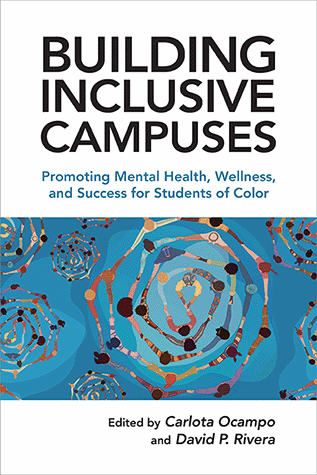
Building Inclusive Campuses
This guide equips faculty, administrators, and psychologists in higher education with practical strategies for initiating institutional, curricular, and classroom reforms that will create academic communities where all students can thrive.
Mental health and emotional wellness are central to retention, persistence, and learning, yet longstanding structural barriers and embedded biases continue to undermine these outcomes for students of color. When schools fail to address these conditions, the costs are felt across the campus—in student success, faculty workload, and institutional effectiveness. Meaningful improvement only comes faculty and staff transforming the institutional culture from within.
Drawing from empirical research and their own successful reform initiatives, an expert panel of educators, faculty, and educational and consulting psychologists describe actionable strategies for creating this change. They advocate trauma-informed leadership that recognizes student adversity; acknowledges institutional shortcomings; and creates a supportive, collaborative, and empowering school community with culturally responsive policies and student services.
Contributors provide guidelines for restructuring curricula to build a student-centered learning environment that capitalizes on students' strengths. These include creating more opportunities to engage in academia through mentorship, experiential learning, and intergroup dialogues and caucuses. At the classroom level, contributors discuss how to address microaggressions and macroaggressions and handle conversations about difficult subjects.
Whether you work in STEM or the humanities, at a large research university or a small liberal arts college, you will find concrete steps to initiate lasting change that will help not just students of color succeed but create a campus-wide culture of wellbeing that benefits everyone.
Contributors
Introduction: Why Supporting Students of Color Matters
Carlota Ocampo and David P. Rivera
Part I. The Problem Is Us, Not "Them": Transforming Leadership, Policy, and Systems
- Chapter 1. Unproblematizing Students of Color: Applying Liberation Psychology and Theory as a Framework for Student Success
Carlota Ocampo and David P. Rivera - Chapter 2. Student Perceptions of Belonging From the Healthy Minds Study: Understanding the Problem to Frame the Solution
Sasha Zhou and Akilah Patterson - Chapter 3. The Excellence in Mental Health on Campus Initiative: An Example of Evidence-Based Campus Transformation
Cirleen DeBlaere and Becky Wai-Ling Packard
Part II. Inside the Curriculum: Inclusive Excellence and Belongingness Create Educational Impact
- Chapter 4. "I Belong Here": How a Science Faculty Started an Inclusive Excellence Revolution and Revitalized Its Majors
Patrice E. Moss, Cynthia DeBoy, Mia Ray, and Kaitlin R. Wellens - Chapter 5. A Pedagogy of Belonging: Advancing an Equity-Centered Model of Transformation and Representation in Higher Education
Diane Forbes Berthoud - Chapter 6. From Dialogue to Flourishing: Centering Belonging and Well-Being Through Intergroup and Caucus Dialogue
Courtney J. Jones Carney - Chapter 7. The Role of the Counseling Center in Creating Culturally Responsive and Inclusive Programming
Batsirai Bvunzawabaya
Part III. Transforming Classroom Experiences: From Stressed and Depressed to Engaged, Energized, and Doing the Best
- Chapter 8. Microaggressions and Macroaggressions: How Can We Respond?
David P. Rivera - Chapter 9. Managing Difficult Conversations and Recognizing Student Distress: Best Practices for the Classroom and Cocurricular Programs
Carlota Ocampo, Sarah Young, Anne Cosimano, and Karen Gerlach - Chapter 10. We Must First Heal Ourselves: Promoting Faculty Mental Health and Wellness Among Faculty and Staff of Color
Cirleen DeBlaere, Zoeann Finzi-Adams, and D'Asha Barnes Daniels
Part IV. Future Directions: What's Next and What's Needed
- Chapter 11 Capacity Building, Sustainability, and Trauma-Informed Leadership Principles for Supporting Student of Color Mental Health
David P. Rivera and Jeanne Manese
Index
About the Editors
Carlota Ocampo, PhD, is provost and CAO at Trinity Washington University in Washington, DC, a predominantly Black and Hispanic-serving women's college, where she implements student-centered initiatives to support flourishing. A neuropsychologist, her APA work includes serving on the Leadership Institute for Women in Psychology advisory council and task forces on teaching and assessment; she was also an American Psychologist predoctoral fellow. On the board of The Steve Fund, she was a national advisor for the Excellence in Mental Health Framework. Her research interests encompass diversity, inequity, health, racist incident-based trauma, and pedagogical reform with changing student populations. Visit her on LinkedInopens in new window.
David P. Rivera, PhD, is associate professor and coordinator of graduate programs in mental health and school counseling at Queens College, City University of New York, and is founding director of the LGBTQI Student Leadership Program. His research, guided by critical theories and social justice, explores cultural competency and the wellbeing of marginalized communities. He coedited the award-winning books Affirming LGBTQ+ Students in Higher Education and Critical Theories for School Psychology and Counseling. Dr. Rivera holds leadership positions with The Steve Fund, the Society for the Psychology of Sexual Orientation and Gender Diversity, and the Council for Opportunity in Education.
In Building Inclusive Campuses, editors and thought leaders Ocampo and Rivera provide concrete inclusion strategies that are enhanced by their knowledge of liberation psychology, trauma-informed education, and sustainable development. Every campus leader committed to equity and belonging will benefit from this thoughtful resource.
—Thema Bryant, PhD, coauthor of The Antiracism Handbook: Practical Tools to Shift Your Mindset and Uproot Racism in Your Life and Community; Professor, Graduate School of Education and Psychology, Pepperdine University, Los Angeles, CA; 2023 President, American Psychological Association
A must-read for anyone working in higher education! This timely and impactful book speaks to the evolving landscape of higher education, offering essential insights into the complex challenges faced on campuses today. It provides critical information for advancing inclusion, mental health, and student success, particularly for students of color, at both the structural and systemic levels.
—Debra M. Kawahara, PhD, 2025 President, American Psychological Association; Interim Academic Dean, California School of Professional Psychology, Alliant University, San Diego
This is a timely and important contribution to higher education. What makes this book compelling is the authors’ ability to combine passion and practicality. Grounded in a thoughtful, systems-focused lens, it not only illuminates the experiences and needs of students of color but also provides data-informed strategies and actionable tools for educators, administrators, and campus partners. It is an engaging and deeply useful resource for anyone committed to moving beyond good intentions and toward meaningful, responsive, and collaborative support for student success.
—Meeta Kumar, PhD, Assistant Vice President for Student Wellness, University of Chicago, Chicago, IL
This book gets at something most campus mental health resources miss—that student well-being isn’t just about counseling services; it’s about transforming everything from our leadership mindset to what happens inside our classrooms. Ocampo and Rivera don’t let institutions off the hook by pathologizing students; instead, they show us how to build campuses where students of color can move from stressed and depressed to genuinely engaged and doing their best work.
—Hollie M. Chessman, PhD, Director and Principal Program Officer, American Council on Education
This text serves as a robust resource for educators committed to creating inclusive, trauma-informed, and healing-centered spaces for students. This book provides extensive evidence to support the need for transformative practices in higher education as well as numerous examples of what these practices could look like on our campuses.
—Jayne K. Sommers, PhD, Associate Professor, Educational Leadership, University of St. Thomas, Minneapolis, MN