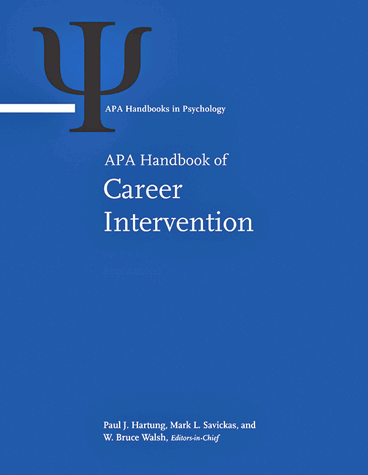
APA Handbook of Career Intervention
Available formats
Part of the landmark APA Handbooks in Psychology® Series from APA
The two-volume APA Handbook of Career Intervention aims to consolidate and advance knowledge about the scientific foundations and practical applications of career intervention. It offers an inclusive resource for understanding and applying principles and practices of career intervention to assist diverse individuals and groups across developmental stages to construct personally meaningful and socially relevant work lives.
The handbook presents information about the historical, contemporary, theoretical, demographic, assessment-based, and professional foundations of career intervention (Volume 1), as a well as specific career intervention models, methods, and materials within each career service noted above and applied to easing career transitions (Volume 2).
In whole or in part, the Handbook aims to be useful to researchers, practitioners, educators, consultants, policy-makers, and students alike across a full array of professions including psychology, counseling, education, and business and industry. Chapter authors are recognized experts in fields ranging from vocational psychology, career development, and industrial and organizational psychology to rehabilitation counseling and higher education. Their collective works examine career intervention within core career theory and practice traditions (i.e., person–environment [P-E] fit, life span development, social cognition and learning, and life–career design) and across the full range of career services (i.e., guidance, education, life design, placement, and coaching) that professionals provide in educational, private practice, community-based, rehabilitation, and other settings.
Volume 1: Foundations
Editorial Board
About the Editors-in-Chief
Contributors
Series Preface
Introduction
I. Past and Prologue
- Career Intervention: From the Industrial to the Digital Age
Mark Pope - Contemporary Conceptualizations of Career
Kerr Inkson - Career Counseling Process and Outcome
Susan C. Whiston and Ciemone S. Rose - Career Intervention Efficacy: Making a Difference in People's Lives
Steven D. Brown
II. Theoretical Perspectives
- Person–Environment Fit
Rong Su, Chris Murdock, and James Rounds - Life Span Career Development
Susan D. Phillips - A Social Cognitive Perspective on Career Intervention
Hung-Bin Sheu and Robert W. Lent - Career Counseling Paradigms: Guiding, Developing, and Designing
Mark L. Savickas - Relationships and Career Development: An Integrative Approach
Hanoch Flum - Environments: Diversity in Theoretical Foundations of Career Intervention
ZiYoung Kang and Gary D. Gottfredson
III. Demographic Considerations
- Children and Adolescents
Justin C. Perry and Eric W. Wallace - Women, Men, and Change: The Role of Career Interventions
Mary J. Heppner and Ae-Kyung Jung - Career Interventions With Racial and Ethnic Minority Clients
Frederick T. L. Leong and Lisa Y. Flores - Social Class and Career Intervention
David L. Blustein, Saliha Kozan, Alice Connors-Kellgren, and Bailey Rand - Immigrant Workers: Career Concerns and Barriers
Donna E. Schultheiss and Brittan L. Davis
IV. Assessment
- Meaning, Measurement, and Assessment of Vocational Interests for Career Intervention
Sandro M. Sodano - Intellectual Abilities for Counseling Interventions, Practice, and Theory: Dismissing Their Significance for Learning and Work Constitutes Malpractice
Harrison J. Kell and David Lubinski - Personality Assessment and Career Interventions
Jérôme Rossier - Process Variables: Maturity, Identity, Decision-Making, and Adjustment
Peter A. Creed and Michelle Hood
V. Professional Context
- Training and Supervision in Career Counseling
Nicholas Ladany and Tiffany O'Shaughnessy - Standards, Competencies, and Guidelines in Career Interventions
Cindy L. Juntunen and Erin L. Martin - Psychotherapy, Counseling, and Career Counseling
Peter McIlveen - Professional Development: Who We Are and What We Do
Jane Goodman and Mary L. Anderson
Index
Volume 2: Applications
Editorial Board
I. Guiding
- Test Interpretation: Talking With People About Their Test Results
Donald G. Zytowski - Person Matching for Career Exploration and Choice
Stephanie T. Burns - Integrative Approaches to Career Intervention
Patrick J. Rottinghaus and Alec J. Eshelman - Using Holland's Theory to Assess Environments
ZiYoung Kang and Gary D. Gottfredson - Using Information and Communication Technology in Delivering Career Interventions
James P. Sampson Jr. and Debra S. Osborn - Card Sorts, Sentence Completions, and Other Qualitative Assessments
Robert C. Chope - Academic Advising
Leigh S. Shaffer
II. Developing
- Enhancing Future Time Perspective and Exploring Occupational Possible Selves
Brian J. Taber - Assessing Children: Interests and Personality
Terence J. G. Tracey and Sandro M. Sodano - Promoting Interest in and Entry Into Science, Technology, Engineering and Mathematics Careers
Marie F. Shoffner and Donna J. Dockery - Vocational Rehabilitation Counseling
Phillip D. Rumrill Jr. and Lynn C. Koch - Fostering Career Exploration
Raysen Cheung - Self-Efficacy Beliefs
Mindi N. Thompson and Stephanie R. Graham - Measuring and Assessing Career Maturity and Adaptability
Kevin Glavin - Making Better Career Decisions
Itamar Gati and Nimrod Levin - Leisure
Howard E. A. Tinsley and Diane J. Tinsley
III. Designing
- Life Themes and Narratives
J. G. Maree - Identity Development
Alan Brown and Jenny Bimrose - Using Audience to Foster Self-Narrative Construction and Career Adaptability
Jennifer J. Del Corso and Hande Sensoy Briddick - Thinking About Vocational Choice
Emily Bullock-Yowell, Denise E. Saunders, and Gary W. Peterson - Practical Career Counseling Applications of the Happenstance Learning Theory
John D. Krumboltz - Using Metaphor in Career Intervention
Norman E. Amundson - Strategies for Discerning and Living a Calling
Bryan J. Dik and Ryan D. Duffy
IV. Placing
- Evidence-Based Job Search Interventions for Unemployed Workers and Youth
Jukka Vuori and Richard H. Price - Employability
Andrew T. Rothwell - Networking
Susan Shortland - Understanding Postsecondary Options: Guiding the Decision-Making Process
Mark A. Kretovics and Tracy M. Lara
V. Coaching
- Mentoring in Postsecondary Education and Organizational Settings
Lillian T. Eby and Erin Dolan - Coaching
Jesse Segers, Nicky Dries, and Dirk Versées - The Synergy Project: A Group Career Counseling Intervention to Enhance Work–Family Management
Rachel Gali Cinamon - Top-Down and Bottom-Up Interventions to Increase Work Engagement
Arnold B. Bakker - Promoting the Work Adjustment of Late-Career Employees
Barbara Griffin - Job Satisfaction, Job Performance, and Success
Donald E. Eggerth
VI. Transitioning
- Individualized Career Plans: Helping Youth Create Successful School-to-Work Transitions
Chris Wood and Heather Dahl - Emerging Adult Career Transitions
José F. Domene, Jeffrey Landine, and John Stewart - Facilitating Midcareer Transitions
Michael E. Hall and Barbara H. Suddarth - Fostering Career Management Using Career Anchor Theory
Jared R. Chapman - Consultation in Litigation
Michael Shahnasarian - Career Interventions: Retirement
Joanne K. Earl, Alexa Muratore, Cindy Leung, and Tin Wei Yu
Index
Paul J. Hartung, PhD, is a professor of family and community medicine at Northeast Ohio Medical University and adjunct professor of counseling at the University of Akron. He has authored more than 75 journal articles and book chapters and edited two books dealing with career development, assessment, and counseling.
He is the current editor of The Career Development Quarterly and also serves on several editorial boards including the Journal of Vocational Behavior, Journal of Career Assessment, and Journal of Counseling and Development.
He is a fellow of APA Division 17 (Society of Counseling Psychology) and the National Career Development Association. In 2009, he received the APA Division 17 John L. Holland Award for Outstanding Achievement in Career and Personality Research. He currently serves as U.S. national liaison to the International Association of Applied Psychology (IAAP Division 16, Division of Counseling Psychology).
Mark L. Savickas, PhD, is professor of family and community medicine at the Northeast Ohio Medical University and adjunct professor of counselor education at Kent State University.
He is president of International Association of Applied Psychology (IAAP) Division 16 (Division of Counseling Psychology; 2011–2014) and serves as a visiting professor at the University of Pretoria (South Africa; 2012–2014) and at the Institute for Employment Research at Warwick University (United Kingdom; 2013–2016).
His 80 articles, 40 book chapters, and 500 presentations to professional groups have dealt with vocational behavior and career counseling. He edited The Career Development Quarterly (1991–1998) and is currently editor of the Journal of Vocational Behavior (1999–present).
He received the APA Division 17 (Society of Counseling Psychology) John Holland Award for Outstanding Achievement in Career and Personality Research (1994) and the Leona Tyler Award for Distinguished Contributions in Counseling Psychology (2011). In 1996, he received the Eminent Career Award from the National Career Development Association.
He is a fellow of the American Counseling Association, APA, Association for Psychological Science, and National Career Development Association. He has received honorary doctorates from the University of Lisbon (Portugal) and the University of Pretoria (South Africa).
W. Bruce Walsh, PhD, is a professor emeritus in the Department of Psychology at The Ohio State University.
He is the founder and charter editor of the Journal of Career Assessment. He has coauthored and coedited 24 books and 150 journal articles.
In 1998, he served as president of APA Division 17 (Society of Counseling Psychology) and in 2010 as president of APA Division 34 (Society for Environmental, Population and Conservation Psychology).
From 1990 to 2002 he served as the director of training for the Counseling Psychology Program at Ohio State.
In 2004, he received the Leona Tyler Award for Distinguished Contributions in Counseling Psychology from APA Division 17 in recognition of outstanding accomplishments. In 2011, he received the W. James Cossé Distinguished Service Award from the American Academy of Counseling Psychology for extraordinary contributions to scholarly research and the professional practice of counseling psychology.
He holds fellow status in APA and Association for Psychological Science, and is licensed as a psychologist in Ohio.
The two-volume APA Handbook of Career Intervention represents an important addition to this field. The work is comprehensive and well organized, successfully interweaving historical, theoretical, and applied themes throughout the chapters. The authors of the chapters represent knowledge and skilled professionals, well matched to their topics. The editors have done an outstanding job of making these chapters coalesce into a meaningful whole, rather than appearing as a disjointed set of interesting topics.
—PsycCRITIQUES