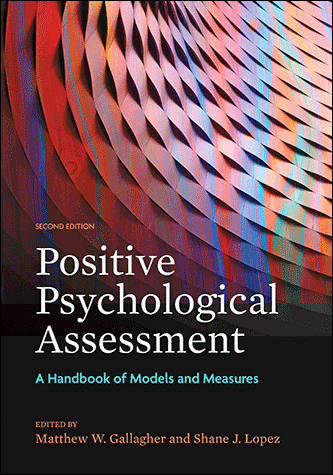
Positive Psychological Assessment
Available formats
Also available from
This book is a primer for practitioners and researchers striving to incorporate the assessment of human strengths, resources, and fulfillment into their work.
Contributors examine the scientific underpinnings and practical applications of measures of hope, optimism, self-efficacy, problem-solving, locus of control, creativity, wisdom, courage, positive emotion, self-esteem, love, emotional intelligence, empathy, attachment, forgiveness, humor, gratitude, faith, morality, coping, well-being, and quality of life.
Vocational and multicultural applications of positive psychological assessment are also discussed, as is the measurement of contextual variables that may facilitate the development or enhancement of human strengths.
This new edition includes updated research and extensive case studies that offer concrete examples of how to use these tools in clinical practice.
Contributors
Foreword
Michael L. Wehmeyer
I. Searching for the Positive
- Introduction to Positive Psychological Assessment
Matthew W. Gallagher - Striking a Vital Balance: Developing a Complementary Focus on Human Weakness and Strength
Shane J. Lopez, C. R. Snyder, Heather N. Rasmussen, and Brian P. Cole - Measuring and Labeling the Positive and the Negative
Lisa M. Edwards, Jennifer Teramoto Pedrotti, Ashley Faytol, Jesse Wynn, C. R. Snyder, and Shane J. Lopez - Assessment of Positive Psychology Constructs Across Cultures
Lisa Y. Flores and Hang-Shim Lee
II. Cognitive Models and Measures
- Optimism
Charles S. Carver and Michael F. Scheier - Hope
Matthew W. Gallagher, Jennifer Teramoto Pedrotti, Shane J. Lopez, and C. R. Snyder - Measuring Career and Occupational Self-Efficacy
Karen M. O'Brien, Monica S. Kearney, and Elizabeth Sauber - Creating a Positive Life: The Role of Problem-Solving Appraisal
Puncky Paul Heppner, Mary J. Heppner, Yu-Wei Wang, and Dong-Gwi Lee - Measuring Creativity in Research and Practice
Barbara A. Kerr and Olivia A. Stull - The Assessment of Wisdom-Related Performance
Ursula M. Staudinger and Bernhard Leipold - Conceptualizing Courage
Christie L. Kelley, Hannah J. Murphy, Chad R. Breeden, Benjamin P. Hardy, Shane J. Lopez, Kristin Koetting O'Byrne, Stephanie Petersen Leachman, and Cynthia L. Pury
III. Emotional Models and Measures
- Measuring Positive Emotions
Louis Tay, Ed Diener, Richard E. Lucas, and Randy J. Larsen - Assessing Self-Esteem
Carrie L. Wyland and Emily S. Shaffer - Measuring Love
Susan S. Hendrick and Clyde Hendrick - Measuring Emotional and Personal Intelligence
David R. Caruso, John D. Mayer, Victoria Bryan, Kimberly G. Phillips, and Peter Salovey
IV. Interpersonal Models and Measures
- Empathy
Qing Zhou, Nancy Eisenberg, and Carlos Valiente - Adult Attachment Security
Frederick G. Lopez - Forgiveness
Laura Y. Thompson and C. R. Snyder - Humor
Rod A. Martin - Gratitude
Robert A. Emmons, Jeffrey Froh, and Rachel Rose - Moral Judgment Maturity: From Clinical to Standard Measures
John C. Gibbs, Karen S. Basinger, Rebecca McDonald, and Dasom Lee
V. Models and Measures of Positive Processes and Outcomes
- Measuring Religious Constructs: A Hierarchical Approach to Construct Organization and Scale Selection
Jo-Ann Tsang, Robert D. Carlisle, and Michael E. McCullough - Vocational Psychology Assessment: Positive Human Characteristics Leading to Positive Work Outcomes
Christine Robitschek and Matthew W. Ashton - Measuring Satisfaction and Meaning at Work
Michael F. Steger, Bryan J. Dik, and Yerin Shim - Defining, Measuring, and Applying Subjective Well-Being
Jeana L. Magyar and Corey L. M. Keyes
VI. Looking Ahead
- The Future of Positive Psychological Assessment: Making a Difference
Matthew W. Gallagher, Shane J. Lopez, and C. R. Snyder
Index
About the Editors
Matthew W. Gallagher, PhD, is an associate professor in the Department of Psychology and Texas Institute for Measurement, Evaluation, and Statistics at the University of Houston.
Dr. Gallagher received his PhD in clinical and quantitative psychology from the University of Kansas. He completed a postdoctoral fellowship at the Center for Anxiety and Related Disorders at Boston University and was previously a staff research psychologist in the Behavioral Science Division of the National Center for PTSD.
His research interests include understanding how positive thinking (e.g., hope, optimism, self-efficacy) promotes well-being and provides resilience to anxiety and stress disorders, identifying mechanisms of change of empirically supported treatments, evaluating the efficacy of transdiagnostic treatments for anxiety and stress disorders, and the development and validation of measures of positive psychological characteristics and emotional disorder symptomatology.
His research has been funded by the National Institute of Mental Health, the National Institute of Drug Abuse, the National Institute of Alcohol Abuse and Alcoholism, and the Department of Defense. His research has won awards from the Association for Psychological Science and the Society for Multivariate Experimental Psychology.
Dr. Gallagher is the author of more than 100 articles, chapters, and books, including the Oxford Handbook of Hope (with Shane J. Lopez), and is a licensed psychologist.
Dr. Gallagher lives in Houston, Texas.
Visit Matthew W. Gallagher, PhD - University of Houstonopens in new window.
Shane J. Lopez, PhD, was a Gallup Senior Scientist and research director of the Clifton Strengths Institute.
Dr. Lopez received his doctorate in counseling psychology from the University of Kansas and was previously a faculty member in the Counseling Psychology Program at the University of Kansas. He was a fellow of APA and the International Positive Psychology Association.
His research focused on developing and disseminating hope and strengths promotion programs in schools, examining the impact of hope on engagement and well-being across the life span, and refining a model and measures of psychological courage. He was the chief architect of the Gallup Student Poll, a measure that has been used to assess the hope, engagement, and well-being of more than 5 million students.
He published more than 100 articles and chapters, and wrote or edited more than a dozen books, including Making Hope Happen: Create the Future You Want for Yourself and Others, The Oxford Handbook of Hope, The Oxford Handbook of Positive Psychology, and Positive Psychology: The Scientific and Practical Explorations of Human Strengths.
He won multiple awards for teaching and mentoring and was a licensed psychologist.
Among the strengths of this multi-author volume are its excellent discussions of the complexity of defining and measuring what might be mistaken for simple psychological characteristics. Further, contributors present an array of scales for measuring the particular traits they discuss. Each chapter also provides an updated review of both research and theory that in turn supports new research developments and theoretical refinements… Highly recommended.
—Choice
There are very important themes in this book — uncovering hidden resources, the power of measuring, and understanding the whole person. The authors explore topics thoroughly and with a high degree of mission.
—Connie Rath, EdD
President, Clifton Foundation, Washington, DC