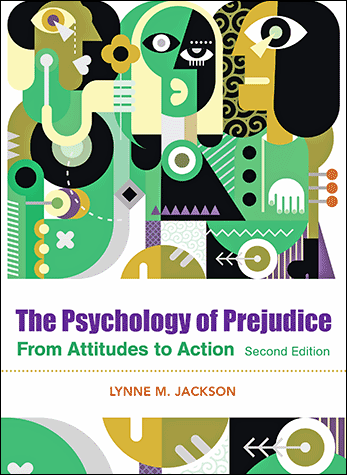
The Psychology of Prejudice
Available formats
Also available from
Given the weaponization of cultural and ideological differences in politics, education, and social media today, the need to understand and fight prejudice is urgent.
This second edition of Lynne Jackson's seminal text presents a significantly updated review of the psychological underpinnings of prejudicial attitudes and behaviors. Jackson synthesizes new research from various areas of psychology to analyze contemporary examples of prejudice, including anti-immigrant policies, police violence against minorities, anti-woman and LGBTQ backlash, and ageist cultural biases. She also explores frequently overlooked issues related to prejudice, such as environmental inequality and speciesism.
Drawing from literature in social, developmental, evolutionary, and personality psychology, Jackson explores the environmental and biological roots of prejudice, explaining how societal factors and human predispositions shape how people understand and respond to diversity. She draws connections between prejudice and other social justice issues, showing how it is related to greater social problems like inequality and political polarization.
She also offers readers a blueprint for overcoming these deeply embedded biases by improving intergroup attitudes and building communities to create progressive social change.
Acknowledgments
Introduction
- Defining Prejudice
- Defining Differences
- The Evolutionary Perspective
- Psychodynamic and Personality Approaches
- Ideology and Prejudice
- Intergroup Relations and Prejudice
- The Development of Prejudice in Children
- Dynamics of Prejudice
- Creating Change
- A Wider Lens
References
Index
About the Author
Lynne M. Jackson, PhD, is an associate professor in the Department of Psychology at King’s University College at Western University, London, Ontario, Canada.
She has published widely on issues related to prejudice, including gender discrimination, attitudes toward immigrants and immigration, and religious intergroup relations.
Her current research examines how people’s attitudes toward other groups, the environment, and non-human animals function collectively to challenge or sustain inequality and exploitation.
Visit the King’s University College faculty pageopens in new window for more information.
This much-needed textbook will be greeted enthusiastically by students and professors alike. Jackson adopts a refreshing conversational style, using a wide lens to explore the problem of prejudice in its complexity. This unique book links prejudice to bullying, collective action, environmentalism, and animal rights, while also highlighting prejudice in action.
—Gordon Hodson, PhD
Department of Psychology, Brock University, St. Catharines, Ontario, Canada
In this comprehensive and sophisticated, yet highly accessible volume, Jackson conveys prejudice’s complexities, providing vivid and timely examples. She sensitively covers current controversies in the field while maintaining a consistent, engaging narrative flow. Highly recommended as the main text for undergraduate courses on prejudice.
—Peter Glick, PhD
Henry Merritt Wriston Professor in the Social Sciences at Lawrence University, Appleton, WI