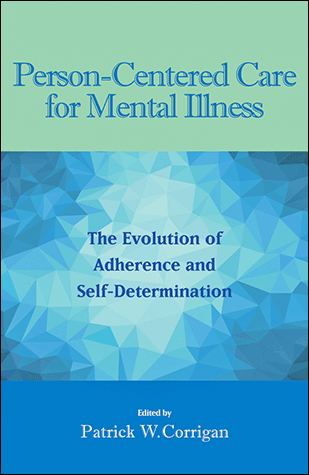
Person-Centered Care for Mental Illness
Many people with serious mental illnesses opt to not seek mental health services, or drop out of interventions early. As a result, their condition may become more disabling. In the past, mental health professionals considered this behavior to be a failure to comply with or adhere to treatment. Such adherence plans are, however, at odds with emerging empirical research and modern philosophies of recovery and personal empowerment.
Using the latest outcomes research, authors in this volume show that having control over one's life goals and treatment plan is essential to clients' recovery. They also demonstrate how person-centered care can take place across various contexts, including mandated treatment, psychotherapy, medication management, supported employment, family education, complementary medicine, and peer support.
Readers will familiarize themselves with practices that enhance self-determination among people with serious mental illness. These include collaborative goal setting, motivational interviewing, and creating psychiatric advance directives. Also reviewed here are cognitive behavioral and rehabilitative interventions that help people with information processing difficulties to better understand their health options.
In the new person-centered care environment, recently codified in the Affordable Care Act, people are seen as consumers of mental health services rather than patients who must comply with doctor's orders. The ideas presented in this volume are the future of care for the seriously mentally ill.
Contributors
Acknowledgments
Introduction
Patrick W. Corrigan
- The Problem of Adherence and the Importance of Self-Determination
Patrick W. Corrigan, Kristin Kosyluk, and Petra Kottsieper - Beyond the Rational Patient: Implications for Health Decisions and Behaviors
Patrick W. Corrigan, Karina J. Powell, and Patrick J. Michaels - How Does Stigma Impede Adherence and Self-Determination?
Patrick W. Corrigan and Andrea B. Bink - Person-Centered Care
Larry Davidson, Janis Tondora, Rebecca Miller, and Maria J. O'Connell - Psychiatric Advance Directives
Maria J. O'Connell - Shared Decision Making
Beth Angell, Elizabeth Matthews, Victoria Stanhope, and Michael Rowe - Increasing Employment Motivation for Individuals With Psychiatric Disabilities
Jonathon E. Larson - Cognitive Approaches That Impact Self-Determination
Patrick J. Michaels, Karina J. Powell, and Patrick W. Corrigan - Self-Determination Within the Context of Legally Mandated Treatment
Amy C. Watson - Peer Support and Service Engagement
Mark S. Salzer and Petra Kottsieper - Self-Determination and Cultural Considerations: An Asian Perspective
Eun-Jeong Lee, Chow Lam, and Nicole Ditchman - Critical Last Thoughts About Self-Determination and Recovery
Patrick W. Corrigan
Index
About the Editor
Patrick W. Corrigan, PsyD, is Distinguished Professor of Psychology at the Illinois Institute of Technology. Previously, he was professor of psychiatry at the University of Chicago, where he directed the Center for Psychiatric Rehabilitation.
His research examines psychiatric disability and the impact of stigma on recovery and rehabilitation. Currently, he is principal investigator of the National Consortium for Stigma and Empowerment (NCSE); funded by the National Institute of Mental Health, NCSE is a collaboration of investigators from more than a dozen research institutions.
He is also principal investigator of current grants from the National Institute for Minority Health and Health Disparities and Patient-Centered Outcomes Research Institute, and he is conducting stigma research with support from the Department of Defense, the Veterans Administration, and the Canadian Institutes of Health Research.
Dr. Corrigan has authored or edited more than a dozen books, most recently The Stigma of Disease and Disability: Understanding Causes and Overcoming Injustices, published by APA.
Dr. Corrigan has published more than 300 peer-reviewed articles and is editor emeritus of the American Journal of Psychiatric Rehabilitation.