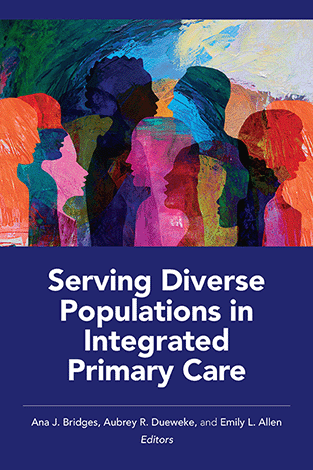
Serving Diverse Populations in Primary Care Behavioral Health
ISBN: 978-1-4338-5097-4A practical guide to delivering culturally responsive behavioral health care in integrated primary care.
Patients from diverse populations often face the greatest barriers to behavioral health care-yet stand to benefit from it most. Integrated primary care has emerged as a promising solution to this challenge by bringing behavioral health support directly into the settings where patients already seek care. But the brief, focused nature of effective integrated care makes it difficult to apply the cultural adaptations designed for longer-format interventions. Front-line providers consequently find themselves in settings where standard techniques for cultural responsiveness no longer fit, and where the stakes of getting it wrong are especially high.
This volume offers clinicians necessary support. Editors Ana J. Bridges, Aubrey Dueweke, and Emily Allen bring together leading clinicians and researchers to deliver practical, field-tested strategies for culturally responsive behavioral health care in integrated primary care settings. Contributors show how to adapt care for the specific populations clinicians encounter in real primary care settingsincluding communities defined by ethnicity and language, geography, sexual and gender identity, neurodivergence, and stigmatized medical conditions. Each chapter grounds clinicians in the historical and cultural context behind these disparities, identifies the concrete barriers patients face in seeking care, and translates that understanding into actionable recommendations for clinicians and health care providers.
Dedication
- Chapter 1. Introduction and the Need for Culturally Responsive Primary Behavioral Health Care
Ana J. Bridges, Aubrey Dueweke, Emily Allen, and Kori Kent - Chapter 2. A Contextual and Moment-at-a-Time Approach to Working in Primary Care
David Bauman and Bridget Beachy, PsyD - Chapter 3. Primary Care Behavioral Health for Black Women During Pregnancy and Postpartum
Ryaja Johnson, Amber J. Landers, Bridget N. Murphy, Angel Ogbeide, Eniola King, and Stacy Ogbeide - Chapter 4. Addressing Rural Latine Mental Health Needs and Barriers Through Integrated Care
Linda Myerholtz, Caroline Roberts, Gabriela Castro, Elizabeth Childs, Jessica Flagler, Diana Rivera-Burgos, Katy Sims, and Karen Smith - Chapter 5. Serving the Behavioral Health Needs of Immigrant and Refugee Families Who Are New to the United States
Leah LaLonde, Yajaira Johnson-Esparza, Laura Harden, Gabriela Gibson-Lopez, Mayra Y. Correa Barada, Shanice Santa-Olivo, and Amina Smajlovic - Chapter 6. Indigenous-Centered Integrated Behavioral Health Care
Ana I. Guzmán, Cynthia E. Guzmán, and Ingrid N. Atiles - Chapter 7. Caring for Asian American, Native Hawaiian, and Pacific Islander (AANHPI) Mental Health in Integrated Primary Care Settings
Teresa Hsu - Chapter 8. Primary Care Behavioral Health for Middle Eastern and North African Populations
Nicole McKelvey, Katherine Sadek, and Nahaal Binazir - Chapter 9. Meeting the Needs of Rural Appalachia: Cultural Considerations for Integrated Care
Natasha Gouge and Alysia Hoover-Thompson - Chapter 10. Serving Military Members and their Families with Primary Care Behavioral Health
Jeffrey L. Goodie, Victoria Baird-Clement, Claire Demming, and Christopher L. Hunter - Chapter 11. Guidance for Serving Lesbian, Gay, Bisexual, Transgender, and Queer Populations in Integrated Primary Care
Kelly Ducheney and Hayley Van Serke - Chapter 12. Enhancing Behavioral Health Care for Autism in the Primary Care Setting
Rebecca Lyren, Christian Klepper, Tyanna Snider, Nichole Baker, Kristin DellArmo, Jennifer Burt, Austin Burns, Brandy Clarke, Natalie Hoff, Allison Morton, Allison Grennan, and Holly Roberts - Chapter 13. Decreasing Stigma and Increasing Quality of Life: Integrated Health Care for Persons Living with HIV
Timothy Stahl - Chapter 14. Strategies for Reaching, Engaging, and Helping People with Higher Weight Throughout the Lifespan
Jeffrey T. Reiter - Chapter 15. General Reflections for Serving Diverse Populations in Primary Care
Aubrey Dueweke, Ana J. Bridges, Emily Allen, and Kori Kent
Appendix: Patient Bill of Rights
About the Editors
About the Contributors
Ana J. Bridges, PhD, is a licensed psychologist and Distinguished Professor of Psychological Science at the University of Arkansas, where she directs the APA-accredited clinical psychology doctoral program and the Driving Research to Enhance Access to Mental health (DREAM) Lab. Her work centers on integrated behavioral health and interprofessional education to expand culturally responsive care for underserved populations. She developed two primary care behavioral health programs and has led multiple HRSA-funded Graduate Psychology Education grants advancing workforce diversity and access. A native of Argentina, Dr. Bridges is fluent in Spanish and committed to improving integrated mental health services for vulnerable communities through research, training, and community partnerships.
Aubrey Dueweke, PhD, is a licensed clinical psychologist and Assistant Professor in the Department of Psychology at East Tennessee State University. She earned her PhD from the University of Arkansas and completed a postdoctoral fellowship in the Mental Health Disparities and Diversity Program at the Medical University of South Carolina. Dr. Dueweke's research focuses on using nontraditional service delivery models, like primary care behavioral health integration, telehealth, and community outreach, to increase access to mental health care for underserved populations. In addition, her research aims to understand and address the structural and attitudinal barriers that can impede help-seeking for mental health concerns. She has clinical expertise working with individuals experiencing posttraumatic stress and suicidal ideation.
Emily Allen, MA, is a fifth-year doctoral candidate in the University of Arkansas' Clinical Psychology program. Her research and clinical interests emphasize increasing access to quality behavioral healthcare and using culturally responsive techniques to support treatment engagement and retention among underserved populations. Emily has experience providing brief interventions in a federally qualified health center, has served on local and national councils focused on inclusivity, and is an APA Minority Fellow, reflecting her applied dedication to reaching marginalized communities.