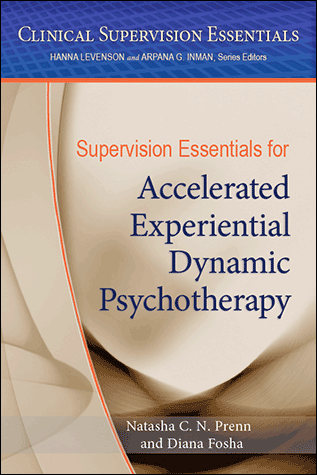
Supervision Essentials for Accelerated Experiential Dynamic Psychotherapy
ISBN: 978-1-4338-2640-5In this comprehensive guide, Natasha Prenn and Diana Fosha, leading voices in the development of Accelerated Experiential Dynamic Psychotherapy, offer a model of clinical supervision based on this approach.
Utilizing insights from attachment theory and research in neuroplasticity, clinicians who practice accelerated experiential dynamic psychotherapy (AEDP) help clients overcome anxiety and defenses to unearth, explore, and process core feelings in order to transform patterns of suffering into long-lasting, positive change.
This book offers a model of clinical supervision that is based on the AEDP approach. Making use of videotaped sessions, AEDP supervisors model a strong focus on here-and-now interactions characterized by affective resonance and empathy. The goal is to offer trainees a visceral, transformative experience that complements their growing intellectual understanding of how to make change happen in AEDP.
Foreword to the Clinical Supervision Essentials Series
Acknowledgments
Introduction
- Chapter 1. Key Concepts
- Chapter 2. Essential Skills
- Chapter 3. AEDP Supervision in Action: Microanalysis of an AEDP Supervision Session
- Chapter 4. Practical Issues
- Chapter 5. Common Challenges
- Chapter 6. Supervisor Development and Self-Care
- Chapter 7. Research Support for the AEDP Supervisory Approach
Suggested Readings
References
Index
About the Authors
Natasha C. N. Prenn, LCSW, is senior faculty at the Accelerated Experiential Dynamic Psychotherapy (AEDP) Institute. She pioneered the AEDP Essential and Advanced Skills Courses, and is well known as a trainer of therapists across the U.S. and abroad. In addition to her clinical practice in New York City, she offers individual and group AEDP supervision and runs supervisor trainings and writing groups. She is the founding coeditor of Transformance: The AEDP Journal.
Diana Fosha, PhD, is the developer of AEDP and founder/director of the AEDP Institute. She wrote The Transforming Power of Affect: A Model for Accelerated Change (2000) and coedited (with D. Siegel and M. Solomon) The Healing Power of Emotion: Affective Neuroscience, Development & Clinical Practice (2009). She has also written numerous articles integrating neuroplasticity, recognition science, and developmental dyadic research into experiential therapy and trauma treatment. APA has released two previous DVDs of her AEDP work. She lives and practices in New York City and teaches worldwide.
Prenn and Fosha remind us that we are all continuous learners in every human exchange. This volume carefully maps AEDP supervision principles and practices and, most importantly, brings to life the human connections that are vital to the development of transformative experiential psychotherapy and the supervision that flows from within it.
—Douglas Braun-Harvey, MFT, CGP, CST
The Harvey Institute, San Diego, CA, and author of Sexual Health in Recovery: A Professional Counselor's Manual
AEDP has been one of the most exciting developments in our field in recent decades. Like AEDP itself, this book is deeply experiential, offering a vivid sense of AEDP practice and of how it is supervised. Readers experience being right there in the room as supervision is conducted by a master clinician.
—Paul L. Wachtel, PhD
CUNY Distinguished Professor, Doctoral Program in Clinical Psychology, City College of CUNY, New York, NY and author of Therapeutic Communication, Second Edition: Knowing What to Say When
From the developer of AEDP together with one of AEDP's top trainers comes a book on the process of AEDP supervision that parallels the powerful approach itself. Prenn and Fosha offer supervisees the same intense experiences they offer clients, and so the learning is deep and transformative.
—Richard C. Schwartz, PhD
Department of Psychiatry, Harvard Medical School, Boston, MA, and developer of the Internal Family Systems Model of psychotherapy
- Accelerated Experiential Dynamic Psychotherapy (AEDP) Supervision
This DVD demonstrates how the supervisory model for the accelerated experiential dynamic psychotherapy approach incorporates many of the key principles used in the therapy itself.