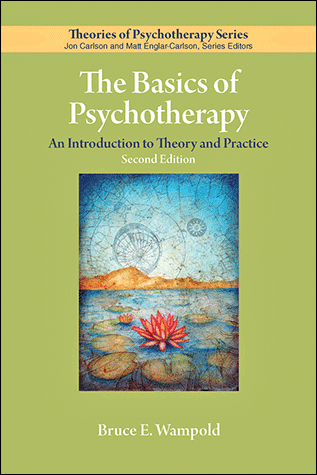
The Basics of Psychotherapy
Part of the bestselling Theories of Psychotherapy® Series from APA
This book presents essential background necessary for understanding the role of theory in psychotherapy practice, and shows how understanding psychotherapy theory is the first step to becoming an effective therapist.
The author provides a thorough but concise overview of the history of psychotherapy, the evolution of psychotherapy theories, and research on the effectiveness of various psychotherapies in general practice and for treatment of specific common disorders.
The Basics of Psychotherapy, now in its second edition, is an accessible, handy resource for students training to be psychotherapists and practitioners seeking to reevaluate theories and corresponding therapies. As the foundational book in the Theories of Psychotherapy Series, this title may be read first or in combination with other books in the series to establish a thorough understanding of psychotherapy and its variants. This updated second edition incorporates new developments in theory and research, new approaches including advances in culturally sensitive therapy, and updates in the classification of mental illness.
Series Preface
- Introduction
- Psychotherapy Theory: The Historical Context
- Role of Theory
- Research on the Effectiveness of Psychotherapy
- How Does Psychotherapy Work?
- Summary
References
Index
About the Author
About the Series Editors
Bruce E. Wampold, PhD, is professor emeritus of counseling psychology at the University of Wisconsin–Madison, director of the Research Institute at Modum Bad Psychiatric Center in Vikersund, Norway, and chief scientist of Theravue, an electronic platform for deliberate practice and therapist improvement.
Dr. Wampold trained in mathematics at the University of Washington before earning his doctorate in counseling psychology at the University of California, Santa Barbara. He is a fellow of APA (Divisions 12 [Society of Clinical Psychology]; 17 [Society of Counseling Psychology]; 29 [Society for the Advancement of Psychotherapy]; and 45 [Society for the Psychological Study of Culture, Ethnicity and Race]) and is board certified in counseling psychology by the American Board of Professional Psychology.
He has written more than 200 books, chapters, and articles related to counseling, psychotherapy, statistics, and research methods, and has received numerous awards, including the 2007 Distinguished Professional Contributions to Applied Research Award from APA, the Distinguished Research Career Award from the Society for Psychotherapy Research, and an Honorary Doctorate from Stockholm University. He is general vice-president and president-elect of the Society of Psychotherapy Research.
Currently, Dr. Wampold's work involves understanding counseling and psychotherapy from empirical, historical, and anthropological perspectives. His pursuit of evidence on psychotherapy has led to the application of sophisticated statistical methods and, at times, to the development of methods when the available methods have been insufficient, to understand the complexities of psychotherapy.
He has contributed to various areas related to psychotherapy, including relative efficacy of various approaches, therapist effects, the therapeutic alliance, placebo effects in medicine and in psychotherapy, trajectories of change, multicultural competence, and expertise in psychotherapy. His analysis of empirical evidence, which has led to the development of a contextual model from which to understand the benefits of counseling and psychotherapy, is found in The Great Psychotherapy Debate: The Evidence for What Makes Psychotherapy Work (2nd ed., Wampold & Imel, 2015).
His current work involves using deliberate practice to assist therapists to improve their outcomes. This work has led to the development of an electronic platform for therapist developmentopens in new window.
Essential.
—Choice
This insightful book reminds me of one of the most important papers on psychotherapy: Carl Rogers's (1957) article on the necessary and sufficient conditions for change. This is because what Bruce E. Wampold covers is absolutely crucial for every trainee (and more experienced therapists) to know and is exactly what every instructor needs in order to teach the historical, cultural, conceptual, clinical, and empirical foundations of our field. And because it convincingly reminds us that theory is the cornerstone of what we do as clinicians and researchers, this book is in itself a masterful picture of psychotherapy — its basics and beyond.
— Louis G. Castonguay, PhD, Professor, Department of Psychology, Pennsylvania State University, University Park