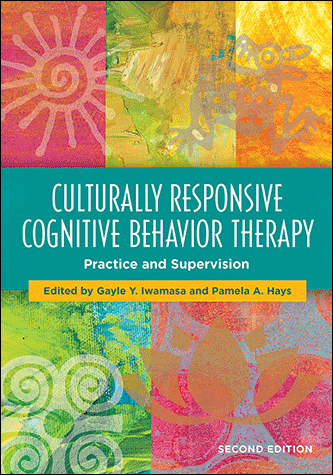
Culturally Responsive Cognitive Behavior Therapy
Available formats
Also available from
In this second edition, Gayle Y. Iwamasa and Pamela A. Hays show mental health providers how to integrate cultural factors into cognitive behavior therapy (CBT). They describe the application of CBT with clients of diverse cultures and discuss how therapists can refine CBT to increase its effectiveness with clients from a variety of cultural backgrounds.
Contributors examine the unique characteristics of CBT and its use with various racial, ethnic, and religious minority groups in the United States. Strategies for using CBT with older adults; individuals with disabilities; and lesbian, gay, bisexual, transgender, queer, and questioning clients are also examined.
A chapter on culturally responsive CBT clinical supervision closes the volume.
This new edition includes updated demographic information, a greater emphasis on culture-specific assessments, and a new chapter on using CBT with clients of South Asian descent.
Contributors
Foreword
Christine A. Padesky
Acknowledgements
Introduction
Pamela A. Hays
Part I: Ethnic Minority Cultural Populations
- Chapter 1: Cognitive Behavior Therapy With American Indians
Justin Douglas McDonald, John Gonzalez, and Emily Sargent - Chapter 2: Cognitive Behavior Therapy With Alaska Native People
Pamela A. Hays - Chapter 3: Cognitive Behavior Therapy With Latinxs
Kurt C. Organista - Chapter 4: Cognitive Behavior Therapy With African Americans
Shalonda Kelly - Chapter 5: Cognitive Behavior Therapy With Asian Americans
Gayle Y. Iwamasa, Curtis Hsia, and Devon Hinton - Chapter 6: Cognitive Behavior Therapy With South Asian Americans
Sheetal Shah and Nita Tewari - Chapter 7: Cognitive Behavior Therapy With People of Arab Heritage
Pamela A. Hays and Nuha Abudabbeh - Chapter 8: Cognitive Behavior Therapy With Orthodox Jews
Steven Friedman, Cheryl M. Paradis, and Daniel Cukor
Part II: Additional Minority Cultural Populations
- Chapter 9: Cognitive Behavior Therapy With Culturally Diverse Older Adults
Angela W. Lau and Lisa M. Kinoshita - Chapter 10: Cognitive Behavior Therapy and People With Disabilities
Linda R. Mona, H’Sien Hayward, and Rebecca P. Cameron - Chapter 11: Affirmative Cognitive Behavior Therapy With Sexual and Gender Minority People
Kimberly F. Balsam, Christopher R. Martell, Kyle P. Jones, and Steven A. Safren
Part III: Supervision
- Chapter 12: Culturally Responsive Cognitive Behavior Therapy Clinical Supervision
Gayle Y. Iwamasa, Shilpa P. Regan, and Kristen H. Sorocco
Index
About the Editors
Gayle Y. Iwamasa, PhD, received her doctorate in clinical psychology from Purdue University. She completed her predoctoral internship and a clinical research fellowship at the University of California, San Francisco.
Dr. Iwamasa currently serves as National Mental Health Technical Assistance Specialist and National Inpatient Mental Health Services Coordinator for the Department of Veterans Affairs (VA). In these roles she provides technical assistance and consultation across the VA system regarding implementation of evidence-based treatments and required mental health services, and serves as subject matter expert regarding inpatient mental health care.
She is also a trained facilitator and leads workshops and trainings both internal and external to the VA. Prior to her current position she spent 16 years in academia educating and training clinical, community, and counseling psychology graduate students.
She has served in several leadership roles in several professional psychological organizations, including president of the Asian American Psychological Association.
Dr. Iwamasa has numerous publications in peer-reviewed journals, chapters, and coedited books. She has presented on cultural diversity issues in psychology nationally and internationally and has also been featured in several psychotherapy videos.
Pamela A. Hays, PhD, received a doctorate in clinical psychology from the University of Hawaii and served as a National Institute of Mental Health postdoctoral fellow at the University of Rochester School of Medicine, followed by 11 years on the graduate faculty of Antioch University Seattle.
Her research has focused on multicultural practice, including work with Muslim women in North Africa, and Vietnamese, Lao, and Cambodian people in the United States.
In 2000, Dr. Hays returned to her hometown on the Kenai Peninsula of Alaska, where she has worked with the community health center, for the Kenaitze Tribe's Dena'ina Wellness Center, and where she is in private practice.
She is the author of several books on multicultural practice, including Addressing Cultural Complexities in Practice, Second Edition: Assessment, Diagnosis, and Therapy; Connecting Across Cultures: The Helper's Toolkit; and Creating Well-Being: Four Steps to a Happier, Healthier Life.
APA has produced numerous videos of her work as a therapist demonstrating cognitive behavior therapy and culturally responsive practice.
For more information on her clinical practice, publications, videos, and workshops, visit her websiteopens in new window.
If you're not already skilled at adapting CBT to your clients' cultures, you need this book! An understanding of culture, which may strongly affect clients' perceptions and behavioral patterns, is essential to accurately conceptualizing the individual and delivering effective treatment.
—Judith S. Beck, PhD, President
Beck Institute for Cognitive Behavior Therapy, Bala Cynwyd, PA, and Clinical Professor, University of Pennsylvania, Philadelphia
This excellent new edition illustrates effective and creative CBT cultural adaptations. Using an integrative cultural and clinical perspective, contributors offer best practices for working with diverse clients within a CBT cultural competence approach. I strongly recommend this invaluable book to all psychotherapists, trainees, supervisors, and educators.
—Lillian Comas-Díaz, PhD
Clinical Professor, Department of Psychiatry and Behavioral Sciences, George Washington University, Washington, DC
How can I make cognitive behavior therapy culturally relevant? Iwamasa and Hays answer this question with the latest conceptual, research, and clinical applications from leaders in the field who consider culture in terms of age, race/ethnicity, sexuality, disability, and religion.
—Gordon C. Nagayama Hall, PhD
Department of Psychology, University of Oregon, Eugene