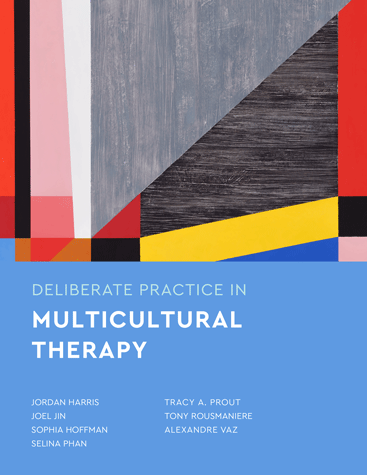
Deliberate Practice in Multicultural Therapy
ISBN: 978-1-4338-3667-1Deliberate practice exercises provide trainees and students opportunities to develop a more multicultural, intersectional approach to psychotherapy and hone their own personal therapeutic style.
These exercises present role-playing scenarios in which two trainees act as a client and a clinician, switching back and forth under the guidance of a supervisor. The clinician improvises appropriate and authentic responses to client statements organized into three difficulty levels—beginner, intermediate, and advanced—that reflect common client questions and concerns.
Each of the first 13 exercises focuses on a single skill, such as developing cultural self-awareness and cultural humility, exploring cultural implications and explanations of clients’ concerns, and repairing culturally based ruptures in the working alliance. Two comprehensive exercises follow in which trainees integrate these essential skills into a single multicultural therapy session.
Step-by-step instructions guide participants through the exercises, identify criteria for mastering each skill, and explain how to monitor and adjust difficulty. Guidelines to help trainers and trainees get the most out of training are also provided.
To demonstrate how deliberate practiceopens in new window can be fully integrated into a professional curriculum, this series features exercises developed and refined within the clinical training curriculum at the Sentio online marriage and family therapy (MFT) therapist training programopens in new window in California, which is where we started developing this series. These exercises, which have been tested at clinical training sites around the world, are used to enhance clinical outcomes within the firsthybrid MFT program approved by the California Board of Behavioral Sciencesopens in new window (BBS) to fully integrate deliberate practice into its entire curriculum. By integrating these models into its hybrid MFT program in California, Sentio University demonstrates that therapist training graduate programs can use deliberate practice to bridge the gap between theory and clinical mastery through repetitive, feedback-informed practice to support the development of modern, outcome-focused clinicians.
Series Preface
Tony Rousmaniere and Alexandre Vaz
Acknowledgments
Part I. Overview and Instructions
- Chapter 1. Introduction and Overview of Deliberate Practice and Multicultural Therapy
- Chapter 2. Instructions for the Multicultural Therapy Deliberate Practice Exercises
Part II. Deliberate Practice Exercises for Multicultural Therapy Skills
Exercises for Beginner Multicultural Therapy Skills
- Exercise 1. Therapist Self-Awareness: Cultural Humility I
- Exercise 2. Assessing Client Expectations
- Exercise 3. Reflecting Content Through a Cultural Lens
- Exercise 4. Inquiring About Identity: Cultural Opportunities I
Exercises for Intermediate Multicultural Therapy Skills
- Exercise 5. Working With Emotions in Context
- Exercise 6. Maintaining a Not-Knowing Stance: Cultural Humility II
- Exercise 7. Inquiring About Cultural Implications of the Problem: Cultural Opportunities II
- Exercise 8. Acknowledging Therapist Limitations
Exercises for Advanced Multicultural Therapy Skills
- Exercise 9. Gathering Information About Safety Concerns
- Exercise 10. Talking About Sex and Success
- Exercise 11. Responding to Resistance and Ambivalence
- Exercise 12. Repairing Ruptures Due to Microaggressions
Comprehensive Exercise
- Exercise 13. Mock Multicultural Therapy Sessions
Part III. Strategies for Enhancing the Deliberate Practice Exercises
- Chapter 3. How to Get the Most Out of Deliberate Practice: Additional Guidance for Trainers and Trainees
Appendix A. Difficulty Assessments and Adjustments
Appendix B. Deliberate Practice Diary Form
Appendix C. Sample Multicultural Therapy Syllabus With Embedded Deliberate Practice Exercises
References
Index
About the Authors
Jordan Harris, PhD, LMFT-S, LPC-S, is a former American Association for Marriage and Family Therapy (AAMFT) Minority Fellow and AAMFT Minority Fellowship Mentor. He’s consulted on various projects around deliberate practice and issues of diversity. Currently he works in private practice and runs the blog www.jordanthecounselor.com, dedicated to all things deliberate practice and practice building.
Joel Jin, PhD, is an assistant professor of clinical psychology at Seattle Pacific University (SPU). At SPU's clinical psychology PhD program, he teaches graduate courses on foundational clinical interventions for psychotherapy, brief psychodynamic therapy, psychopathology, psychological assessment, and understanding cultural differences and diversity. His research lab investigates the impact of perfectionism and stigma on mental health and wellbeing. His research team tests how mindfulness-based and compassion-focused interventions can help students of the global majority thrive.
Sophia Hoffman, PhD, is the Assistant Program Director and the Director of Clinical Training at the combined School-Clinical Child PsyD Program at Ferkauf Graduate School of Psychology at Yeshiva University. Dr. Hoffman works with children, adolescents, and their families at Lifespan Therapists of Brooklyn. She specializes in working with challenging behaviors in early childhood and consulting with parents about how those behaviors affect school experiences. Dr. Hoffman has extensive experience helping families manage childhood trauma and the subsequent challenging behaviors expressed at home and at school. Cultural humility is at the center of her practice.
Selina Phan is a doctoral candidate in the School-Clinical Child Psychology Program at Ferkauf School of Psychology. She received a dual bachelor's degree in Psychology and Behavior & Health from Boston University. As a home visitor, Selina provided community-based case management and parent training services to low-income families with children from birth to 5 years old. Her clinical interests are in childhood anxiety, depression, ADHD, trauma, and parent management.
Tracy A. Prout, PhD, is associate professor of psychology at the Ferkauf Graduate School of Psychology at Yeshiva University. She teaches evidence-based psychodynamic psychotherapy in the School-Clinical Child Combined Doctoral Program, supervises advanced graduate students in the psychodynamic psychotherapy practicum, and leads the psychodynamic psychotherapy lab at Ferkauf. Dr. Prout is principal investigator for several studies related to Regulation Focused Psychotherapy for Children (RFP-C) and supervises all graduate research assistants who work on these projects. Dr. Prout coleads IMPACT Psychological Services, an integrative, group private practice, with locations in Beacon and Mamaroneck, New York serving children, teens, families and adults.
Tony Rousmaniere, PsyD, is president of Sentio University marriage and family therapy (MFT) program in Californiaopens in new window. He led the development of online/hybrid MFT programopens in new window, which is the first MFT therapist training program approved by the California Board of Behavioral Science for MFT licensure that fully integrates deliberate practiceopens in new window. Dr. Rousmaniere is the author/coeditor of many books on psychotherapy training. He is also the executive director of the Sentio Counseling Centeropens in new window, which is Sentio MFT program’s guaranteed practicumopens in new window site where students provide sliding-scale online therapy in Californiaopens in new window, and past president of the APA’s Division 29.
Alexandre Vaz, PhD, is chief academic officer of Sentio University marriage and family therapy (MFT) program in Californiaopens in new window. This innovative online/hybrid MFT programopens in new window was the first approved by the California Board of Behavioral Science for MFT licensure to fully integrate deliberate practiceopens in new window into its curriculum to ensure superior clinical outcomes. He is also director of clinical training for the Sentio Counseling Centeropens in new window which is Sentio MFT program’s guaranteed practicumopens in new window site where students provide low-cost online couples therapy in Californiaopens in new window. Dr. Vaz is the author/coeditor of many books on deliberate practice and psychotherapy training.
It is the emphasis on not only the “why” but the “how” we as clinicians and clinical supervisors can provide culturally affirming care and training that sets this book apart from others on multicultural therapy.
—Sheeva Mostoufi, PhD, Training Coordinator and Licensed Clinical Psychologist, Old Town Psychology, Alexandria, VA
This book is jam-packed with examples in which trainees can learn firsthand how to make use of cultural opportunities during therapy, regardless of theoretical orientation. The deliberate practice framework for working with these opportunities results in trainees experientially learning what it means to take a culturally humble perspective, and thereby begin to develop their own cultural comfort. The experiential focus throughout makes the learning come alive and leads to greater authenticity.
—Hanna Levenson, PhD, Professor, Wright Institute, Berkeley, CA
Multicultural competence is composed of attitudes, knowledge, and skills. But the field has been less adept at equipping therapists with the necessary multicultural skills than it has in addressing attitudes and knowledge. This essential addition to the field not only identifies core multicultural skills but also provides an effective mechanism for helping therapists develop them.
—Rodney Goodyear, PhD, Emeritus Professor, University of Southern California, Los Angeles, and University of Redlands, Redlands, CA
The right book at the right time! This book captures the important shift that has occurred in the training of multiculturalism—from gaining multicultural competence to developing a multicultural orientation that focuses on ongoing personal and professional development. True to the foundation of Deliberate Practice, and based in their scholarly expertise, Harris et al. offer practical “simulators” or mock therapy sessions that mimic actual therapeutic encounters or events focused on essential multicultural therapy skills.
—Arpana G. Inman, PhD, ABPP, Dean and Distinguished Professor, Graduate School of Applied and Professional Psychology, Rutgers University-New Brunswick, New Brunswick, NJ
This book is part of the Essentials of Deliberate Practice series by Tony Rousmaniere and Alexandre Vaz. The clinician and practitioner resources on this page include a Deliberate Practice Reaction Form and a Deliberate Practice Diary Form that can be used with every book in this series, as well as volume-specific content.
These documents are offered for your personal use in clinical training or teaching courses. If you reprint or adapt them for publication, permission is required from the publisher.
Deliberate Practice Reaction Form
The Deliberate Practice Reaction Form can be used with any of the deliberate practice exercises throughout the series to measure how challenging it was for the trainees and to adjust the difficulty as needed. Appendix A includes a black-and-white version of the form with instructions for assessing and modifying an exercise’s difficulty. A color version of the Deliberate Practice Reaction Form is also available for individual download.
- Appendix A: Difficulty Assessments and Adjustmentsopens in new window (PDF)
- Deliberate Practice Reaction Formopens in new window (PDF)
Deliberate Practice Diary Form
The Deliberate Practice Diary Form is an optional form that trainees can complete during a training session’s final evaluation or between sessions to process their experiences with the activity, including what was and was not helpful and what they learned. Appendix B, which is the same across all books in the series, presents this form.
Volume-specific materials
The following content is unique to Deliberate Practice in Multicultural Therapy and includes a sample syllabus that integrates the deliberate practice exercises into a standard clinical course.
- Appendix C: Sample Multicultural Therapy Syllabus With Embedded Deliberate Practice Exercises (PDFopens in new window | Wordopens in new window)
Video demonstration
A YouTube series (Practice Time! with Amy DeSmidt and Jamie Manser)opens in new window highlights authentic deliberate practice sessions featuring exercises from this book and other volumes in the Essentials of Deliberate Practice series.
Supplemental resources for therapist training
Designed for faculty at graduate institutions, these supplemental resources provide a framework and clear examples for implementing deliberate practice within existing therapist training curricula. Sentio University is where we started to develop what would become the APA Essentials of Deliberate Practice series. We provide a comprehensive suite of free psychotherapy training resources based on the deliberate practice methodologyopens in new window. These materials are designed to supplement modern hybrid and online therapist training curricula and are used extensively within our own clinical programs.
- California MFT program integration: These materials are a core component of the Sentio hybrid MFT program in Californiaopens in new window, the first in the state to fully integrate DP into its entire curriculum and receive California Board of Behavioral Sciences approval for licensure.
- Free deliberate practice exercises: Access our library of therapist skill-building worksheetsopens in new window used to enhance the online California MFT degree through repetitive, feedback-informed practice.
- Deliberate practice video demonstrations: Visit our YouTube channel for free therapist training videosopens in new window to view clinical demonstrations from the APA Essentials of Deliberate Practice book series. These videos illustrate key skills used to enhance the online California MFT degree through repetitive, feedback-informed practice.
- AI and emerging therapy resources: Learn how deliberate practice can be used to safely and ethically integrate AI for therapist trainingopens in new window. Review our AI research programopens in new window and our clinical guidelines on using AIopens in new window to prepare for the modern landscape of digital mental health.