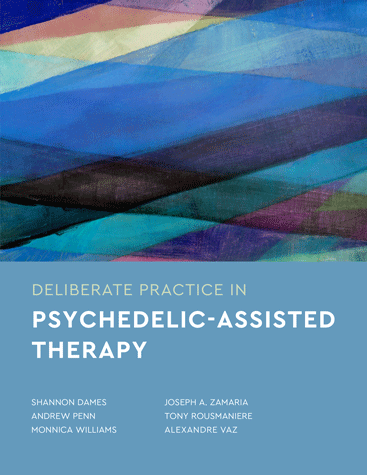
Deliberate Practice in Psychedelic-Assisted Therapy
ISBN: 978-1-4338-4171-2Deliberate practice exercises help trainees achieve competence in essential psychedelic-assisted psychotherapy skills and apply them in a range of clinical situations while honing their own personal style and language.
These exercises present role-playing scenarios in which two trainees act as a client and a therapist, switching back and forth under the guidance of a supervisor. The therapist improvises appropriate and authentic responses to client statements organized into three difficulty levels—beginner, intermediate, and advanced—that reflect common client questions and concerns.
Each of the first 12 exercises focuses on a single skill that include tending to clients’ bodily and emotional states before introducing psychedelic medicine to treatment, exploring ethical and cultural implications, and working with clients in altered states of consciousness to promote wellbeing. Two comprehensive exercises follow in which trainees integrate these essential skills into a single psychedelic-assisted therapy session.
Step-by-step instructions guide participants through the exercises, identify criteria for mastering each skill, and explain how to monitor and adjust difficulty. Guidelines to help trainers and trainees get the most out of training are also provided.
To demonstrate how deliberate practiceopens in new window can be fully integrated into a professional curriculum, this series features exercises developed and refined within the clinical training curriculum at the Sentio online marriage and family therapy (MFT) therapist training programopens in new window in California, which is where we started developing this series. These exercises, which have been tested at clinical training sites around the world, are used to enhance clinical outcomes within the firsthybrid MFT program approved by the California Board of Behavioral Sciencesopens in new window (BBS) to fully integrate deliberate practice into its entire curriculum. By integrating these models into its hybrid MFT program in California, Sentio University demonstrates that therapist training graduate programs can use deliberate practice to bridge the gap between theory and clinical mastery through repetitive, feedback-informed practice to support the development of modern, outcome-focused clinicians.
Series Preface
Tony Rousmaniere and Alexandre Vaz
Acknowledgments
Part I. Overview and Instructions
- Chapter 1. Introduction and Overview of Deliberate Practice and Psychedelic-Assisted Therapy
- Chapter 2. Instructions for the Therapeutic Approach for Psychedelic-Assisted Therapy Deliberate Practice Exercises
Part II. Deliberate Practice Exercises for Psychedelic-Assisted Therapy Skills
Exercises for Beginner Psychedelic-Assisted Therapy Skills
- Exercise 1. Redirecting to the Body
- Exercise 2. Compassionately Witnessing Strong Emotions
- Exercise 3. Exploring Intentions and Expectations
- Exercise 4. Cultural Considerations: Racial and Ethnically Diverse Communities
Exercises for Intermediate Psychedelic-Assisted Therapy Skills
- Exercise 5. Boundaries and Informed Consent
- Exercise 6. Responding to Relational Ruptures
- Exercise 7. Working with Client’s Internal Conflict
- Exercise 8. Addressing Transference
Exercises for Advanced Psychedelic-Assisted Therapy Skills
- Exercise 9. Navigating Strong Emotions
- Exercise 10. Making Sense of the Experience: Integration I
- Exercise 11. Working with Disappointment: Integration II
- Exercise 12. Embodying Insights: Integration III
Comprehensive Exercises
- Exercise 13. Annotated Psychedelic-Assisted Therapy Practice Session Transcript
- Exercise 14. Mock Psychedelic-Assisted Therapy Sessions
Part III. Strategies for Enhancing the Deliberate Practice Exercises
- Chapter 3. How to Get the Most Out of Deliberate Practice: Additional Guidance for Trainers and Trainees
Appendix A. Difficulty Assessments and Adjustments
Appendix B. Deliberate Practice Diary Form
Appendix C. Sample Psychedelic-Assisted Therapy Syllabus With Embedded Deliberate Practice Exercises
References
Index
About the Authors
Shannon Dames, RN, MPH, EdD, is chair of psychedelic-assisted therapy programming and a nursing professor at Vancouver Island University in Nanaimo, British Columbia. She has expertise in resilience development and psychedelic-assisted therapy research and education. Dr. Dames’s work focuses on the collaborative, interdisciplinary development of equity and culturally informed service delivery, research, and education infrastructure development in the re-emerging field of psychedelic-assisted therapy. Her work acknowledges multiple ways of knowing, with a specific interest in collaborating to understand how Western and Indigenous ways of knowing might be shared for the healing benefit of all.
Andrew Penn, MS, PMHNP, is a clinical professor of nursing and a researcher at the Translational Psychedelic Research Program at University of California, San Francisco, where he teaches psychopharmacology and clinical psychiatry, and an attending nurse practitioner at the San Francisco Veterans Administration Hospital. He has taught around the world, including SXSW, Aspen Health Ideas Festival, TEDx, and the Singapore Ministry of Health. He is cofounder of the Organization of Psychedelic and Entheogenic Nursesopens in new window and has advocated for and written about nursing in psychedelic therapy in the American Journal of Nursing and the Journal of Humanistic Psychology. Visit his website.
Monnica Williams, PhD, is clinical psychologist specializing in cognitive behavior therapies. She is a professor in the School of Psychology at the University of Ottawa, Canada research chair in mental health disparities, and director of the Laboratory for Culture and Mental Health Disparities. She is the clinical director of the Behavioral Wellness Clinic in Connecticut, and Behavioural Wellness Clinic in Ottawa. She was also director of the Center for Mental Health Disparities at the University of Louisville in Psychological and Brain Sciences (2011–2016). At the University of Connecticut (2016–2019), she had appointments in psychological science and psychiatry.
Joseph A. Zamaria, PsyD, ABPP, is an associate clinical professor of psychiatry and behavioral sciences at the University of California, San Francisco School of Medicine, where he is associate program director for psychotherapy for UCSF’s psychiatry residency and an attending psychologist in UCSF’s outpatient psychiatry clinics. Dr. Zamaria has worked for years as a therapist and researcher in clinical trials of psychedelic-assisted therapy to treat a range of conditions. Additionally, he is on the faculty at UC Berkeley within the Berkeley Center for the Science of Psychedelics, where he directs the psychotherapy and clinical science curricula.
Tony Rousmaniere, PsyD, is president of Sentio University marriage and family therapy (MFT) program in Californiaopens in new window. He led the development of online/hybrid MFT programopens in new window, which is the first MFT therapist training program approved by the California Board of Behavioral Science for MFT licensure that fully integrates deliberate practiceopens in new window. Dr. Rousmaniere is the author/coeditor of many books on psychotherapy training. He is also the executive director of the Sentio Counseling Centeropens in new window, which is Sentio MFT program’s guaranteed practicumopens in new window site where students provide sliding-scale online therapy in Californiaopens in new window, and past president of the APA’s Division 29.
Alexandre Vaz, PhD, is chief academic officer of Sentio University marriage and family therapy (MFT) program in Californiaopens in new window. This innovative online/hybrid MFT programopens in new window was the first approved by the California Board of Behavioral Science for MFT licensure to fully integrate deliberate practiceopens in new window into its curriculum to ensure superior clinical outcomes. He is also director of clinical training for the Sentio Counseling Centeropens in new window which is Sentio MFT program’s guaranteed practicumopens in new window site where students provide low-cost online couples therapy in Californiaopens in new window. Dr. Vaz is the author/coeditor of many books on deliberate practice and psychotherapy training.
This book is just terrific. The authors have taken an unruly endeavor—teaching psychedelic-assisted therapy—and organized it in a lyrical, lovely, and thorough way. The focus remains resolutely on the patient–therapist relationship, and the practical exercises allow therapists to grow in skill and attunement, according to their own talent and personality. Most of all, the book allows for teachers to bring out the inner wisdom of each student, supporting the same kind of personal growth we hope to evoke in our patients.
—Jeffrey Guss, MD, Lead Trainer, Fluence; Clinical Assistant Professor of Psychiatry, NYU School of Medicine, New York, NY, United States
This book emphasizes the critical importance of therapists’ presence and the personal work that is required to develop and maintain a capacity for “properly attuned flexibility” in the face of intense experiences. The authors then provide a rich collection of practice exercises that are a valuable resource for therapists to learn to embody this capacity. This resource is particularly welcome as psychedelic-assisted therapy approaches regulatory approval.
—Michael Mithoefer, MD, MDMA Researcher, MAPS Public Benefit Corporation, Asheville, NC, United States
This thoughtfully organized book covers the key aspects of psychedelic-assisted psychotherapy. Any therapist in this emerging field is bound to find something practical and thought-provoking in these lovingly prepared pages.
—Zach Walsh, PhD, RPsych, Professor of Clinical Psychology, University of British Columbia, and Director of the Therapeutic, Recreational and Problematic Substance Use Lab, Kelowna, BC, Canada
This manual is an indispensable resource for those seeking to integrate psychedelic-assisted therapy into their professional repertoire. The authors skillfully guide readers through practical exercises, addressing the myriad of therapy challenges that may arise when working with clients interested in psychedelic medicines. This book serves as a vital educational tool to support clinicians on their ongoing learning journey, enabling them to cultivate optimal healing environments for their clients.
—Pamela Kryskow, MD, Medical Chair, Vancouver Island University Post Graduate Certificate in Psychedelic Assisted Therapy, Nanaimo, BC, Canada
What a book! It’s not just a book, it’s like having a group of experienced, tender-hearted, wise clinicians and guides by your side. They educate, support, encourage, and cheer on a psychedelic-assisted therapist at every stage of their career. I am wildly enthusiastic about this book and plan to keep it on my bookshelf throughout my career as a psychedelic-assisted therapist. The wisdom and knowledge within this book are exemplary, but it’s the presentation that makes it a knockout. I highly recommend it.
—Saundra Jain, MA, PsyD, LPC, Adjunct Clinical Affiliate, School of Nursing, University of Texas at Austin, Austin, TX, United States
This book is part of the Essentials of Deliberate Practice series by Tony Rousmaniere and Alexandre Vaz. The clinician and practitioner resources on this page include a Deliberate Practice Reaction Form and a Deliberate Practice Diary Form that can be used with every book in this series, as well as volume-specific content.
These documents are offered for your personal use in clinical training or teaching courses. If you reprint or adapt them for publication, permission is required from the publisher.
Deliberate Practice Reaction Form
The Deliberate Practice Reaction Form can be used with any of the deliberate practice exercises throughout the series to measure how challenging it was for the trainees and to adjust the difficulty as needed. Appendix A includes a black-and-white version of the form with instructions for assessing and modifying an exercise’s difficulty. A color version of the Deliberate Practice Reaction Form is also available for individual download.
- Appendix A: Difficulty Assessments and Adjustments (PDF)opens in new window
- Deliberate Practice Reaction Form (PDF)opens in new window
Deliberate Practice Diary Form
The Deliberate Practice Diary Form is an optional form that trainees can complete during a training session’s final evaluation or between sessions to process their experiences with the activity, including what was and was not helpful and what they learned. Appendix B, which is the same across all books in the series, presents this form.
Volume-specific materials
The following content is unique to Deliberate Practice in Psychedelic-Assisted Therapy and includes a sample syllabus that integrates the deliberate practice exercises into a standard clinical course.
- Appendix C: Sample Psychedelic-Assisted Therapy Syllabus With Embedded Deliberate Practice Exercises (PDFopens in new window | Wordopens in new window)
Video demonstration
A YouTube series (Practice Time! with Amy DeSmidt and Jamie Manser)opens in new window highlights authentic deliberate practice sessions featuring exercises from this book and other volumes in the Essentials of Deliberate Practice series.
Supplemental resources for therapist training
Designed for faculty at graduate institutions, these supplemental resources provide a framework and clear examples for implementing deliberate practice within existing therapist training curricula. Sentio University is where we started to develop what would become the APA Essentials of Deliberate Practice series. We provide a comprehensive suite of free psychotherapy training resources based on the deliberate practice methodologyopens in new window. These materials are designed to supplement modern hybrid and online therapist training curricula and are used extensively within our own clinical programs.
- California MFT program integration: These materials are a core component of the Sentio hybrid MFT program in Californiaopens in new window, the first in the state to fully integrate DP into its entire curriculum and receive California Board of Behavioral Sciences approval for licensure.
- Free deliberate practice exercises: Access our library of therapist skill-building worksheetsopens in new window used to enhance the online California MFT degree through repetitive, feedback-informed practice.
- Deliberate practice video demonstrations: Visit our YouTube channel for free therapist training videosopens in new window to view clinical demonstrations from the APA Essentials of Deliberate Practice book series. These videos illustrate key skills used to enhance the online California MFT degree through repetitive, feedback-informed practice.
- AI and emerging therapy resources: Learn how deliberate practice can be used to safely and ethically integrate AI for therapist trainingopens in new window. Review our AI research programopens in new window and our clinical guidelines on using AIopens in new window to prepare for the modern landscape of digital mental health.