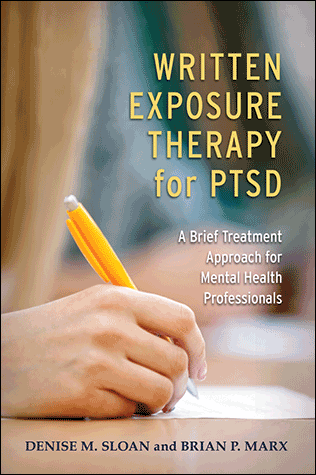
Written Exposure Therapy for PTSD
Denise M. Sloan and Brian P. Marx developed written exposure therapy (WET) in response to a growing demand for an effective PTSD treatment that is easier to implement, more affordable, and has lower dropout rates than other trauma interventions.
In their unique approach, the client writes about a single traumatic event, and the therapist focuses on the client's experiences while writing about the trauma, rather than the event itself.
This manual provides mental health professionals with instructions for conducting WET with clients who have PTSD. It contains a scripted protocol for WET, along with detailed guidance for conducting each session.
Sloan and Marx answer frequently asked questions from clinicians and review real-life case examples that demonstrate solutions to common issues and challenges that can occur during WET sessions. They also explain how to assess the client before treatment to determine the appropriateness of WET as well as during treatment to monitor the client's progress.
Key background information about WET's theoretical underpinnings is also reviewed.
Watch a video with the authors

Foreword
Charles W. Hoge
Acknowledgments
Introduction
- Overview of PTSD and Trauma-Focused Interventions
- Development and Efficacy Findings of Written Exposure Therapy
- Assessing PTSD Before Beginning Written Exposure Therapy
- Delivery of Written Exposure Therapy and Special Considerations
- Frequently Asked Questions About Delivering Written Exposure Therapy
- Case Illustrations
Appendix. Written Exposure Therapy Script
References
Index
About the Authors
Denise M. Sloan, PhD, is the associate director of the Behavioral Science Division, National Center for PTSD at VA Boston Healthcare System and a professor of psychiatry at Boston University School of Medicine.
Dr. Sloan is a Fellow of APA and the Association for Cognitive and Behavioral Therapies. She graduated with Honors in Psychology from the State University of New York at Stony Brook and earned her doctorate in clinical psychology from Case Western Reserve University.
Dr. Sloan is an expert on psychosocial interventions for traumatic stress disorders with a specific interest in efficient treatment approaches for traumatic stress disorders. Her work has been funded by several organizations, including the National Institute of Mental Health, the Department of Defense, and the Department of Veteran Affairs.
She has published more than 100 journal articles and has coedited two books. She serves as editor of Behavior Therapy and is a consulting editor for six scientific journals.
Brian P. Marx, PhD, is the deputy director of the Behavioral Science Division, National Center for PTSD at VA Boston Healthcare System, and a professor of psychiatry at Boston University School of Medicine. He is a Fellow of APA.
Dr. Marx graduated with Honors in Psychology from Boston University in 1989. He completed his doctorate in clinical psychology from the University of Mississippi.
Dr. Marx is an expert in behavior therapy, PTSD assessment, and the effects of trauma. His research interests include the assessment and treatment of PTSD, the identification of risk factors for posttraumatic difficulties, and suicide risk detection and prevention among veterans. His research has received funding from several federal agencies.
Dr. Marx has published more than 170 journal articles and serves on the editorial boards of several scientific journals. He coauthored Making Cognitive-Behavioral Therapy Work, which is now in its third edition.
Sloan and Marx, two of the foremost authorities on the nature and treatment of PTSD, have created and validated a powerful new treatment that is brief, efficient, and, most important, easy to use. This is clearly the next step forward, and every therapist seeing trauma patients should be aware of it.
—David H. Barlow, PhD, ABPP
Professor of Psychology and Psychiatry Emeritus, Boston University, and Founder, Center for Anxiety and Related Disorders, Boston, MA
WET is emerging as a low-dose, high-impact intervention for PTSD treatment. In this easy-to-read, comprehensive overview of WET, Sloan and Marx review the efficacy of the protocol, discuss key issues for assessment, and provide step-by-step guidance for conducting each WET session. Perfect for clinicians at any point in their career.
—Meaghan O'Donnell, PhD
Head of Research, Phoenix Australia, Centre for Post-Traumatic Mental Health, University of Melbourne, Melbourne, Australia