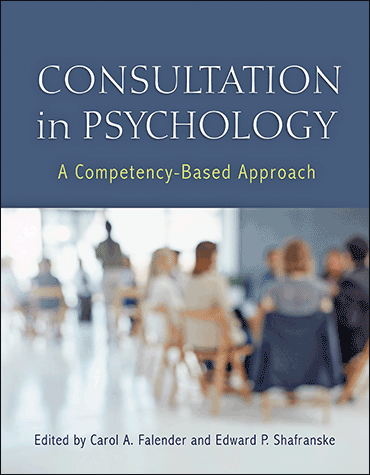
Consultation in Psychology
Available formats
Also available from
Increasingly, psychologists are being enlisted to provide consultation in clinical, health, corporate, and community settings, although many have received only minimal training in consultation. This volume provides a comprehensive foundation to develop or enhance consultation practice.
Consultation is a distinct professional practice with goals and functions different from direct clinical service or clinical supervision. While all consultation settings require certain basic competencies, each setting requires additional unique ones.
Thus, the opening chapters of this book introduce a competency-based, multicultural, and ethical approach to consultation that is relevant to all contexts, while subsequent chapters build on this foundation and describe the knowledge, skills, and attitudes necessary for consultation in a variety of specific contexts. These include medical, pediatric, forensic, school, corporate, leadership, family, religious, police, and military settings.
Both students and practicing psychologists will benefit from this essential guide.
Contributors
Introduction
Carol A. Falender and Edward P. Shafranske
I. Foundations of Consultation Practice
- Consultation in Psychology: A Distinct Professional Practice
Carol A. Falender and Edward P. Shafranske - The Competency Framework: Best Practices in Consultation
Carol A. Falender and Edward P. Shafranske - Ethical, Legal, and Professional Issues in Consultation for Psychologists
Jeffrey E. Barnett - Consultation in Health Service Psychology: The Present and the Future
David J. Martin - Consultation in Interprofessional Practice and Collaboration
Patricia Arredondo - Can You See Me Now? Understanding Culture and Multicultural Phenomena as Essential to the Process of Consultation
William D. Parham
II. Exemplars and Approaches
- Pediatric Consultation
Michael C. Roberts, Rebecca J. Johnson, and Christina M. Amaro - Consultation in Medical Settings
Barbara Cubic - Consultation in Leadership
Jennifer Wootten and Nadine J. Kaslow - Consultation in Corporations and Organizations
Rodney L. Lowman - School-Based Consultation
Markeda Newell, Carly Tindall, Kelsie Reed, and Scott Zwolski - Consultation With Religious Professionals and Institutions
Thomas G. Plante - Forensic Consultation
Jeffrey N. Younggren, Michael C. Gottlieb, and Cassandra L. Boness - Custody Case Family Consultation
G. Andrew H. Benjamin and Florence W. Kaslow - Consultation in Police and Public Safety Psychology
Cary L. Mitchell and Edrick H. Dorian - Consultation Within the Military Setting
Christina L. Schendel and Carrie H. Kennedy
Afterword: Advancing Consultation Practice
Carol A. Falender and Edward P. Shafranske
Index
About the Editors
Carol A. Falender, PhD, is coauthor, with Edward P. Shafranske, of Supervision Essentials for the Practice of Competency-Based Clinical Supervision (2017), Clinical Supervision: A Competency-Based Approach (2004), and Getting the Most Out of Clinical Training and Supervision: A Guide for Practicum Students and Interns (2012). She is coeditor, with Edward P. Shafranske, of Casebook for Clinical Supervision: A Competency-Based Approach (2008) and, with Edward P. Shafranske and Celia J. Falicov, Multiculturalism and Diversity in Clinical Supervision: A Competency-Based Approach (2014).
In 2018, Dr. Falender received APA’s Distinguished Contributions to Education and Training in Psychology award. She was a member of the Supervision Guidelines Group of the Association of State and Provincial Psychology Boards and chaired the Supervision Guidelines Task Force of APA’s Board of Educational Affairs. For more than 20 years, she directed APA-approved internship programs at child and family guidance clinics and has served as a consultant to multiple organizations and trained consultants.
Dr. Falender is a Fellow of APA and was president of APA’s Division 37 (Society for Child and Family Policy and Practice). She is an adjunct professor at Pepperdine University in Los Angeles, California; clinical professor in the Department of Psychology at the University of California, Los Angeles; and chair of the California Psychological Association Continuing Education Committee.
Edward P. Shafranske, PhD, ABPP, is a professor of psychology, Muriel Lipsey Chair in Clinical and Counseling Psychology, and director of the PsyD program in clinical psychology at Pepperdine University in Los Angeles, California. He serves on a number of editorial boards and has published widely in the fields of clinical training and supervision and the applied psychology of religion.
Dr. Shafranske is coauthor, with Carol A. Falender, of books related to clinical training, including Clinical Supervision: A Competency-Based Approach (2004), Getting the Most Out of Clinical Training and Supervision: A Guide for Practicum Students and Interns (2012), and Supervision Essentials for the Practice of Competency-Based Clinical Supervision (2017). He is coeditor, with Carol A. Falender, of Casebook for Clinical Supervision: A Competency-Based Approach (2008) and, with Carol A. Falender and Celia J. Falicov, Multiculturalism and Diversity in Clinical Supervision: A Competency-Based Approach (2014).
Dr. Shafranske is a Fellow of APA Divisions 12, 29, and 36 and has served twice as president of APA Division 36. The California Psychological Association has recognized him for his contributions to psychology. He also is associate clinical professor of psychiatry, School of Medicine, at the University of California, Irvine; maintains a private clinical practice; and has served as a consultant to clinicians, academic programs, and religious institutions.
I would unequivocally adopt this book for a future course. The authors present foundations of consultation practice as well as examples of consultation in various settings. The chapters on context-specific consultation provide the requirements clinicians need to be competent in those areas.
—Nadya A. Fouad, PhD, ABPP
Mary and Ted Kellner Endowed Chair of Educational Psychology and Distinguished Professor, University of Wisconsin–Milwaukee
Falender and Shafranske contribute a thoughtful and comprehensive framework for competencies required in consultation. This book represents a variety of areas of expertise, outlining specific competencies and practical tips for consultation across a range of settings. Each chapter highlights ethics, diversity, and evidence-based models of consultation, advancing the recognition of consultation competencies for health service psychologists.
—Mary Mendoza-Newman, PhD
Senior Assistant Director for Training, Stanford University, Stanford, CA