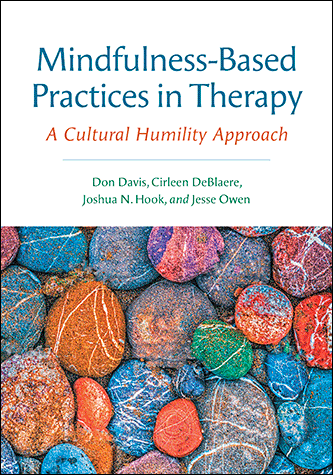
Mindfulness-Based Practices in Therapy
Available formats
Also available from
Eastern spirituality has exerted considerable influence on the fields of counseling and psychology through the use of mindfulness-based practices. This book serves as a practical introduction to integrating mindfulness-based practices in therapy, with a focus on assessing whether it is appropriate to use or adapt mindfulness activities to the specific cultural identity or identities of clients.
Interventions can be adapted to account for clients' religious/spiritual identity, gender norms, racial/ethnic background, community values and pressures, personality traits, unfamiliarity with mindfulness-based practices, cognitive flexibility, and individual life experiences.
The authors present an approach to integrating mindfulness in therapy that emphasizes cultural humility, which combines an accurate view of oneself (including limits in one's awareness, knowledge, and skills for working with individuals from diverse groups) with the ability to cultivate an "other-oriented" stance, thus enhancing one's ability to work with clients from a variety of cultural backgrounds.
By incorporating this client-centered approach, therapists will be better able to align the therapy process with clients' values, narratives about change, and therapy goals.
Preface
I. Conceptual and Personal Foundations
- Cultural Humility and Mindfulness: Why This, Why Now?
- What We Need to “Know” About Mindfulness
- Balancing Two Multicultural Concerns Related to Mindfulness
- Understanding a Multicultural Orientation Perspective of Mindfulness
- Increasing Cultural Comfort for Spiritual Diversity
II. Application of Multicultural Orientation in Stages of Therapy
- Assessing the Appropriateness of Mindfulness Interventions for Clients
- Negotiating the Plan
- Earning Trust With Spiritual Communities
- Integrating Mindfulness in the Real World
References
Index
About the Authors
Don Davis, PhD, is an associate professor of counseling psychology, counselor education and practice, and mental health counseling at Georgia State University in Atlanta.
His research interests focus on positive psychology, especially humility and related virtues. He also does research and writing on spirituality and its intersection with other identities in counseling. He teaches courses on leadership in positive psychology, group counseling, and appraisal and measurement, and also coordinates a doctoral track designed to prepare master’s students to apply to doctoral programs in either counseling psychology or counselor education and practice.
Dr. Davis has coedited or coauthored several books, including Cultural Humility: Engaging Diverse Identities in Therapy (2017); Helping Groups Heal: Leading Groups in the Process of Transformation (2017); and the Handbook of Humility: Theory, Research, and Applications (2017). He is an associate editor of The Journal of Positive Psychology and also serves on the editorial boards of the Journal of Counseling Psychology and Spirituality in Clinical Practice.
Cirleen DeBlaere, PhD, is an associate professor of counseling psychology at Georgia State University in Atlanta.
Her research and professional interests focus on examining the experiences of individuals with marginalized identities. Her research has been published in premier journals in her field, such as the Journal of Counseling Psychology, The Counseling Psychologist, and Psychology of Women Quarterly.
She has been recognized with several national awards, including the 2011 Outstanding TCP [The Counseling Psychologist] Major Contribution Award, 2012 Research on Psychotherapy With Women Award, 2012 Women of Color Psychologies Award, and 2018 Evelyn Hooker Award for Distinguished Contribution by an Ally.
Dr. DeBlaere is invested in teaching, training, and service activities that manifest her investment in diversity and social justice issues. For instance, she currently serves as the vice president for diversity and public interest for APA Division 17 (Society of Counseling Psychology). Recently, she was awarded the Outstanding Early Career Professional Supervisor/Trainer Award from the Society of Counseling Psychology’s Supervision and Training Section in recognition of her contributions to supervision and training.
Dr. DeBlaere also cofounded and is the inaugural cochair of the Division on Asian Americans With Multiple Heritages of the Asian American Psychological Association. She serves or has served on multiple editorial boards as a member, including the Journal of Counseling Psychology and Psychology of Women Quarterly; and as an associate editor, including The Counseling Psychologist, Psychology of Sexual Orientation and Gender Diversity, and Sex Roles: A Journal of Research. She coauthored the book Cultural Humility: Engaging Diverse Identities in Therapy (2017).
Joshua N. Hook, PhD, is an associate professor of counseling psychology at the University of North Texas in Denton, where he teaches the graduate multicultural counseling course. He is a licensed clinical psychologist in Texas.
Dr. Hook’s professional interests include humility, religion and spirituality, and multicultural counseling. His research has been published in premier journals in his field, such as the Journal of Counseling Psychology, The Counseling Psychologist, The Journal of Positive Psychology, and Psychology of Religion and Spirituality. He has coedited or coauthored several books, including Cultural Humility: Engaging Diverse Identities in Therapy (2017); Helping Groups Heal: Leading Groups in the Process of Transformation (2017); and the Handbook of Humility: Theory, Research, and Applications (2017). He serves on several editorial boards, including the Journal of Counseling Psychology, Psychology of Religion and Spirituality, and Spirituality in Clinical Practice.
In 2019, he won the Fritz & Linn Kuder Early Career Award for Distinguished Scientific Contributions to Counseling Psychology.
He blogs regularly at https://www.JoshuaNHook.comopens in new window.
Jesse Owen, PhD, is a professor of counseling psychology at the University of Denver in Colorado. His research interests focus on multicultural processes in psychotherapy, therapist expertise, and romantic relationships.
He is an APA fellow for the Society for the Advancement of Psychotherapy (SAP; Division 29), and he has been awarded the Early Career Awards for SAP and Division 17 (Counseling Psychology). He also has served as SAP’s domain chair and representative for education and training, and he currently is the treasurer.
Dr. Owen has published more than 125 peer-reviewed publications, most of which focus on psychotherapy process and outcomes; he is the incoming editor for the journal Psychotherapy; and he coauthored the book Cultural Humility: Engaging Diverse Identities in Therapy (2017).
In his small private practice in Denver, Dr. Owen focuses on individual and couple therapy as well as psychological assessment.
A true gift to the world of multicultural and social justice psychotherapy, this text extends the important connections between mindfulness and cultural humility. Practical case examples make this content accessible, readily incorporable into any therapist’s practice, and a blueprint for integrating mindfulness in everything we do.
—Anneliese Singh, PhD, LPC
Professor and Associate Dean of Diversity, Equity, and Inclusion, University of Georgia, Athens
This timely and invaluable book offers an enriching application of multicultural theory to the rapidly growing area of mindfulness. The authors skillfully weave reflections and exercises into an important discourse on cultural appropriation, cultural humility, and power. A must-read for mindfulness teachers and therapists across all traditions who wish to balance honoring the roots of mindfulness while sensitively adapting the practices to the religious, cultural, and psychological backgrounds of their clients.
—Shari M. Geller, PhD
Clinical Psychologist, author of A Practical Guide to Cultivating Therapeutic Presence and coauthor of Therapeutic Presence: A Mindful Approach to Effective Therapy