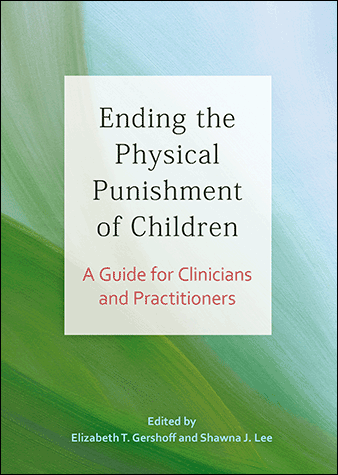
Ending the Physical Punishment of Children
Available formats
Also available from
Research shows that corporal punishment harms children and is ineffective at changing their behavior. In this volume, Elizabeth T. Gershoff and Shawna J. Lee present 15 effective interventions designed to prevent parents from physically punishing their children.
Each chapter author reviews a different intervention, summarizes its evidence base and generalizability across populations and contexts, and explains how to implement it in community and mental health settings. Some strategies explicitly discourage parents from using physical punishment, while others focus on teaching alternative ways to manage children’s behavior.
Gershoff and Lee show how the various interventions can be implemented in individual, family, or group therapy or used to educate the public in hospitals or other community settings. All of the strategies will help parents change their behavior in ways that promote their children’s healthy development.
Therapists, social workers, policy makers, and other community health and safety professionals will appreciate the various strategies presented in this book.
Contributors
Introduction: The Rationale for Reducing Physical Punishment
Elizabeth T. Gershoff and Shawna J. Lee
I. Individual- and Family-Level Interventions
- Brief Online Education
George W. Holden and Alan S. Brown - Alternative Biblical Interpretations Intervention
Cindy Miller-Perrin and Robin Perrin - Baby Books
Stephanie M. Reich and Guadalupe Díaz - Motivational Interviewing
George W. Holden and Grant W. O. Holland
II. Hospital- or Clinic-Based Interventions
- Play Nicely
Seth Scholer - Safe Environment for Every Kid (SEEK)
Howard Dubowitz - The Video Interaction Project (VIP)
Caitlin Canfield, Erin Roby, and Alan Mendelsohn - An Educational Intervention for Health Care Providers
Gail Hornor, Saribel Garcia Quinones, Deborah Bretl, Ellen Chiocca, Carrie Donnell, Katharine Doughty, Bridget Marshall, and Kristen Morris
III. Group-Based Interventions
- Positive Discipline in Everyday Parenting (PDEP)
Joan E. Durrant - The ACT Raising Safe Kids Program
Michele Knox and Morgan Dynes - The Chicago Parent Program
Susan M. Breitenstein, Deborah Gross, and Amie F. Bettencourt - The Moms’ Empowerment Program
Andrew Grogan-Kaylor, Kathryn H. Howell, Maria M. Galano, and Sandra A. Graham-Bermann
IV. Multilevel or Universal Interventions
- Triple P — Positive Parenting Program
Ronald J. Prinz - No Hit Zones
Elizabeth T. Gershoff - Legal Prohibitions of Physical Punishment
Elizabeth T. Gershoff and Joan E. Durrant
Afterword: Common Themes and Next Steps
Elizabeth T. Gershoff and Shawna J. Lee
Index
About the Editors
Elizabeth T. Gershoff, PhD, is a professor of human development and family sciences and is associate director for faculty development at the Population Research Center, both at the University of Texas at Austin. She has published extensively on the topic of physical punishment and is an internationally recognized expert on the effects that physical punishment by parents or by school personnel has on children.
Shawna J. Lee, PhD, is an associate professor in the School of Social Work at the University of Michigan.
Dr. Lee has published numerous articles and book chapters on early parent–child relationships, physical discipline of children, and child maltreatment prevention. She was lead author of the American Professional Society on the Abuse of Children statement against the use of physical punishment.
With the American Psychological Association’s and the American Academy of Pediatrics’s recommendation against parents spanking their children, clinicians are looking for effective alternatives. The techniques in this brilliant book provide the key.
—Gail S. Goodman, PhD
Distinguished Professor of Psychology, University of California, Davis