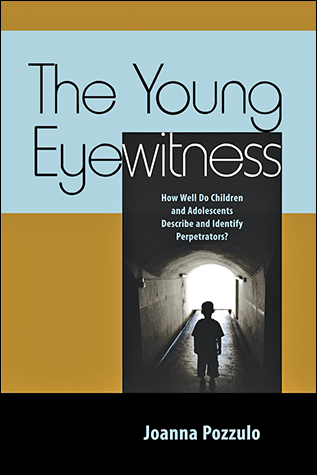
The Young Eyewitness
Every year, numerous crimes involving child eyewitnesses occur. In some cases, children are the only eyewitnesses, which makes their testimony especially critical for solving the cases. But how reliable is child eyewitness evidence?
This book summarizes the research on how well children can describe an event and perpetrator, which is a recall task, and how well they can identify the perpetrator in person or in photographs, which is a recognition task.
Joanna Pozzulo argues that although children may be less advanced in these skills than adults, they nonetheless can provide invaluable evidence. She interprets the research in light of developmental theories and notes its practical implications for forensic investigations. Interviewing techniques that facilitate accurate recall are presented, as are lineup techniques that facilitate accurate recognition.
This book is an essential resource for all forensic investigators.
Introduction
- Overview of Forensic Concepts
- Ability of Young Eyewitnesses to Describe a Person
- Techniques to Improve the Amount and Accuracy of Recall Information
- Effects of Lineup Construction and Procedures
- Other Factors Influencing the Young Eyewitness' Identification Accuracy
- Why Recall and Identification Abilities Differ Between Young and Adult Eyewitnesses
- Relation Between Describing the Perpetrator and Identifying the Perpetrator
- Jurors' Perceptions of the Young Eyewitness
- Policy Implications
- Future Directions for Young Eyewitness Research
References
Index
About the Author
Joanna Pozzulo, PhD, is a professor of psychology and chair of the Department of Psychology at Carleton University, Ottawa, Ontario, Canada.
Dr. Pozzulo is a leading expert on children's eyewitness identification abilities. Her research, funded by the Social Sciences and Humanities Research Council and Carleton University, focuses on the development of face memory and the procedures that police can use to increase the reliability of eyewitness identification from lineups.
Dr. Pozzulo has coauthored two textbooks on forensic psychology. She has received numerous awards for her research and teaching.
What is particularly impressive about this book is that Pozzulo successfully makes the complex field of young eyewitness memory accessible to all readers while not short-shrifting the technical complexities.
—PsycCRITIQUES
Pozzulo introduces this work in a straightforward and convincing manner—there are no gaps in following her logic. The reader is left with a clear sense of the problem, a firm appreciation for why the problem must be addressed, and, most importantly, absolute certainty that accuracy can be improved.
—Choice
This authoritative book is the best source of information for research on children's eyewitness identification. It should sit prominently on the desks of attorneys, researchers, and interviewers who work in this field.
—Maggie Bruck, PhD
Professor of Child Psychiatry, Johns Hopkins School of Medicine, Baltimore, MD
This book, authored by a leading authority on child and adolescent eyewitnesses, is a must-read for students, instructors, investigators, and practicing lawyers with interests in eyewitness testimony in general and the involvement of youth as witnesses in particular. No other book — contemporary or historical — so comprehensively and effectively integrates decades of research to inform us about youths' abilities to describe and identify perpetrators, factors affecting their abilities, the jury's perception of youth who testify, and the paths toward improvement in the justice system through policy change.
—Brian Cutler, PhD
Professor, Faculty of Social Science & Humanities, University of Ontario Institute of Technology, Oshawa, Canada