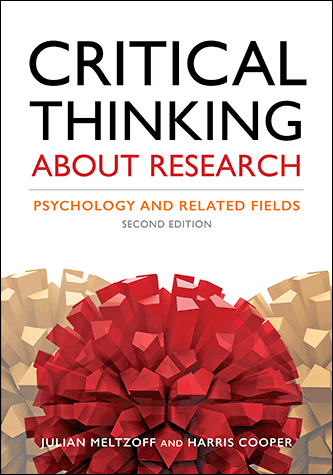
Critical Thinking About Research
Available formats
Also available from
Could the research you read be fundamentally flawed? Could critical defects in methodology slip by you undetected? To become informed consumers of research, students need to thoughtfully evaluate the research they read rather than accept it without question.
This second edition of a classic text gives students the tools they need to apply critical reasoning when reading behavioral science research. It updates the original text with recent developments in research methods, including a new chapter on meta-analyses.
Part I gives a thorough overview of the steps in a research project and focuses on how to assess whether the conclusions researchers draw in a behavioral science report are warranted by their methods. Topics include research hypotheses, sampling, experimental design, data analysis, interpretation of results, and ethics.
Part II allows readers to practice critical thinking with a series of fictitious journal articles containing built-in flaws in method and interpretation. Clever and engaging, each article is accompanied by a commentary that points out the errors of procedure and logic that have been deliberately embedded in the article.
This combination of instruction and practical application will promote active learning and critical thinking in students studying the behavioral sciences.
Foreword
Preface to the Second Edition
Preface to the First Edition
Introduction
I. Principles of Critical Thinking
- Seeking Trustworthy Knowledge
- Research Questions and Hypotheses
- Research Variables and Strategies
- The Sample
- Confounding Variables and Their Control
- Research Designs and Threats to Internal Validity
- Manipulation and Measurement Validity
- Data Analysis, Discussion, and Conclusions
- Inferences, Conclusions, and the Research Report
- Research Syntheses and Meta-Analysis
- Research Ethics
II. Critical Thinking Using Practice Articles
- Use of Counselor "Street Talk" to Stimulate Self- Disclosure of Inner-City Youths
- Treatment of Flying Phobia: Comparative Efficacy of Two Behavioral Methods
- The Effect of Divorce on Sons' Aggression
- Dyslexia in Fifth-Grade Girls: Personality and Perceptual Factors
- Time Estimation: Effect of Depression and Pleasantness or Unpleasantness of an Experience
- Bossiness in Firstborn Girls
- Effect of Context Upon Accuracy of Recall of Affective Experiences
- The Effects of Medication and Cognitive Behavior Therapy on Insomnia
- Midlife Crises of Men at Age 50
- Effect of Job Stress and Stress Management on Low Back Pain
- Evaluation of Health Maintenance Organizations
- Effects of Jury Selection Consultation on Trial Outcome
- Contingency Reinforcement in the Treatment of Talking Aloud to Self: A Single-Case Study
- The Effect of Race of Examiner on IQ Scores of American Indians
- Social Effects of Tax Deadline
- Comparative Effectiveness of Teacher Management Styles in a Fifth Grade Classroom
- Age Differences in Gullibility: A Meta-Analysis
Epilogue
Glossary
References
Index
About the Authors
Julian Meltzoff, PhD, earned his doctorate in psychology from the University of Pennsylvania.
From 1979 to 1996 he was professor of psychology and director of research at the California School of Professional Psychology in San Diego. He taught graduate courses in the design and critique of research, conducted doctoral research seminars, and supervised the school's dissertation process. Prior to 1979, Dr. Meltzoff served for an extended period as chief psychologist in Veterans Affairs facilities in Pennsylvania and New York.
Dr. Meltzoff was engaged in doing research, writing about research, and consulting on research throughout his clinical, administrative, and academic career. He is the coauthor of The Day Treatment Center: Principles, Application, and Evaluation (1966) and Research in Psychotherapy (1970), as well as numerous journal articles and book chapters.
He passed away in December 2015 at age 94.
Harris Cooper, PhD, is the Hugo L. Blomquist Distinguished Professor of Psychology & Neuroscience at Duke University.
He is the author of several books, including Research Synthesis and Meta-Analysis: A Step-by-Step Approach (2009), Ethical Choices in Research: Managing Data, Writing Reports, and Publishing Results in the Social Sciences (2016), and Reporting Research in Psychology: How to Meet Journal Article Reporting Standards (2011).
He served as editor of the Psychological Bulletin and Archives of Scientific Psychology, and as department chair at Duke University and the University of Missouri–Columbia.
This volume provides a valuable background for the skills students must develop to be good consumers and producers of research.
—Choice
When it comes to research methods, research design, and critical thinking about psychological research, this volume is truly the only game in town. It is encyclopedic and addresses almost every topic that might be included in a research methods course at either the advanced undergraduate or graduate level. The 17 practice articles provide an exceptional pedagogical tool for fostering discussion of how abstract principles unfold in a research context.
—Mark Appelbaum, PhD
Emeritus Professor, Department of Psychology, University of California, San Diego
This is THE book for every student or smart consumer of scientific research who wants to hone their skills at evaluating research. In exceptionally clear language, the authors teach the basic principles of research methods and show readers how to identify the truth value of research findings. Engaging examples of research articles — and critiques of them — allow readers to apply and test their new knowledge.
—Wendy Wood, PhD
Professor of Psychology and Business, University of Southern California, Los Angeles
Praise for the First Edition
This is an excellent book for teaching college students — or anyone else, for that matter — how to be smart when it comes to interpreting other people's research. It is well thought out and filled with useful examples that illustrate how fuzzy thinking can lead to incorrect conclusions.
—Lawrence Kutner, PhD
Department of Psychiatry, Harvard Medical School, Boston, MA