The Aging Brain
Available formats
Also available from
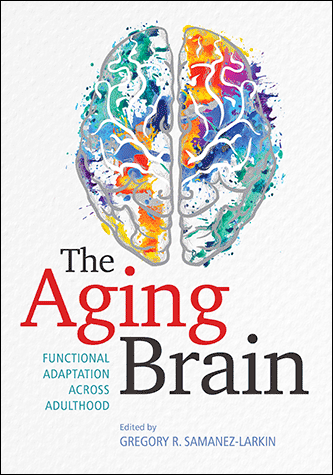
Brain aging has long been viewed as a process of slow, inevitable deterioration. This theory has been challenged with new research demonstrating a more complex set of changes — growth, decline, adaptation, selectivity, and reorganization — in brain structure and function across adulthood.
In fact, research in both behavioral and brain sciences shows that not all cognitive processes decline with age, some improve over the course of adulthood, and those that improve often compensate for those that decline. It turns out that the aging brain is very much alive, a remarkable example of life's ability to survive and adapt in increasingly challenging environments.
Chapters in this multidisciplinary volume examine structural and related functional changes in the aging brain and the neural mechanisms underlying such changes, age-related changes in learning and episodic memory, risk and protective factors, and the assessment and prevention of cognitive decline.
Contributors
Preface
Gregory R. Samanez-Larkin
Introduction
Gregory R. Samanez-Larkin
- Structure and Function of the Aging Brain
R. Nathan Spreng and Gary R. Turner - Neural Mechanisms Underlying Age-Related Changes in Attentional Selectivity
Briana L. Kennedy and Mara Mather - Learning and Memory in the Aging Brain: The Function of Declarative and Nondeclarative Memory Over the Lifespan
Nichole R. Lighthall, Lindsay B. Conner, and Kelly S. Giovanello - Age-Related Changes in Episodic Memory
Audrey Duarte and Elizabeth Kensinger - Motivated Memory, Learning, and Decision-Making in Older Age: Shifts in Priorities and Goals
Mary B. Hargis, Alexander L. M. Siegel, and Alan D. Castel - Social Function and Motivation in the Aging Brain
Angela Gutchess and Gregory R. Samanez-Larkin - Compensation and Brain Aging: A Review and Analysis of Evidence
Laura B. Zahodne and Patricia A. Reuter-Lorenz - Risk and Protective Factors in Cognitive Aging: Advances in Assessment, Prevention, and Promotion of Alternative Pathways
Roger A. Dixon and Margie E. Lachman
Index
About the Editor
Gregory R. Samanez-Larkin, PhD, is an assistant professor in the Department of Psychology and Neuroscience and core faculty member in the Center for Cognitive Neuroscience in the Duke Institute for Brain Sciences at Duke University. He is a founding director of the Scientific Research Network on Decision Neuroscience and Aging and the Summer School in Social Neuroscience and Neuroeconomics.
Dr. Samanez-Larkin is on the editorial board of the journal Psychology and Aging (APA).
Samanez-Larkin and his lab members conduct research focused on identifying psychological and neurobiological strengths at all stages of adulthood that enhance everyday decision making and improve health and well-being in older age. His laboratory uses a combination of behavioral measures, computational modeling, structural (DTI) and functional (fMRI) brain imaging, and molecular brain imaging (PET) of the dopamine system.
He conducted many of the foundational studies on reward processing and decision making in the aging human brain and continues to be a leader in research on decision neuroscience and aging. He has been continuously supported by training and research grants from the National Institute on Aging since 2005.
Dr. Samanez-Larkin teaches undergraduate courses on statistical methods and applications of human brain imaging in everyday life. As a graduate student at Stanford University he received the Albert H. and Barbara R. Hastorf Prize for Teaching in 2010 and as a junior faculty member at Yale University he received the Poorvu Family Award for Interdisciplinary Teaching in 2015. He was on the Yale College Committee on Teaching and Learning from 2015–2016.
He grew up in Flint, Michigan and was an undergraduate at the University of Michigan–Flint before transferring to the University of Michigan where he received a bachelor's degree in Psychology Honors in 2002. After spending 3 years as a lab manager (and moonlighting as a freelance graphic designer), he completed a PhD in psychology at Stanford University in 2010. He was a post-doctoral fellow at Vanderbilt University and then faculty member at Yale before moving to Duke in 2017.
He lives with his spouse, a child clinical psychologist, and three daughters in Durham, North Carolina.
The target audience for this edited volume is researchers in the neuroscience and psychology of aging…. For the intended audience…this book makes an excellent contribution to knowledge…. Highly recommended.
—Choice
Written by knowledgeable experts, this remarkably readable book provides a comprehensive overview of the best research on the aging brain, encompassing cognitive, emotional, social, and motivational processes. What sets this book apart from others, however, is a refreshingly contemporary emphasis on functional adaptation — the ability to cope, compensate, and continue to develop as the brain ages.
—Valerie F. Reyna, PhD
Lois and Melvin Tukman Professor; Director, Human Neuroscience Institute; Co-Director, Center for Behavioral Economics and Decision Research; Cornell University, Ithaca, NY
In this book, the authors emphasize strategies rather than abilities, which reflects a shift in thinking from age-related "impairments" to "differences" that might have multiple causes. They also provide timely and thoughtful discussions of neural compensation in aging and protective/moderating factors on age effects.
—Cheryl L. Grady, PhD
Senior Scientist, Rotman Research Institute at Baycrest; Professor of Psychiatry and Psychology, University of Toronto, Toronto, Ontario, Canada
This volume presents an important synthesis of what we know about the brain as people age. Contributors present thorough overviews and helpful calls for future research. A must-read for any researchers interested in memory over the lifespan.
—Eric J. Johnson, PhD
Norman Eig Professor of Business, and Director, Center for the Decision Sciences, Columbia Business School, Columbia University, New York, NY