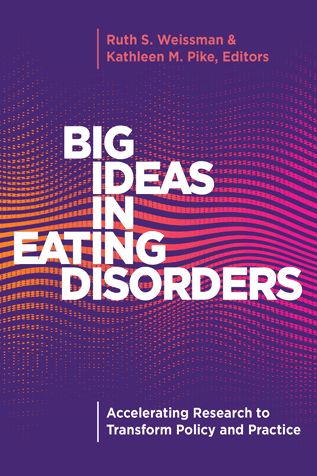
Big Ideas in Eating Disorders
Available formats
Also available from
Turning bold ideas into real progress for eating disorder prevention and treatment.
Eating disorders are among the most serious mental health conditions. The field has made major strides in identifying risk factors, refining interventions, and building evidence-based treatments. Yet the reality remains stark: eating disorders continue to pose a critical public health challenge, and far too many people still lack access to effective care.
This book brings together “big ideas” to close the gap between what science taught us and what still needs to happen to eradicate eating disorders. Leading scholars, clinicians, and individuals with lived experience share transformative strategies to reshape the field, from risk reduction to prevention to treatment.
Big ideas move us forward, not in small steps, but in leaps. Each chapter highlights a key knowledge or practice gap, then lays out a bold concept designed to propel the field ahead, along with actionable steps to turn that vision into reality. Chapters are also accompanied by podcasts featuring the personal stories behind the contributors. Learn more about the motivations, challenges, and journeys of these researchers by visiting the Big Ideas in Eating Disorders podcastopens in new window.
Foreword. Same Questions – New Answers
Foreword. Catalyzing a Field: Lessons From Public Health
Introduction: What Is the Big Idea?
Ruth S. Weissman and Kathleen M. Pike
Part I. Transforming the Characterization and Identification of Feeding and Eating Disorders
- Chapter 1. What Is an Eating Disorder? A Reimagining of the Diagnostic Spectrum of Eating Disorders
Phillipa Hay and Deborah Mitchison - Chapter 2. Bridging The Paradigm Divide: A Novel Framework for Pediatric Feeding and Eating Disorder Diagnosis and Intervention
William G. Sharp and Kathryn M. Peterson - Chapter 3. Muscles and Misdiagnosis: Introducing a Muscularity-Oriented Eating Disorder Phenotype
Stuart B. Murray and Jason M. Nagata - Chapter 4. Leveraging Social Media Algorithms to Improve Eating Disorder Screening
Scott Griffiths and Roisin McNaney
Part II. Elucidating Mechanisms Involved in the Development and Maintenance of Feeding and Eating Disorders
- Chapter 5. Shaped by Society: Beyond a Culturalist Understanding of Eating Disorder Risk
Anne E. Becker - Chapter 6. Women’s Reproductive Health Must Be a Priority in Eating Disorders Research to Move the Field Forward
Kelly L. Klump and Kristen M. Culbert - Chapter 7. At What Cost? Understanding Binge-Type Eating Disorders Through the Lens of Cognitive Effort
Laura A. Berner and Riley Macks - Chapter 8. They Are Called Eating Disorders for a Reason: The Study of Eating Behavior Is Key to Advance Science and Care
B. Timothy Walsh
Part III. Reenvisioning Clinical Care
- Chapter 9. From Discovery to Clinical Utility: The Promise of Eating Disorders Genetics
Cynthia M. Bulik - Chapter 10. Uncovering the Brain’s Response to Psychotherapy to Transform the Next Generation of Care for Eating Disorders
Jennifer J. Thomas and Ashley Dunford - Chapter 11. Recovery in Your Pocket: Transforming Eating Disorder Care With Smartphones
Jake Linardon - Chapter 12. Rethinking Early Intervention to Drive Better Health Outcomes
Tracey D. Wade, Maya Jabs, Mia L. Pellizzer, Jamie-Lee Pennesi, Marcela Radunz, and Yuan Zhou - Chapter 13. Leveraging Technology to Improve Screening, Early Detection, and Intervention for Eating Disorders at Scale
Ellen E. Fitzsimmons-Craft, Laura D’Adamo, and Denise E. Wilfley
Part IV. Transformational Policies for Prevention and Treatment of Feeding and Eating Disorders
- Chapter 14. From Data to Action: A Population Surveillance Framework to Improve Eating Disorder Policies and Outcomes
Deborah Mitchison and Matthew Fuller-Tyszkiewicz - Chapter 15. Predicting Risk, Preventing Harm: Using Multilevel Spatial Methods to Counter Political and Commercial Drivers of Eating Disorders
S. Bryn Austin, Ariel L. Beccia, and Lingbo Liu - Chapter 16. An Enhanced Bolder Model for Building Advocacy Into Researching, Preventing, and Treating the Eating Pathology Spectrum
Michael P. Levine
Part V. Accelerating Research on Feeding and Eating Disorders
- Chapter 17. Formal Mathematical and Computational Modeling of Eating Disorders as Complex Dynamical Systems
Shirley B. Wang and Adanya D. Johnson - Chapter 18. The Digital Dilemma: A Research Agenda to Determine Why More Tools Have Not Meant Better Outcomes
Stephanie Bauer and Markus Moessner - Chapter 19. Personalized Pathways: Advancing Tailored Treatments in Eating Disorder Research
Tracey Wade, Raima Harding, Mia L. Pellizzer, Jamie-Lee Pennesi, Marcela Radunz, and Yuan Zhou - Chapter 20. Scientific Enterprise in the 21st Century: How Metascience Can and Will Propel Eating Disorder Research Forward
Matthew Fuller-Tyszkiewicz and Jake Linardon
Conclusion: Generating Big Ideas to Transform the Eating Disorders Landscape
Kathleen M. Pike and Ruth S. Weissman
Ruth S. Weissman, PhD, is professor of psychology and Walter A. Crowell University Professor of the Social Sciences, Emerita, at Wesleyan University, where she has taught since 1987. Her contributions to research and teaching have been recognized with awards including the Academy for Eating Disorders (AED) Lifetime Achievement Award and the AED’s Leadership Award for Research; the Research Award of the Coalition for Eating Disorders Research, Policy, and Action, and the New England Psychological Association’s Distinguished Contribution Award. She is a past president of the Academy for Eating Disorders, and past president of the Eating Disorders Research Society. She currently serves as the editor-in-chief of the International Journal of Eating Disorders.
Kathleen M. Pike, PhD, is professor of psychology at Columbia University Irving Medical Center, where she launched her career in eating disorders over thirty years ago. A world expert in the field, Dr. Pike has served as President of the Eating Disorders Research Society and is a Fellow of the Academy for Eating Disorders. She is recognized for her pioneering work in developing innovative, evidence-based treatments and for her scientific contributions to expanding global understanding of eating disorders. Dr. Pike is also host of the podcast Big Ideas In Eating Disorders, where she talks with leaders in the field who share their ideas and stories as they have never been told before.
Finally, a brand new look at eating disorders with an eye to moving the field quickly toward meaningful solutions. Drs. Weissman and Pike have assembled an impressive group of scholars who reveal their Big Ideas to improve identification, understanding, treatment, and clinical outcome for the millions of individuals worldwide affected by these complex conditions.
—Evelyn Attia, MD, Suzanne Crosby Murphy Professor of Psychiatry, Columbia University Irving Medical Center, New York, NY, United States; Professor of Clinical Psychiatry, Weill Cornell Medicine, New York, NY; Director, Center for Eating Disorders, New York– Presbyterian Hospital, White Plains, NY
This book is exactly what the field needs right now. It offers inspiration and exposure to innovative thinking, as well as new and bold ideas emerging from many years of research, clinical work, personal experience with eating disorders, and reflection. The editors, world-leading researchers in the field, have truly succeeded in bringing together contributors who share ideas, visions, and reflections that feel like a feast for the mind.
—Ata Ghaderi, PhD, Professor, Karolinska Institutet, Stockholm, Sweden
Led by pioneers of innovation, Big Ideas in Eating Disorders delivers on its promise to give bold answers to tough questions. Companion podcasts with clinicians, scientists, and individuals with lived experiences bring personal stories to life—laying the critical foundation for major breakthroughs that will help us to eradicate eating disorders.
—Pamela K. Keel, PhD, Robert O. Lawton Distinguished Professor, Department of Psychology, Florida State University, Tallahassee, FL, United States; Fellow, American Psychological Association
No room for comfort with worn-out ideas here. This book engages readers in a bold, forward-looking experiment. Each of the best thinkers in the eating-disorders world envisions a “Big Idea,” explaining why it’s needed, how to test it, and how to make it happen. Whether you are a clinician, researcher, educator, or advocate, this book will widen your perspectives on eating-disorder classification, etiology, care, and policy in ways you have not considered before.
—Howard Steiger, PhD, Emeritus Professor, Department of Psychiatry, McGill University, Montreal, QC, Canada; Former Head, Eating Disorders Continuum, Douglas Mental Health University Institute, Montreal, QC