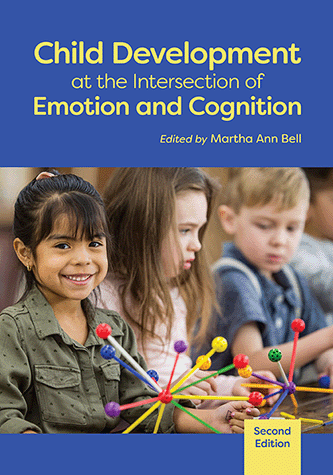
Child Development at the Intersection of Emotion and Cognition
In this extensively revised edition, Martha Ann Bell and her contributors synthesize the newest research on how cognitive and emotional processes influence each other in child development.
Historically, research in child development has treated cognitive processes as separate and distinct from social-emotional processes. However, many of the factors that influence self-regulation are also closely linked to cognitive development. For example, genetics, prenatal environment, relationships, language, and physiological processes are all links between emotion and cognition in child development.
The first edition of this volume greatly increased our understanding of emotion-cognition integration. This second edition incorporates new longitudinal research demonstrating this integration during infancy and throughout childhood. Chapters incorporate new research methods based on technological advances that have greatly enhanced our ability to examine early human brain development. The resulting volume is a critical read for those interested in understanding how brain development influences our behavior and social interactions.
Contributors
Introduction: Cognition and Emotion as Codeveloping Processes
Martha Ann Bell
Part I. Basic Developmental Processes
Chapter 1. The Neuroscience of Social Relationships in Early Development
Jessica A. Stern and Tobias Grossmann
Chapter 2. The Role of Language in the Development of Emotion Regulation
Margaret A. Fields-Olivieri, Yeunjoo Kim, Kristin J. Jennings, and Pamela M. Cole
Chapter 3. Hot Executive Function: Emotion and the Development of Cognitive Control
Philip David Zelazo, Isabelle F. Morris, Li Qu, and Amanda C. Kesek
Chapter 4. Emotion Regulation and Executive Function
Claire Hughes and Laura Katus
Chapter 5. Foundations of Cognitive Reappraisal of Emotion in Childhood
Elizabeth L. Davis
Part II. Environmental and Contextual Processes
Chapter 6. Feeling and Understanding Through the Prism of Relationships
Ross A. Thompson
Chapter 7. Cognition and Emotion: Family Member Similarity and Intergenerational Transmission
Kirby Deater-Deckard, Yelim Hong, Christina Bertrand, and Ann Folker
Chapter 8. Living in a Digital World: Understanding the Development of Adolescent Emotional Adjustment in the Context of Digital Technologies
Jennifer L. de Rutte, Abigail Findley, and Tracy A. Dennis-Tiwary
Part III. Implications for Education and Clinical Research
Chapter 9. Childhood Shyness: An Exemplar of the Interface of Cognition and Emotion in Human Development
Louis A. Schmidt, Raha Hassan, Xiaoxue Kong, Taigan L. MacGowan, and Kristie L. Poole
Chapter 10. Self-Regulation and Academic Achievement
Claire E. Cameron, Megan M. McClelland, Jennie Grammer, and Frederick J. Morrison
Chapter 11. External and Internal Attention Processes in the Early Integration of Cognition and Emotion: Risk and Protective Factors for Anxiety in the Context of Behavioral Inhibition
Marisa N. Lytle, Kelley E. Gunther, and Koraly Pérez-Edgar
Chapter 12. The Intersection of Cognition and Emotion in Developmental Psychopathology
Sarah L. Karalunas, Joel T. Nigg, and McKenzie Figuracion
Index
About the Editor
Martha Ann Bell, PhD, is University Distinguished Professor, College of Science Faculty Fellow, and Professor of Psychology at Virginia Tech, where she has been on faculty since 1996 as a member of the developmental science program. Her research team examines individual differences in the development of executive function and emotion regulation across infancy and childhood, with her and collaborators’ work funded by the National Institutes of Health (NICHD, NIMH, NIDA) and the National Science Foundation.
Bell is a fellow of APA (Division 7, Developmental Psychology; Division 3, Experimental Psychology and Cognitive Science) and a fellow of the Association for Psychological Science. She is past recipient of the Senior Investigator Award from the International Society for Developmental Psychobiology, as well as the society’s Rovee-Collier Mentor Award. She also has received Virginia Tech’s top awards for research (Alumni Award for Research Excellence) and mentoring (Outstanding Graduate Mentor Award – College of Science). Bell is past Editor of the journal Infancy and past chair of the NIH study section Cognition and Perception.
The field is ripe for the kind of synthesis reviews that these chapters provide, bringing together the hottest areas in psychological science. This volume achieves that goal masterfully. The chapters are written by leaders in the field and organize not just what is happening, but also why. Each contribution is readable and helpful, making it a valuable text for students and more advanced scholars alike.
—Seth Pollak, PhD, Paughan Bascom Distinguished Professor of Psychology, University of Wisconsin–Madison, Madison, WI, United States
For too long, cognition and emotion were considered as largely separate and unrelated; emotions were considered lowlier (cognition being more exalted) and something to be controlled, regulated, or inhibited. Here, Martha Ann Bell has assembled impressive contributors who elaborate on the rich bidirectional relation between cognitive and emotional development, and how emotions can aid, as well as impair, cognitive performance. Entire chapters are also devoted to the effects of the social environment or context on cognition and emotions, and discussion of biological and neural underpinnings of cognitive and emotional development appears in several of the chapters. This is an excellent, cutting-edge text for people interested in understanding more about cognitive development, emotional development, the diverse ways in which they are related, and the roles of social and biological factors.
—Adele Diamond, PhD, FRSC, FAPA, FAPS, FSEP, ScD, DPhil, Canada Research Chair Professor of Developmental Cognitive Neuroscience, and Head, Program in Developmental Cognitive Neuroscience, Department of Psychiatry, University of British Columbia, Vancouver, BC, Canada