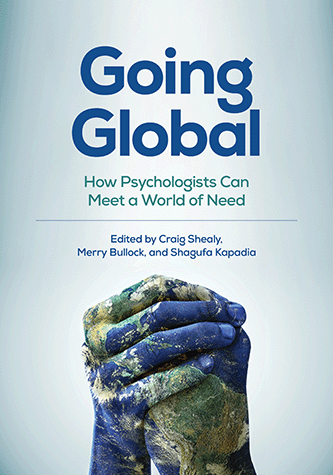
Going Global
Available formats
Also available from
This is the authoritative guide for psychologists who want to become involved in international efforts to meet pressing global needs.
Psychologists are increasingly applying their knowledge, skills, and values to big-picture issues such as sustainability, human rights, conflict resolution, global education, and religious and cultural understanding. However, education, training, and professional development often overlook “thinking and acting globally” as a vital component of the professional identities of psychologists.
With decades of international experience as scholars, educators, practitioners, policymakers, and consultants, contributors to this book describe exemplary programs, relevant trends, and dynamic possibilities for global engagement.
They focus specifically on nine key areas of expertise through which psychologists can make a difference:
- advocacy,
- assessment,
- consultation,
- intervention,
- leadership,
- policy,
- research,
- service, and
- teaching.
Introduction to Going Global: Why Psychologists Should Meet a World of Need
Craig Shealy, Merry Bullock, and Shagufa Kapadia
- Chapter 1. Advocacy: Global Opportunities and Responsibilities for Psychologists
Corann Okorodudu and Thema Bryant-Davis - Chapter 2. Assessment: The Power and Potential of Psychology Testing, Educational Measurement, and Program Evaluation Around the World
William E. Hanson, Jacqueline P. Leighton, Stewart I. Donaldson, Thomas Oakland, Mark D. Terjesen, and Craig N. Shealy - Chapter 3. Consultation: Who Needs Psychological Expertise Around the World and Why?
Connie Henson, John Fulkerson, Paula Caliguiri, and Craig Shealy - Chapter 4. Intervention: Enhancing Mental Health and Well-Being Around the World
Laura R. Johnson, Christopher F. Drescher, and Michael J. Bordieri - Chapter 5. Leadership: How Psychology and Psychologists Develop Global Leaders and Leadership
Sandra L. Shullman, Randall P. White, Lindy Brewster, Steven E. Grande, and Devi Bhuyan - Chapter 6. Policy: Why and How to Become Engaged as an International Policy Psychologist
Merry Bullock, Tor Levin Hofgaard, Ezequiel Benito, Pamela Flattau, Amanda Clinton, Craig Shealy, and Shagufa Kapadia - Chapter 7. Research: International Possibilities and Partnerships for Psychologists
Shagufa Kapadia, Chandra M. Mehrotra, Bonnie Kaul Nastasi, and Melanie M. Domenech Rodriguez - Chapter 8. Service: Towards a Global Psychology of Collaboration, Counterflow, and Capacity Building
Chris E. Stout, Elaine D. Hanson, and Gwen V. Mitchell - Chapter 9. Teaching: Opportunities and Recommendations for Internationalizing Psychology Education
Richard Velayo, Sherri McCarthy, and Lee Sternberger - Chapter 10. Concluding Thoughts on Going Global: How Psychologists Should Meet a World of Need
Craig Shealy, Merry Bullock, and Shagufa Kapadia
Craig N. Shealy, PhD, is a professor of psychology at Western Washington University and the executive director of the International Beliefs and Values Institute (IBAVI), which coordinates an array of scholarly, grant, educational, and service activities in the United States and internationally. Dr. Shealy’s research on the Beliefs, Events, and Values Inventory (BEVI) has been featured in multiple publications.
A licensed clinical psychologist, he is a Fulbright specialist in Japan, fellow of APA, past president of APA’s Division of International Psychology, a Nehru chair at MS Baroda University in India, and a National Register Legacy of Excellence Psychologist.
Merry Bullock, PhD, is secretary-general of the International Council of Psychologists and cochair of the Global Network of Psychologists for Human Rights Steering Committee. She has served in leadership roles in many psychology organizations, including APA (senior director of the APA Office of International Affairs for over a decade), the International Union of Psychological Science (deputy secretary-general), and APA’s International Division (president).
Dr. Bullock's research and scholarly writing explore early cognitive and motivational development, scientific reasoning, policy applications, and internationalization.
She is the recipient of awards for distinguished contributions to psychology from national, regional, and international organizations.
Shagufa Kapadia, PhD, is a professor in the department of human development and family studies and former director of Women's Studies Research Center at The Maharaja Sayajirao University of Baroda, India.
Her scholarly interests are cultural and cross-cultural perspectives in human development, particularly adolescence and emerging adulthood. She has researched cultural dimensions of socialization, morality, social support exchange, identity, and hopes and aspirations.
Dr. Kapadia has been a recipient of the Fulbright Senior Research Fellowship and the Shastri Indo-Canadian Faculty Research Award. She serves as the India Coordinator of the International Society for the Study of Behavioral Development (ISSBD).
American psychologists have woken up to the fact that they cannot acquire a comprehensive and even legitimate understanding of people, both individually and in groups, unless they go global. Seeking global understanding is not only essential to successful research, teaching, therapy, counseling, and consulting, it is also the key to combating fear of foreigners, xenophobia, and even hate. This book provides penetrating, invaluable insights from diverse and distinguished world experts as to why we all need to go global—not only to enhance our own understanding but also to serve the world in the way psychologists should, and indeed, must, in the 21st century.
—Robert J. Sternberg, PhD, Professor, Department of Psychology, College of Human Ecology, Cornell University, Ithaca, NY, United States; Honorary Professor of Psychology, Heidelberg University, Heidelberg, Germany
This book is a great read for any educator, clinician, policy maker, and advocate interested in international psychology. It consolidates all themes that constitute the cornerstone of global psychology in the 21st century.
—Brigitte Khoury, PhD, American University of Beirut, Beirut, Lebanon