APA Book Talk
Interviews With APA Book Authors

Transcript
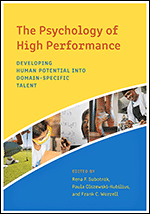
Announcer, Jamie Buck: [00:00:05] Welcome to "APA Book Talk" - the podcast about the latest psychology books from the American Psychological Association. It is our pleasure today to have Rena Subotnik, Paula Olszewski-Kubilius, and Frank Worrell, here to talk about their recently published book, The Psychology of High Performance.
Rena Subotnik: [00:00:23] Hi, I'm Rena Subotnick. I'm director of the Center for Psychology in Schools and Education at the American Psychological Association. One of the center's central missions is to generate public awareness, advocacy, clinical applications and cutting-edge research ideas that will enhance the achievement and performance in children and adolescents with special gifts and talents in all domains.
Frank Worrell: [00:00:48] Hello, my name is Frank Worrell. I'm a professor of education and psychology at the University of California, Berkeley, where I actually run the school psychology program. And I'm the faculty director of the Academic Talent Development Program.
Paula Olszewski-Kubilius: [00:01:02] Hello, my name is Paula Olszewski-Kubilius. I'm the director of the Center for Count Development at Northwestern University and I'm a professor in the School of Education and Social Policy.
Host, Chi Wang: [00:01:15] So we're very glad to have you all here. The editors of the book, The Psychology of High Performance.
Host, Chi Wang: [00:01:24] Can you briefly tell us what the book is about?
Rena Subotnik: [00:01:28] It's a result of a gathering of psychologists from sports, from the military, from the arts and from schools. And high performance psychology is focused on optimizing the talents of individuals so that they can perform the way they'd like to.
And so we put together a coalition sponsored by the American Psychological Foundation to generate research and ideas for presenting this research to the public. So what we decided to do for this book was to focus on domains of art, sports, the professions and academics.
And specifically, what we were interested in was, what each of the contributors were made up of the coalition members, as well as some international colleagues, was what are the abilities that are needed?
For example, in golf as compared to a team sport or medicine as compared to software engineering, what psychosocial skills are needed in, for example, acting compared to dancing? What is the insider knowledge that's needed in the visual arts as opposed to the culinary arts? And what do we still need to know in each of those domains? So this was the challenge of the book and this is what we were hoping to present and we feel like we were successful with that.
Host, Chi Wang: [00:03:17] Can you briefly tell me what is psychology of high performances?
Rena Subotnik: [00:03:23] When most people think of psychology outside of the community of APA, they think about therapists. And of course, therapists are very important to the health of our nation and the world. However, there are a number of other psychology domains that focus in different areas, and particularly we're interested in the psychology that's applied to high ability people who need help in maximizing their performance.
Frank Worrell: [00:04:00] One definition of psychology is the study of individual differences. And of course, we have people who are along the distribution. The psychology of high performance focuses on individuals who are the upper end of the distribution.
So, the people in the National Basketball Association, the people who in fact at the cutting edge of science and technology, all of these, how do these people get there? Right. They started off on a trajectory. And the psychologists work in that space of high performance, all working to help these people optimize their talents.
So, we have, in fact, researchers who are studying what are the best ways to do this? We also have clinicians who are helping individuals who are doing this, you know, manage their anxiety, manage distraction and those kinds of things, all with the goal of saying, how do I actually make the best contribution I can make and continue to develop.
Host, Chi Wang: [00:04:50] That's a very interesting concept. So, what cause would inspire you to write this book?
Rena Subotnik: [00:04:59] In the 1980s, the three of us encountered a book called Developing Talent in Young People. It was written and edited by Benjamin Bloom and his colleagues at the University of Chicago. And what was really exciting for us was how different it was from most of what we had been reading up until that time, which focused pretty exclusively on intellectual and academic talent.
This book not only focused on intellectual and academic talent, but also on the development of world class performance in sports and the arts. And this was mind boggling because of how different it was and how insightful it was to see how different and the same developing talent was across those domains.
In 2009, many years later, we had the fortune of getting support to spend a couple of years doing a deep dive into the psychological science, literature on giftedness, talent, eminence and high performance in different domains. What was exciting was to see how much existed in the performance domains.
Those are well invested areas. This is where people spend money because it matters, if you're a high performer or not. It matters if you invest in talent and in a way that seems different from the academic domains and specifically that includes psychosocial skills that you need to develop for high performance and insider knowledge.
Psychosocial skills are those that allow us to address things like performance anxiety, which every human being on earth experiences at one point or another, avoiding distractions so we can concentrate on our work, restoring self-confidence or strategic risk taking and then on the social front of the psychosocial domain, we also include learning how to promote yourself in a tasteful way as well as being a dependable colleague.
Insider knowledge refers to the secrets of success that are most often shared by parents or mentors in the know. But it's called insider knowledge because it's not widely known and those who are not informed or at a serious disadvantage.
Host, Chi Wang: [00:07:43] So I see that there are five domains mentioned in the book. For example, sports or music. I'm really interested and want to know who should read this book and how can the readers use that information in the book.
Paula Olszewski-Kubilius: [00:07:59] So I think the book would appeal to a variety of groups of people. So, for example, educators who work with children in schools. I think that they could learn a great deal about when to look for talent, how it might be visible in children and what they could do to promote it.
For example, one of the themes that comes out of the book is the importance of outside of school opportunities. Many children got motivated or engaged by something that they did outside of school. So, educators can help direct kids to those kinds of opportunities. That would be an important role for them.
Another interesting finding, I think, in the field of art was that there's a very defined progression of drawing skills and children. But most of us hit an obstacle because we lacked specific skills to do more representational drawing. And that's when many children give up.
They assume they're just not talented or that's not a field for them. And if we just did a little bit more training on some of these specific skills, we could probably encourage more kids to stay with that domain and pursue it.
Frank Worrell: [00:09:26] I would add, if I could, that to expand on what Paula said, that this would be useful for a variety of graduate students in a number of fields. So, in the school context, that includes school psychologist. It includes counselors, social workers and so forth. And I think it would be useful for them to encounter this information in graduate school. So, they take it into their careers. And I think similarly at the college level, counseling psychologists are often in addition to the university professors being the ones who are working to help students optimize their performance.
Rena Subotnik: [00:10:03] I'd like to also add that it would be really important for all of these audiences that Paula mentioned, that Frank mentioned to take into consideration what it is that gatekeepers are looking for at the end of preparing students. We may not know exactly what it takes to be selected by an artistic director or a grant reviewer, et cetera, and that this book provides that kind of insider knowledge as well.
Host, Chi Wang: [00:10:34] So what did you learn during the process of writing the book?
Frank Worrell: [00:10:39] Some things related to a specific domain and some things that were more general. For example, in the domain of dance, there are differences in the type of creativity required in ballet, in contrast with contemporary dance.
In ballet, the dancer's creativity is in reproducing what the choreographer has done very precisely, but yet appearing to be totally natural, whereas contemporary dancers use their creativity to depart from the choreography and give the dance a more personal touch.
We learned, for instance, that in acting in the academic domains, deliberate practice, which has become a very common thing, this idea of 10000 hours, you know, deliberate practice doesn't work in the same way as what is practiced in some of those domains. Acting is just not as clear cut or able to be defined in the way that you can repeat it over and over again.
And finally, I think one thing that we learned is the domains are evolving, right. So, for example, in art education, with the advent of computers, there's less consensus on what foundational skills should be. The field is going through a bit of a shift. Simulations are now replacing real objects because people couldn't do things on their computers.
Host, Chi Wang: [00:11:51] I see. So, in this book, I know there are a lot of case studies. Do you all have a favorite one? And can you tell me why?
Frank Worrell: [00:11:58] There are a number of interesting stories, or stories that I found interesting. We learned, for instance, in the field of golf, right. As individuals get more competent than golf and are moving up the talent development space that the fathers need to get out of the way.
Often times kids who are playing golf, they come from golfing families. So, their parents play golf, and often the fathers. But the fathers then need to get out of the way and let the coaches do the work because they can interrupt.
And what was fascinating about me so we learned this in writing the book, one of my students is currently doing a paper on athletics. And it turns out that in the athletic domain, this is not an uncommon thing, but the parents are getting in the way of the coaches helping develop the talent of the students.
Another interesting story, this theory of mathematics. So, Professor Avi Berman was interviewed and he talked about, you know, how do you, in fact, identify kids who are going to persist? And so, what you do is give them a challenging problem.
You know, one week. Right. And I'll go and work on this. So, you know, it's difficult, you know. I mean, they may not be able to solve it. He says, did they come back? Do they come back the next week? Because you know that. And if they do, that's a sign that they had, you know, what it takes to move forward, at least wanted to keep it up.
Successful people. Again, it's this practical intelligence thing. Figure out what it is they're good at and what they're not good at. And then they utilize their strengths.
Finally, as to maximize their strengths and compensate for or remediate that weaknesses at all of the chapters in the book, we see that that applies across all of the domains. And so, those are some of the stories that I found particularly interesting.
Host, Chi Wang: [00:13:46] I see. What are the most common questions or misconceptions, if any, that you see in this field, the field of psychology, of giftedness?
Paula Olszewski-Kubilius: [00:13:57] There is a lot of debate still going on about, you know, what giftedness fundamentally is. And there are people who are at extremes. They say things like it's just a matter of how much time and energy you invest, that anybody can reach high levels of performance if you just work hard enough at it and put in tons of practice.
And then there are the other people who say that, you know, giftedness is a trait and, you know, it's something you inherit, and have.
The reality is, and I think this book clearly shows it is that, you know, giftedness is complex and translating ability into high performance is multifaceted and involves many factors. And it includes ability and it includes practice and motivation and it includes psychosocial skills.
Frank Worrell: [00:14:56] You know, if I could add, I think one of the things we do in schools is we identify kids as gifted. So, we give IQ scores. And one of the things that this book is about is about performance. What are you doing? And the way we do this identification at school is you got identified as gifted and then and then you are gifted for life.
I was at a conference just last week, a small gifted conference. And I was asked the question after my presentation, well, what if somebody writes beautiful poetry? You know, they're writing, really outstanding poetry, but they live in the forest.
And you never see it, right? Are they not gifted? And I said, you know, that's the question. When the tree falls in the forest and there's no one around, does it make a sound? If we never see it, we can never classify it as gifted until it enters into the world. We don't know. And so the giftedness in adulthood really is defined by what you're doing.
And so, we look at the people who just got the Nobel Prizes that were announced in the last couple of weeks and the two teams that are now playing in the World Series, we are seeing those accomplishments. And if we don't see them, we can't speak to the giftedness. They may be gifted or not. But it remains an unanswered question.
Rena Subotnik: [00:16:16] The book also speaks to our responsibilities as psychologists in this field that if you look at any domain, the people who are most likely to be successful are those who have parents or other family members in the domain. And it's our responsibility as psychologists and educators to ensure that those who have abilities but don't have access to this insider knowledge, that it's made more explicit for them.
Also, in the academic world, in the world of teachers, many of them view their responsibility to work with academically gifted children, to get them into a good high school or into a good college.
But it's much more than that. It's as was alluded to by both Paula and Frank that it's also important that they know about outside of school activities that could reinforce whatever it is that they're doing in school, that they have a sense of the long term of what it takes to be a scientist, to be a creative writer, to be an historian in their field.
And so that's part of our job, is to help people in schools to expand their role as talent development, experts and to promote high performance.
Paula Olszewski-Kubilius: [00:17:53] And I think also educators in K-12 schooling have not seen their role—teachers, classroom teachers—as particularly cultivating these psychosocial skills that are so important. So, things like, you know, being afraid of doing something challenging because you might not get an A or participating in competition because you might not win.
All these things are important for students to develop, because if they're going to continue, the work is only going to get more and more challenging and the competition is only going to get more and more fierce.
Teachers don't necessarily see themselves as the people that should be developing these skills. And I understand that they have a lot to do and so forth. But I think the message is that teachers can do this by the way they challenge kids in their classrooms. It's not necessarily pulling a kid aside and talking to them about, you know, being competitive.
It's about placing them in those situations and giving them the support that they need to deal with them, which can happen in a normal classroom routine simply by giving kids who are capable more challenging work and then supporting them when they don't get an A or when they feel like they didn't do as well as they as they could have. Emphasizing the role of effort and study and practice.
So, I think it's always left to the school psychologist to develop these psychosocial skills when at least for all kids, but particularly for kids who strive for high levels of achievement and excellence. This is something that classroom teachers can really do a lot with and for.
Host, Chi Wang: [00:19:55] All right. Once again, thank you all for joining me today. And it's my pleasure to talk with you about the book.
All Guests: [00:20:03] Thank you for having us. We really enjoyed this conversation. Thank you. Bye.
Announcer, Jamie Buck: [00:20:09] This has been "APA Book Talk", the podcast about the latest psychology books from the American Psychological Association. Until next time.
Date created: 2020