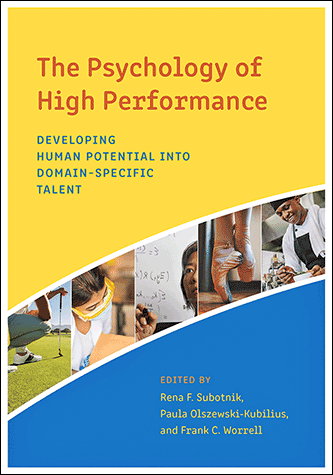
The Psychology of High Performance
Available formats
Also available from
In this volume, Rena F. Subotnik, Paula Olszewski-Kubilius, and Frank C. Worrell explore how an individual's early potential develops into high performance in five domains:
- sport (specifically golf and team sports)
- the professions (medicine, software engineering, professional teams)
- academics (mathematics, psychology)
- the performing arts (dance, acting)
- the producing arts (culinary arts, drawing/painting)
The contributors address many questions: What does "raw" potential in a specific domain looks like? How can those abilities be nurtured and grown, and what psychosocial skills are necessary for this development?
They examine similarities and differences within and between domains and present personal interviews with "gatekeepers" — experts in a field whose professional judgment determines whether individuals' developed abilities are good investments for further instruction and coaching.
With its mix of scholarship and personal interviews, this book brings new insights based on psychological science and best practices to inform educators, parents, coaches, and psychologists guiding young people on their path to becoming high performers.
Contributors
Acknowledgments
Introduction
Rena F. Subotnik, Paula Olszewski-Kubilius, and Frank C. Worrell
- High Performance: The Central Psychological Mechanism for Talent Development
Rena F. Subotnik, Paula Olszewski-Kubilius, and Frank C. Worrell
I. Sport
- High-Performance Talent Development in Golf
Steven T. Portenga
Gatekeeper Interview: Jay Hogue, Assistant Gymnastics Coach, University of Denver
Steven T. Portenga - Talent Identification and Development in Game Sports
Job Fransen and Arne Güllich - Reflections on Talent Development in Sport
Steven T. Portenga
II. The Professions
- Talent Development in Medicine and Software Engineering
Melissa A. McWilliams, Emily Z. Holding, and Steven E. Knotek
Gatekeeper Interview: Michael Reed, Software Engineer and Site Lead, Google Chapel Hill
Steven E. Knotek - What Makes a Team of Experts an Expert Team?
Denise L. Reyes and Eduardo Salas - Reflections on Talent Development in the Professions
Steven E. Knotek and Eduardo Salas
III. Academia
- Developing Mathematical Talent in Schoolchildren: Who, What, and How?
Roza Leikin
Gatekeeper Interview: Avi Berman, Professor Emeritus of Mathematics, the Technion–Israel Institute of Technology
Roza Leikin - Talent Development in the Domain of Academic Psychology
Dean Keith Simonton
Gatekeeper Interview: Robert J. Sternberg, Professor of Human Development, Cornell University
Dean Keith Simonton - Reflections on Talent Development in Academics
Paula Olszewski-Kubilius, Frank C. Worrell, Rena F. Subotnik, and Megan Foley-Nicpon
IV. Performing Arts
- The Development of Acting Talent: Possibilities and Approaches
Tony Noice and Helga Noice
Gatekeeper Interview: David Black, Producer, Director, Actor, Teacher
Aaron Kozbelt - Talent Development in Dance: Perspectives From Gatekeepers in Hong Kong and Finland
Joey Chua
Gatekeeper Interview: Stephen Pier, Professor of Dance and Division Director, The Hartt School, University of Hartford
Aaron Kozbelt - Reflections on Talent Development in Performing Arts: Concluding Comments
Aaron Kozbelt
V. Producing Arts
- Talent and Ability in Drawing and Visual Arts
Aaron Kozbelt and Andrea Kantrowitz
Gatekeeper Interview: Talent and Ability in Drawing: An Account From the Field
Linda Jarvin - Culinary Arts: Talent and Their Development
Laurent Aron, Marion Botella, and Todd Lubart - Reflections on Talent Development in Arts Production
Linda Jarvin
VI. Conclusion
- The Psychology of High Performance: Overarching Themes
Frank C. Worrell, Paula Olszewski-Kubilius, and Rena F. Subotnik
Index
About
Rena F. Subotnik, PhD, is the director of the Center for Psychology in Schools and Education at APA in Washington, DC. She is coauthor (with Paula Olszewski-Kubilius and Frank C. Worrell) of the articles "The U.S. Neglects Its Best Science Students" (Scientific American); "Nurturing the Young Genius: Renewing Our Commitment to Gifted Education Is the Key to a More Innovative, Productive, and Culturally Rich Society" (Scientific American Mind); and "Rethinking Giftedness and Gifted Education: A Proposed Direction Forward Based on Psychological Science" (Psychological Science in the Public Interest). She is coeditor of the books Methodologies for Conducting Research on Giftedness (with Bruce Thompson, 2010) and The Development of Giftedness and Talent Across the Life Span (with Frances Degan Horowitz & Dona J. Matthews, 2009).
Paula Olszewski-Kubilius, PhD, is the director of the Center for Talent Development and a professor in the School of Education and Social Policy at Northwestern University in Evanston, Illinois. Recent publications include "Minority Achievement Gaps in STEM: Findings of a Longitudinal Study of Project Excite" (with Saiying Steenbergen-Hu, Rhoda Rosen, & Dana Thomson, 2017) in Gifted Child Quarterly and "The Role of the Family in Talent Development," (with Rena F. Subotnik & Frank C. Worrell, 2018) in the APA Handbook of Giftedness and Talent. She is past-president of the National Association for Gifted Children, from which she received the Distinguished Scholar Award in 2009.
Frank C. Worrell, PhD, is a professor of school psychology at the University of California, Berkeley. A 2016–2018 member-at-large of the APA Board of Directors, Dr. Worrell is a former editor of the Review of Educational Research and a 2013 recipient of the Distinguished Scholar Award from the National Association for Gifted Children. Recent publications include Achieving College Dreams: How a University–Charter District Partnership Created an Early College High School (with Rhona S. Weinstein, 2016) and "Talent Development: A Path Towards Eminence" (with Paula Olszewski-Kubilius & Rena F. Subotnik, 2018) in the APA Handbook of Giftedness and Talent.
- 2020 NAGC Book of the Year Award Winner
- Finalist in the 2020 PROSE Awards
This book is wonderfully interdisciplinary.
—Choice
Covering a variety of domains — from golf to psychology to dance, for example — this book will be useful to theorists, researchers, and gatekeepers/coaches in the various disciplines. The focus on talent development illuminates the power of individual, environmental, social, and chance supports on the road from abilities to eminence. This important work will likely shape the next wave of research in talent development.
—Jane Close Conoley, PhD
President, California State University, Long Beach
This is an outstanding interdisciplinary and unifying contribution to our understanding of the development of expertise across domains of extraordinary human achievement
—Jonathan Wai, PhD
Assistant Professor and 21st Century Endowed Chair in Education Policy at the University of Arkansas, Fayetteville