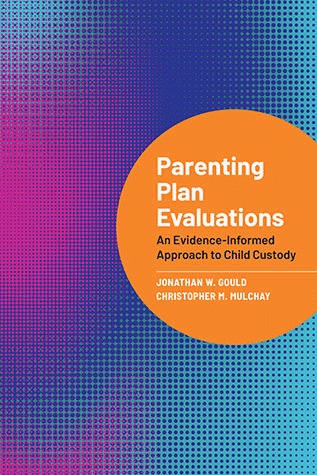
Parenting Plan Evaluations
Unlock the science behind child custody evaluations.
Psychologists today play a crucial role in providing court assessments for child custody cases. But, gone are the days of relying solely on clinical judgment—courts now demand a more scientific approach.
This guide offers an evidence-informed framework for conducting child custody evaluations. It reviews critical components such as forensic interviewing, parent-child observation, document review, and accounting for one’s own personal biases. The authors explore the strengths and limitations of psychological testing and assessment, and demonstrate how custody evaluations require a dimensional approach that emphasizes behaviors over diagnoses. Extensive research is synthesized on all these critical topics, as well as more specific issues such as alienation, parent-child contact problems, domestic violence, and parental relocation requests.
Whether you're a seasoned professional or new to the field, this book is an indispensable resource for conducting scientifically sound, legally defensible evaluations.
Introduction: The Forensic Explorer
Part I. Conceptual Foundation for an Evidence-Informed Approach to Parenting Plan Evaluation
- Chapter 1. Daubert and the Changing Nature of Parenting Plan Evaluations: From Clinical to Forensic
- Chapter 2. Current Expectations and Criticisms of Parenting Plan Evaluations
- Chapter 3. Common Errors in Child Custody Evaluations
- Chapter 4. The Role of Clinical Judgment in the Time of Daubert
Part II. Using Scientific Knowledge and Process
- Chapter 5. What Qualifies as Scientific Evidence in Parenting Plan Evaluations?
- Chapter 6. Applying General Scientific Findings to Individual Cases: The G2i Challenge
Part III. Mitigating Bias in Your Evaluation
- Chapter 7. The Role of Bias in Data Collection, Data Integration, and Opinion Formation
- Chapter 8. Sociocultural Identities and Systemic Inequities
- Chapter 9. Gender Identity and Sexual Orientation
Part IV. Data Collection and Integration
- Chapter 10. Using Story Development Principles to Guide Data Collection and Integration
- Chapter 11. Procedural Variables in Forensic Interviewing
- Chapter 12. What to Ask About in Forensic Interviews
- Chapter 13. Special Considerations for Interviewing Young Children
- Chapter 14. Parent-Child Observation
- Chapter 15. Usefulness and Limitations of Psychological Testing and Assessment
- Chapter 16. Selecting and Using Psychological Tests
- Chapter 17. The Shift from Categorical to Dimensional Diagnostic Models
- Chapter 18. Collateral Interviews and Record Review
Part V. Common Issues in Parenting Plan Evaluation
- Chapter 19. Early Conceptualizations of Parent-Child Contact Problems
- Chapter 20. Modern Conceptualizations of Parent-Child Contact Problems
- Chapter 21. Evolving Conceptualizations of Domestic Violence
- Chapter 22. Tools to Assess for Domestic Violence
- Chapter 23. Forensic Assessment of Parental Requests to Relocate
Epilogue: The Integration of Judgment, Data, and Science in Custody Evaluation
References
Jonathan W. Gould, PhD, is a board-certified forensic psychologist specializing in psychological aspects of family law matters, including child custody and child maltreatment. He has authored or coauthored seven books and several dozen peer-reviewed articles and book chapters addressing child custody matters. He has presented at national and international conferences to mental health professionals, attorneys, and judges for more than three decades. This book represents an update and conceptual extension of his previous books, Conducting Scientifically Crafted Child Custody Evaluations and The Art and Science of Child Custody Evaluations (with David Martindale).
Christopher M. Mulchay, PhD, ABPP, is the coauthor of The Family Law Professional's Field Guide to High-Conflict Litigation: Dynamics, Not Diagnoses. With Jonathan Gould, Dr. Mulchay has coauthored chapters on child custody in both The Oxford Handbook of Psychology and Law (2023) and APA Handbook of Forensic Psychology (2025). Dr. Mulchay has also reviewed tests for the Journal of Pediatric Neuropsychology. He has published four test reviews, and he has multiple currently under review. Dr. Mulchay is board-certified in forensic psychology by the American Board of Professional Psychology. He is a fellow in the American Academy of Forensic Psychologists.
There is really nothing like this book. What makes it especially strong is the clear and detailed background and rationales explaining why each component of a custody evaluation might be necessary and how an evaluator might make appropriate decisions about what to include in their evaluations. The breadth and depth of coverage make this book the definitive handbook for custody evaluators. It is exceptionally well referenced and will equip evaluators with the skills and information necessary to answer challenging questions, including those from hostile lawyers dissatisfied with the recommendations offered.
—Michael E. Lamb, PhD, Department of Psychology, Sidney Sussex College, University of Cambridge, Cambridge, England
Parenting Plan Evaluations: An Evidence-Informed Approach to Child Custody offers a sophisticated and comprehensive guide to one of the most challenging areas of family law. Grounded in the scientific process, it blends dimensional and categorical analyses with an ecological perspective. Jon Gould and Chris Mulchay have taken their guidance to the next level with new insights, data-gathering tools, and research for conducting one of family court’s toughest jobs. For mental health professionals, attorneys, judges, or anyone working in the family court system, this is essential reading if you want to stay current and make decisions in the best interest of children.
—Robin M. Deutsch, PhD, ABPP, independent practice, Newton, MA, United States
Like Gutenberg’s printing press, Edison’s light bulb, and Jobs’s personal computer, this magnificent volume is a game changer. Gould and Mulchay have performed a feat of alchemy: They have taken a million disparate concepts, practices, and cases and produced intellectual gold. Don’t let the page count sway you. This volume distills many thousands of pages’ worth of insight, concepts, and hands-on practical direction. If you read or rely on one published work in family law, this must be it. Thank you, Jon and Chris, for helping us to better help children.
—Benjamin D. Garber, PhD, Family Law Consulting, PLLC, Hollis, NH, United States; DEFUSEdivorce.com
Watch the author(s) discuss Parenting Plan Evaluations.opens in new window Interested in this book? Purchase a copy to continue (or start) the conversation with your clients.