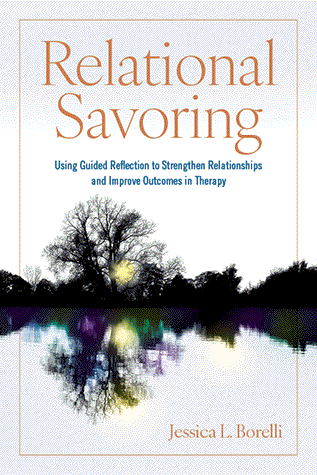
Relational Savoring
Available formats
Also available from
This book provides an overview of the science and practice of relational savoring, a brief, guided reflection exercise that helps clients reconnect with memories of being closely connected with another person.
Positive connection with others provide essential psychological benefits. Yet for many therapy clients, it is all too easy to overlook these positive moments. Relational savoring helps clients reflect on and value these experiences and relationships, to achieve improved relationship satisfaction and better emotion regulation.
This book blends research, theory, expert clinical guidance, and compelling case examples to show how therapists can use the relational savoring approach with clients. Therapists first help clients choose an appropriate memory to savor, then guide them through a reflection exercise where they reflect on the emotions, thoughts, and significance associated with a close-connected experience occurring within an attachment relationship (e.g., parent-child or intimate partnerships).
Relational savoring is an ideal complement to other, ongoing interventions. Alternatively, the approach can be used on its own. Given its versatility, effectiveness, and brevity, this intervention will be a welcome addition to any therapist’s toolkit.
Acknowledgments
- 1. Overview of Relational Savoring
Part I. Theoretical and Empirical Support
- 2. Theoretical Principles Underlying Relational Savoring
- 3. Evidence Base for Relational Savoring
Part II. The How-To of Relational Savoring
- 4. Phase 1: Memory Selection
- 5. Phase 2: Memory Reflection
- 6. Addressing General Areas of Difficulty and Clinical Techniques to Circumvent Them
Part III. Relational Savoring in Clinical Context
- 7. Tailoring Your Relational Savoring Intervention to Your Individual Client
- 8. Adapting Relational Savoring for Individuals With Specific Mental Health Concerns
- 9. Relational Savoring in Couples and Families
- 10. The Cultural Congruence of Relational Savoring and Partnering With Community Agencies to Heighten It
Afterword: Relational Savoring for Therapists
References
Index
About the Author
Jessica L. Borelli, PhD, is a professor of psychological science at the University of California, Irvine. She received her PhD in psychology from Yale University and completed her predoctoral internship at the University of California, Los Angeles Semel Institute for Neuroscience and Human Behavior. Dr. Borelli’s work focuses on the intersection of attachment relationships and health, with a particular focus on the impact of relationships on emotion. She has published more than 150 journal articles in her area of interest. In addition to writing journal articles, she enjoys teaching and speaking to the public about the science of relationships.
In collaboration with Dr. Stacey Doan, she is the author of a parenting book, Nature Meets Nurture: Science-Based Strategies for Raising Resilient Kids (APA LifeTools). Alongside her academic work, she is a practicing psychologist specializing in children and families, and is the clinical director of Compass Therapy, a private practice in Newport Beach, California.
She lives in Irvine, California, with her husband and three children, with whom she enjoys laughing, singing, and all forms of silliness.
Relational Savoring is truly revelatory, showing through both narrative accounts and research evidence that an explicit focus on positive aspects of relationships can enhance thriving, even for those who have not had a large share of such. Via vivid first-person narratives and a careful review of research—all based on attachment theory—Borelli makes a convincing—and moving—case. Among other features, this book shows that early trauma is not a blueprint for later-life suffering. In fact, despite far too much “doom and gloom” coverage these days on the supposedly permanent effects of early maltreatment, a sensitive focus on interactions that were truly validating can help to turn the tide.
—Stephen P. Hinshaw, PhD, Distinguished Professor of Psychology, University of California, Berkeley; author of Another Kind of Madness: A Journey Through the Stigma and Hope of Mental Illness
This wise and very readable book offers new and experienced clinicians a fresh, practical, and very useful perspective to overcome blocks in the therapeutic process and promote emotional growth. Jessica Borelli is a gifted clinician and rigorous researcher whose relational savoring approach offers hope, joy, and supportive avenues to self-understanding. Intervention strategies are described clearly, easy to implement, and effective. The book is a pleasure to read. I strongly recommend it as a very valuable professional and personal resource.
—Alicia F. Lieberman, PhD, Irving B. Harris Endowed Chair in Infant Mental Health and Professor, Department of Psychiatry and Behavioral Sciences, University of California, San Francisco, and Director, Child Trauma Research Program, San Francisco General Hospital, San Francisco, CA
Jessica Borelli has crafted a brilliant and important book, filled with deep insights into the conceptual underpinnings, clinical applications, and psychosocial benefits of relational savoring. The text is a rich tapestry that blends enlightening case material, foundational attachment theory, compelling research studies, and astute observation in highly creative, intellectually stimulating, and clinically useful ways. I strongly recommend this groundbreaking book to scholars, practitioners, and students alike—for truly there is something invaluable here for everyone.
—Fred B. Bryant, PhD, Emeritus Professor of Psychology, Loyola University Chicago, Chicago, IL
In this beautifully written and immensely readable book, Jessica Borelli describes her groundbreaking approach to cultivating positive relational memories and using them to promote healing and integration. Applicable to work in a variety of clinical settings, and with a wide array of populations, including adults, children, parents, and couples, relational savoring complements a range of other evidence-based approaches to transforming suffering and building lasting, sustaining relationships.
—Arietta Slade, PhD, Professor of Clinical Child Psychology, Yale Child Study Center, New Haven, CT