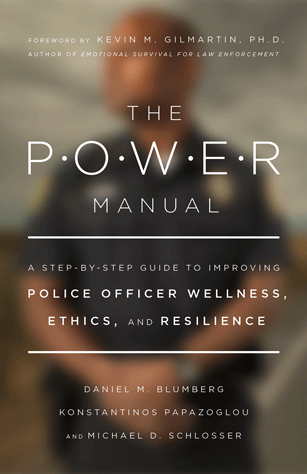
The POWER Manual
For bulk sales inquiries please email books salesopens in new window.
Includes a foreword by Kevin M. Gilmartin, PhD, author of the bestselling Emotional Survival for Law Enforcement: A Guide for Officers and Their Families.
A police officer’s power does not come from their badge, gear, or tactical skills. It comes from POWER: Police Officer Wellness, Ethics, and Resilience.
This book offers practical, research-based strategies to help all members of law enforcement improve their wellness, strengthen their ethical commitments, and increase their resilience both on- and off-duty.
Even with access to a gym or counseling through work, police officers will benefit from developing a personal plan to maintain overall health. This book focuses on physical, cognitive, emotional, social, and spiritual wellness. It describes steps to optimize wellbeing and maintain effective job performance.
Foreword by Kevin M. Gilmartin, PhD
Introduction: Achieving Balance
Part I. Wellness
- Chapter 1. Physical Health
- Chapter 2. Cognitive Wellness
- Chapter 3. Emotional Wellness
- Chapter 4. Social Wellness
- Chapter 5. Spiritual Wellness
Part II. Ethics
- Chapter 6. Commitment to the Noble Cause
- Chapter 7. The Guardian Spirit of Policing
- Chapter 8. Moral Distress and Ethical Exhaustion
Part III. Resilience
- Chapter 9. Stress Inoculation
- Chapter 10. Growth Through Adversity
- Chapter 11. Self-Compassion & Positive Psychology
- Chapter 12. Closing Thoughts: Maintaining Balance
References
Additional Resources
About the Authors
Daniel M. Blumberg, PhD, is a licensed clinical psychologist who has spent the past three decades providing clinical and consulting services to local, state, and federal law enforcement agencies. His areas of expertise include workplace stress prevention and trauma recovery, as well as the selection, training, and supervision of undercover operatives.
His research interests include police integrity, the moral risks of policing, and programs to improve relations between the police and the community. He is the director of The POWER Project (policepowerproject.org), a training and consultation public benefit corporation for law enforcement.
Konstantinos Papazoglou, PhD, is the founder and director of ProWellness Inc., a mental health service provider group based in Toronto, Canada. He is also the principal founder of The POWER Project, which provides evidence- and practice-based educational and consulting services on police wellness, ethics, and resilience. With a background in providing clinical assessment and treatment to criminal justice offenders, he is now involved in community policing and trauma-focused programs that support victims of violent crimes.
He is an affiliated researcher with the Loss, Trauma, and Emotion Lab at Teachers College, Columbia University. His research work focuses on stress, trauma, and resilience promotion among police officers.
Michael D. Schlosser, PhD, is director of the University of Illinois Police Training Institute. He retired as a lieutenant from the Rantoul, Illinois Police Department in 2004. Dr. Schlosser has conducted and collaborated in cross-disciplinary research projects at the University of Illinois and is credited for his innovative ideas toward police reform.
He has authored dozens of articles, made media appearances, and given over 100 presentations across the country on topics such as police tactics, police training, use of force, de-escalation techniques, control and arrest tactics, the intersection of police and race, diversity, police officer wellness, and police family wellness.
Offers a personal touch and connects in a practical way with first responders at any stage of their career. Tools like these are essential for any first responder and informative for their families.
—Sajel Bellon EdD, RP., CTSS founder of Mind Armour™ & SOS Psychotherapy
The Power Manual is a much needed and valuable resource for police officers and those working within the mental health field.
—Dr. Carolyn Burns, registered psychologist
Filled with actionable items necessary to improve officer mental health, enhance resilience, and reinforce police principles. It should be required reading for anyone working in or associated with law enforcement in any way.
—Dr. Olivia Johnson (DM), founder, Blue Wall Institute
The book convinces readers that personal wellness is not only a prerequisite of resilience, but also a goal towards which law enforcement organizations should aim.
—Dr. Cristina Dan, officer psychologist, Ministry of Internal Affairs, Romania; associate lecturer, National School of Political and Administrative Studies, Bucharest, Romania
Essential and especially valuable because its authors have great capacity to connect science with law enforcement work.
—PC. Lissa Ruocco
I highly recommend this powerful piece of work for clinicians, trainers, academy instructors, leadership, and front-line personnel.
—Tina Jaeckle, PhD, LCSW, board certified expert in traumatic stress, crisis and trauma clinician, consultant, and instructor law enforcement and first responders
A game changer by helping us understand the way our wellness is connected to our decision making…I believe the solutions to some of the most important challenges in law enforcement will be found in this book.
—Mike Doyle, police officer founder and host Tactical Tangents Podcast
The authors have successfully weaved positive psychology into the police culture. Police officers will easily relate to the way the tools are presented and the rationale for using them.
—Chris Checkett, MSW, LISW-S, founder of Cleveland Mindfulness Center, cocreator of the Mindfulness Training Program for the city of Cleveland, Division of Police
Provides a great quality support for all police officers and for them to know they are not alone.
—Dr Katy Kamkar, PhD, CPsych, clinical psychologist and assistant professor, Department of Psychiatry University of Toronto; chair of Canadian Psychological Association, Traumatic Stress Sector
Adds personal voices of those who really know what the work is like. Highly recommended to all first responders to assist them in becoming and staying well.
—Dr. Mari Koskelainen, senior advisor, clinical psychologist, National Bureau of Investigation, Finland.
A critical work to assist first responders with a resource that is not readily available or accessible for a variety of reasons. This resource has significant potential to alleviate both known and unknown sources of stress and continue to build resilience.
—Joseph E. Pascarella, PhD, MPH, associate professor of Criminal Justice, Saint Joseph’s College, New York, retired captain, New York Police Department
Adds practical strategies for officers. This Manual helps to move the pendulum in the direction of progress for the health and wellbeing of law enforcement officers and in turn for the communities they serve.
—Barbara Benoliel, PhD, senior core faculty, Walden University
Has the double value of allowing psychologists to have deeper information of how police officers feel and also allows police officers to feel that they have a voice heard by scientific researchers who want to help them to be psychologically well and resilient…I strongly recommend…
—Cristina Queirós, associate professor of Faculty of Psychology and Education Sciences, University of Porto, Portugal
Will become required take home literature for ALL First Responders…focusing on topics, such as PTSD, moral injury, sanctuary trauma, perceived injustice, and suicide prevention.
—Sgt. Bill Rusk (Ret.) MA, executive director, Badge of Life Canada, police chaplain (CPCA), CISM instructor (OCISF), certified psychophysiologist (MA Qualifying) North American Board of Certified Psychophysiologists
I highly recommend police officers and those who are to brief them to read the book in the light of supporting health and wellness.
—May-Britt V. R. Ronnebro, superintendent at the Swedish National Police with 40+ years of duty., secretary general at the International Executive Board of International Police Association
Closely inspects mental health, coping and ethicality through an evidence-based approach grounded in positive psychology. Its utility is also in the preventative recommendations to reduce negative outcomes and increase the quality of life for police officers.
—Peter Lambrinakos, M.O.M. chief of police and corporate security, VIA Rail Canada
Provides vital evidenced-based information that can be used today to enhance an officer’s resilience and overall well-being.
—Jeff Thompson, PhD, international trainer and researcher
Welcome to the resource library for The POWER Manual: A Step-by-Step Guide to Improving Police Officer Wellness, Ethics, and Resilience. The link below allows you to download The POWER Manual journal pages.
We created this optional resource to help structure your thoughts, should you wish to write in a journal as part of your commitment to personal and professional wellness. It also contains quick reference lists and charts summarizing key ideas from the book, as well as inspirational quotes from Officer Mike to help you embody your strengths.
These documents are offered for your personal use. If you reprint or adapt them for publication, permission is required from the publisher. All material is ©2021 American Psychological Association unless otherwise noted. The opinions and statements presented in these documents are the responsibility of the authors, and such opinions do not necessarily represent the opinions or policies of APA.
© 2021 American Psychological Association.