

You’ve been selected as a peer reviewer for a journal. What happens next? Read on for step-by-step guidance on how to conduct a review.
Guidance for preparing a review
Before we begin: Your role as reviewer
As a reviewer, you serve the dual roles of evaluator and educator.
In your evaluative role, you will provide a recommendation to the action editor on whether the manuscript should be accepted, rejected, or revised/resubmitted.
In your role as educator, your goal is to provide constructive feedback that will help the authors improve the quality of their manuscripts, regardless of the recommended decision. As a reviewer, you play a profound role in shaping the career trajectory of our authors, some of whom are students and early career professionals.
First things first: Should you accept or decline a review?
The following infographic outlines the questions you should consider when deciding whether to accept or decline an invitation to review:
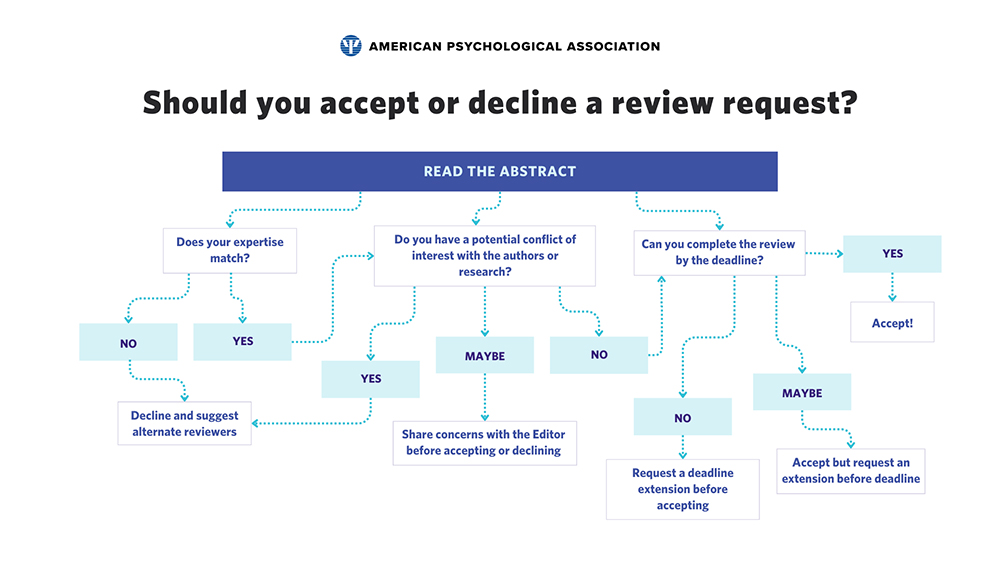
If in doubt, email the editorial office. The editor may also be able to advise if your expertise meets their needs. Not all reviewers need full expertise in the manuscript topic. One reviewer may be an expert in the subject material and another in the methodology.
Suggest alternate reviewers whenever possible—this is an opportunity to broaden a journal’s reviewer pool to support authors and help others build review experience.
Confidentiality is a priority
Reviewing provides a first look at new and upcoming work in the field. This is an opportunity that should not be exploited: confidentiality is an ethical responsibility when preparing a peer review.
Unpublished manuscripts and their data should not be shared without explicit permission from the editor. Reviewers may not discuss the manuscript nor its review process with anyone except for the editor—this includes with students or colleagues. If a reviewer prepares the review with a co-reviewer (e.g., a graduate student or mentor), the reviewer must disclose the name of the co-reviewer to the editor when they submit their review.
Reviewers are asked to follow best practices in peer review confidentiality, such as ensuring that all documentation related to the manuscript is kept in electronic form on password protected computers, and all materials are destroyed after a final decision is reached on the manuscript. This may prevent accidental breaches of confidentiality.
Reviews should not be written by generative AI. It is against APA publishing policies to enter submitted content into generative AI tools and removes the integral human assessment of science. Uploading materials from submitted manuscripts into generative AI tools violates the confidentiality of the peer review process—when information is entered into generative AI, the organization that runs the generative AI will likely have access to these data. Reviewers are encouraged to be up to date on APA’s AI policies and guidance on AI disclosures.
Components of a review
Before we dig into the actual assessment, let’s look at the various components of a review.
Review form
- This can vary by journal, so it is best to preview the review form prior to preparing your feedback.
- Rating scales on specific characteristics
- Appropriateness for this journal
- Significance of the issue
- Interest to readership
- Quality of research (design and analysis)
- Adequacy of the data
- Data interpretation
- Quality of writing (clarity, style)
- Coverage of topic
- Relevance/adequacy of literature reviewed
- Contribution of new knowledge
- Utility of tables/figures
- Recommendation for final decision
- Accept
- Minor Revision
- Major Revision
- Reject
- Author narrative
- APA’s default is for the reviewer’s identity to be anonymous, regardless of whether the submission is masked and the author identities anonymized
- Shared with the author as part of the decision letter
- 1–2-page summary of major strengths/weaknesses, as well as any important minor points to consider
- Provision of all constructive and actionable feedback
- Bullet points are often most helpful to the author as they design a point-by-point response back to your commentary
- Some journals allow reviewers to upload attachments as part of their review, which allows the reviewer to include a version of the manuscript with tracked changes if desired
- Important note: do not include your recommended decision within the narrative to the author
- Comments to the editor
- Confidential (make sure to enter the appropriate feedback in the correct text box—the comments to the editor are not included with the decision letter)
- Frank assessment, including fundamental flaws and fit with journal
- Should be consistent with the author narrative but often offers an opportunity for more direct communication of your concerns to assist the editor
- If you provide a recommendation for decision, please provide justification for your recommendation
- May include information about expertise which would unmask the reviewer to the author, so is best included in the comments to the editor
Assessing the manuscript
Overall assessment
Start with a brief summary of your overall impression of the manuscript:
- Is it a strong contribution to the field?
- Does it have significant flaws?
The APA Style Journal Article Reporting Standards (JARS) is a helpful resource on what information should be included in all manuscript sections for quantitative, qualitative, and mixed methods research; and how to best discuss race, ethnicity, and culture.
Summary and key strengths
Briefly describe the key strengths of the manuscript:
- Highlight points that make it interesting, informative, important, or novel
- Include a brief summary of your essential understanding of the study and its findings so authors are assured that you have read the manuscript in detail
Major points
Identify the most important problems, challenges, errors, omissions, or limitations of the manuscript. Focus primarily on deficiencies in the science, not in the writing.
The preferred format for this assessment is a numbered or bulleted list with no more than 5–10 items.
Consider these questions:
- Does the manuscript make a meaningful contribution?
- Is the literature review comprehensive?
- Reflect on the methodology—if you review a qualitative paper, remember that qualitative research has unique considerations (Levitt et al., 2017):
- Is the science strong?
- Is the research design appropriate?
- Are the statistics reported accurately?
- Are the methods explained appropriately?
- Were the appropriate participants included?
- Was the sample size adequate?
- Are the findings important and of interest to the community?
- Are the implications of the findings adequately discussed and interpreted?
Minor points
List any other problems, challenges, errors, omissions, or limitations that should be addressed—this may include violations of APA Style, problems with grammar, or quality of writing.
The preferred format for this assessment is a list with up to 10–20 items. Use the manuscript’s section and subsection headings to structure your comments and indicate the location(s) of the problems by page, paragraph, and/or line number.
Remember to focus on the content: manuscripts will undergo copyediting if accepted.
Paying attention to tone
The following table lists examples of inappropriate review comments and appropriate alternatives.
| Inappropriate | Appropriate |
|---|---|
|
“Great paper!” |
Very rarely does a manuscript need no improvement. Summarize the strengths and provide concrete feedback. |
|
“Your writing is terrible.” |
“The manuscript should undergo an additional proofread to improve the clarity of the authors’ arguments and enhance readability.” |
|
“This paper doesn't belong in this journal.” |
“Clarifying how the manuscript aligns with the journal's scope would be beneficial.” |
|
“This work is not original and adds nothing new.” |
“While the topic is relevant, the manuscript would benefit from a clearer articulation of its novel contributions.” |
|
“The authors clearly don't understand their own results.” |
“Clarifying the interpretation of the results would improve the manuscript.” |
|
“The authors clearly have no idea what they're doing.” |
“Consider revising the manuscript to reflect a more rigorous and informed approach to the topic.” |
|
“Your statistical analysis is a joke.” |
“The statistical methods could be improved by providing more detailed justification and assumptions.” |
|
“The references are outdated and irrelevant.” |
“Incorporating more recent and relevant references would strengthen the literature review.” |
|
“This seems like a passion project rather than serious research.” |
“Ensuring the research is framed within a rigorous scientific context would enhance its credibility.” |
|
“You are too aggressive in presenting your arguments.” |
“The authors should clarify the tone to maintain a more neutral and objective style, which would strengthen the manuscript.” |
|
“You should have an English speaker review the language in this paper.” |
“The manuscript would benefit from additional academic writing or language editing support.” |
Equity, diversity, and inclusion
In addition to being knowledgeable of the field, reviewers should be capable of evaluating psychological research in an equitable fashion. This includes awareness of individual and group biases and the impacts of limitations on full participation in psychological science—through this awareness, reviewers support the publication of manuscripts with a range of methodologies and types of evidence that address the needs of underserved populations.
When reviewing a manuscript in the context of equity, consider the following:
- How well does the manuscript contribute to the psychological well-being of underserved populations facing documented barriers to care, including but not limited to: communities disproportionately affected by social, economic, or geographic disadvantage?
- Is reinforcement of stereotypes or contributions of bias avoided in the methods?
- Could the writing be used or misused to cause harm, especially to vulnerable populations?
- Has the participant sample been appropriately described—did the authors explain their sample and describe their sample inclusion efforts?
- Are the references inclusive?
- Is biased language present?
- Refer to APA’s Bias-Free Language Guidelines and Inclusive Language Guidelines for support.
Making your recommendation
Journal decision terms may vary, but reviewers will typically come across these decision types:
- Accept: no revisions required—it is rare for a first submission to be accepted without any further revision
- Minor revision: manuscript is nearly publishable, but needs minor changes
- Major revision: manuscript could be published, but substantial revisions are needed
- Reject: manuscript does not meet publication standards of the journal, including papers with flaws in design or analysis
The editor will use all reviews combined with their own assessment of the manuscript to inform their decision. Reviewers are not “voting” on the paper’s acceptance. The final decision on a manuscript is at the editor’s discretion. Consult with the editor if clarity is needed on recommendation terms.
If authors are invited to revise their manuscript, a reviewer will often be asked to re-review the revision.
Timeliness
Timely reviews are important in advancing novel findings, innovations, and critical insights. Authors, particularly those early in their careers, may depend on publications for professional advancement, grant applications or further research endeavors.
However, unexpected life circumstances may delay a review. If you anticipate a delay, please inform the editorial office as soon as possible. Deadline extensions are available, but communication with the editor is key.
Important considerations
High quality reviews accomplish the following:
- Help authors improve their manuscripts
- Contribute to determining an article’s suitability for publication
- Identify strengths and areas for improvement
- Uphold excellence and integrity of published research
- Provide actionable feedback for the editor to incorporate into their decision letter
Helpful reviews do the following:
- Maintain a professional and respectful tone
- Focus on edits that improve clarity, rather than make assumptions about the authors (e.g., assuming what their first language is)
- Phrase feedback in the third person (e.g., “the authors,” “they,” “the manuscript”) rather than the second person (“you”)
- Support recommendation with detailed, comprehensive analysis of quality, coherence, methods, results, and interpretations
- Disclose areas where the reviewer may not be an expert to provide transparency
- Separate major and minor points
- Number points to facilitate editor’s reference to review in decision letter
- Arrive by the deadline or a deadline extension is requested and approved by the editor in advance
Unhelpful reviews do the following:
- Use second person (“you”) throughout, which may be interpreted as accusatory
- Are very short, with no detailed or concrete feedback
- “This paper has potential, but could use improvement” with no specific suggestions listed
- “This paper is great—nice work!” with no other feedback
- Offer criticism without any constructive feedback
- “Your paper is terrible.”
- Question the authors’ qualifications instead of highlighting how to improve the manuscript
- “The authors do not understand the literature.”
- Use an inflammatory tone
- “What a waste of time.”
- Include personal attacks
- “These authors always have useless findings.”
- Focus on author attributes instead of the science
- “The authors are not experienced enough to publish on this topic.”
- “The authors are too emotional.”
Summary
- Apply to become a reviewer and ask those already reviewing if you can join them as a co-reviewer to learn more about the process.
- Follow a structured format to assist you, the editor, and the authors in moving forward practical suggestions to fruition.
- Refer to the APA Style JARS to determine what authors should include in their manuscripts depending on their methodology and how race, ethnicity, and culture should be discussed.
- Make your reviews practical, user-friendly, and filled with actionable recommendations.
- Attend to EDI principles in your reviews
- Be timely—communicate with the editorial office if you need additional time or are unable to complete a review.
- Mentor others in reviewing as a method of giving back to the profession and community.
Download the quick guide to peer review (PDF, 75KB)opens in new window.
Additional resources
- Sign up to become a reviewer for APA Journals
- APA Reviewer Resources Center
- APA Style Bias-Free Language Guide
- APA’s Inclusive Language Guide
- APA Style Journal Article Reporting Standards (JARS)
- Best practices for co-reviewing
- COPE Ethical Guidelines for Peer Reviewersopens in new window
- Get recognized for peer review
- Levitt, H. M., Motulsky, S. L., Wertz, F. J., Morrow, S. L., & Ponterotto, J. G. (2017). Recommendations for designing and reviewing qualitative research in psychology: Promoting methodological integrity. Qualitative Psychology, 4(1), 2–22. https://doi.org/10.1037/qup0000082
- Guidelines for reviewing qualitative research from Qualitative Psychology
Date created: November 2025