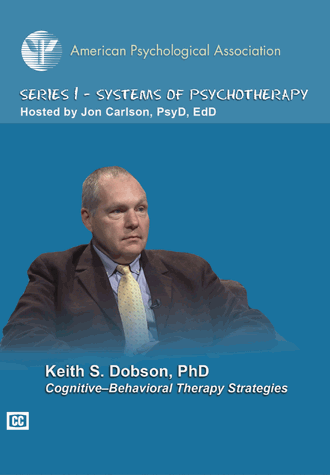
Cognitive–Behavioral Therapy Strategies
ISBN: 978-1-4338-0989-7Cognitive–behavioral therapy (CBT), a system of treatment involving a focus on thinking and its influence on both behavior and feelings, is one of the dominant approaches to psychotherapy. CBT is based on a model of psychopathology that emphasizes the role of dysfunctional beliefs and situational cognitions and their influence on emotional and behavioral outcomes, which in turn reinforce negative beliefs and thought patterns.
Cognitive–Behavioral Therapy Strategies illustrates multiple aspects of the CBT system of psychotherapy, including the setting conditions (e.g., the therapy relationship), parameters around the techniques, and the techniques themselves.
Using selected vignettes from actual therapy sessions, Keith S. Dobson explores the key techniques used in cognitive–behavioral therapy, including developing a therapeutic alliance, case conceptualization, psychoeducation, assigning homework, and assessing automatic thoughts.
Keith S. Dobson, PhD, is a professor of clinical psychology at the University of Calgary. He has served in various roles there, including past director of clinical psychology and coleader of the Hotchkiss Brain Institute Depression Research program, and current head of psychology. His research has focused on both cognitive models and mechanisms in depression and the treatment of depression, particularly using cognitive–behavioral therapies.
Dr. Dobson's research has resulted in more than 150 published articles and chapters, nine books, and numerous conference and workshop presentations in many countries. Recent books include The Prevention of Anxiety and Depression (Dozois & Dobson, 2004), Risk Factors for Depression (Dobson & Dozois, 2008), Evidence-Based Practice of Cognitive–Behavioral Therapy (Dobson & Dobson, 2009) and the Handbook of Cognitive–Behavioral Therapy, 3rd Edition (Dobson, 2010).
In addition to his research in depression, he has written about developments in professional psychology and ethics, and has been actively involved in organized psychology in Canada, including a term as president of the Canadian Psychological Association. He was a member of the University of Calgary Research Ethics Board for many years, and is president of the Academy of Cognitive Therapy, as well as the president of the International Association for Cognitive Psychotherapy.
Among other awards, he has been given the Canadian Psychological Association's Award for Distinguished Contributions to the Profession of Psychology.
- Alford, B. A., & Beck, A. T. (1997). The integrative power of cognitive therapy. New York, NY: Guilford.
- Antony, M., Ledley, R., & Heimberg, R. (Eds.). (2005). Improving outcomes and preventing relapse in cognitive–behavioral therapy. New York, NY: Guilford.
- Beck, A. T., Rush, A. J., Shaw, B. F., & Emery, G. (1979). Cognitive therapy of depression. New York, NY: Guilford.
- Beck, J. S. (1995). Cognitive therapy: Basics and beyond. New York, NY: Guilford.
- Dobson, D. J. A., & Dobson, K. S. (2009). Evidence-based practice of cognitive–behavioral therapy. New York, NY: Guilford.
- Dobson, K. S. (Ed.). (2010). Handbook of cognitive–behavioral therapies (3rd Edition). New York, NY: Guilford.
- Hays, P., & Iwamasa, G. (Eds.) (2006). Culturally responsive cognitive–behavioral therapy: Assessment, practice, and supervision. Washington, DC: American Psychological Association Press.
- Ledley, D. R., Marx, P., & Heimberg, R. G. (2005). Making cognitive–behavioral therapy work: Clinical process for new practitioners. New York, NY: Guilford.
- Persons, J. B. (1989). Cognitive therapy in practice: A case formulation approach. New York, NY: Norton.
- Wright, J., Basco, M. R., & Thase, M. (2005). Learning cognitive-behavior therapy: An illustrated guide. Arlington, VA: American Psychiatric Publishing.
APA Videos
- Cognitive–Behavior Therapy for Depression Series
Jacqueline B. Persons, Joan Davidson, and Michael A. Tompkins - Cognitive–Behavioral Family Therapy
Frank M. Dattilio - Cognitive Behavioral Therapy for Social Anxiety
Amy Wenzel - Cognitive Therapy
Judith S. Beck - Cognitive Therapy for Borderline Personality Disorder
Mary Anne Layden - Cognitive Therapy for Panic Disorder
David M. Clark - Mindfulness-Based Cognitive Therapy for Depression
Zindel V. Segal - Schema Therapy
Jeffrey E. Young - Treating Clients With Generalized Anxiety Disorder
Michelle G. Craske
APA Books
- Bipolar Disorder: A Cognitive Therapy Approach
Cory F. Newman, Robert L. Leahy, Aaron T. Beck, Noreen Reilly-Harrington, and Laszlo Gyulai - Cognitive Therapy for Suicidal Patients: Scientific and Clinical Applications
Amy Wenzel, Gregory K. Brown, and Aaron T. Beck